A warehouse solar cleaning quote is not comparable until it says how the team reaches the array, where suitable water comes from and what happens to warehouse operations during the visit. A low price per panel can leave the owner paying separately for access equipment, water treatment, out-of-hours attendance or a return visit.
For a Dubai warehouse owner or authorised occupier, the useful decision is not simply “how often should we wash the panels?” It is whether the proposed solar layout can be maintained safely at a known whole-site cost. Resolve that before accepting the installation offer, not after the first cleaning crew arrives.
Start with the O&M provider, not a general washing quote
DEWA’s Shams Dubai FAQ places maintenance responsibility on the customer, requires a signed operation and maintenance contract as part of connection, and says the service provider must have the relevant DEWA enrolment. It also warns owners not to interact with system components. Treat this as a managed solar service, not an instruction to send warehouse staff onto the roof.
Ask the enrolled provider to identify who manages cleaning, any subcontractors and the interface with electrical maintenance. A cleaning visit is not automatically an electrical inspection or a fault-repair service. Put those boundaries in writing.
Before comparing prices, supply the same roof plan, array layout, access information and operating restrictions to every bidder. Our warehouse pre-quote feasibility checklist covers the wider building assessment; here, the question is whether the finished layout comes with a workable service route.
Have the bidder walk the complete service route
Ask for a site-specific method and logistics plan, prepared by competent people. It should trace the journey from the security gate and equipment-unloading point to each array section, then explain how equipment and waste leave the site. A photograph of the roof is not that plan.
Arrival and staging: where can the team park and unload without obstructing loading bays, forklift routes or emergency access?
Roof access: what existing access is suitable, and what additional equipment or permanent provision has to be designed, approved and priced?
Movement and reach: how will the team reach all modules without walking on panels, using unsuitable roof areas or compromising rooflights and other openings?
Work window: when can the visit happen safely, who authorises access and what weather, site or electrical conditions require postponement?
Return to service: who confirms that equipment, hoses and temporary restrictions have been removed and any required technical checks are complete?
Do not prescribe a ladder, anchor arrangement, isolation procedure or walking route yourself. Have the solar provider coordinate the actual roof, electrical and work-at-height controls with the building’s responsible parties. If the access proposal depends on future roof works, settle those works before treating the maintenance price as firm.
Allocate water, access and disruption explicitly
Use the following as a tender schedule, not a statement that every warehouse needs every item. Each bidder should mark an item included, owner-supplied, separately priced or not applicable, and explain the basis.
Service input | What the bidder should establish | What the owner needs priced |
|---|---|---|
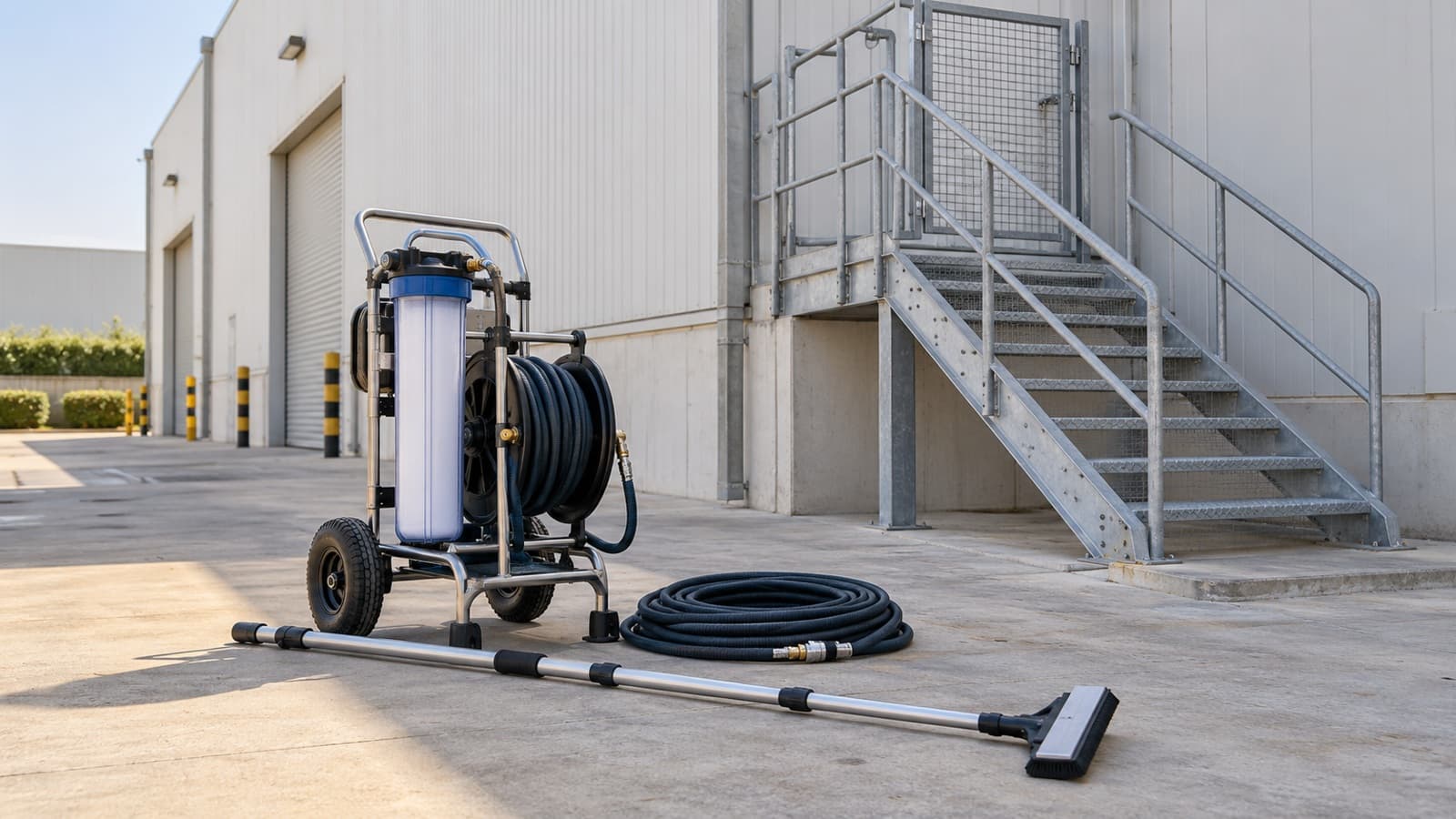
Water and treatment | Proposed method, manufacturer compatibility, usable supply location, expected quantity and any treatment or delivery | Water, treatment consumables, transport and any necessary supply works; identify who pays |
Access and mobilisation | Safe access route, equipment staging, array reach and any specialist access equipment | Each mobilisation, hire, competent operators and any permanent access provision |
Warehouse operating window | Security induction, escort, bay or yard restrictions and any required shutdown coordination | Out-of-hours charges and separately identified operational disruption, rather than an assumed zero |
Drainage and completion | How the method manages runoff, protects the roof and leaves drains and working areas unobstructed | Any additional protection, cleanup and agreed damage-reporting responsibility |
Exceptions and records | Storm visits, inaccessible sections, cancellation conditions and evidence of completed work | Extra-visit and aborted-visit rates, rescheduling terms and the service report |
“Water available on site” is too vague. Ask the provider to verify whether the actual supply can support its proposed method, not merely whether the building has a tap. Equally, “access by client” needs a defined deliverable and cost, not an unpriced promise from the facilities team.
The NREL-led operation and maintenance best-practices guide, published in December 2018, recommends following module-manufacturer cleaning instructions. It describes cleaning cost as including crew mobilisation and area-related labour and materials, and calls for a local, site-specific cost-benefit assessment. This is international technical guidance, not a Dubai rate card or a universal cleaning specification.
Compare annual cost, not just the cheapest visit
Ask each bidder to reconcile its service offer into the same annual budget:
Planned service: the proposed number of complete visits and the all-in price of each, or the precise coverage of a fixed annual fee.
Owner-paid inputs: water, treatment, access, escort or other inputs excluded from that fee.
Exceptions: separately priced additional visits, cancellations and return attendance, with an agreed allowance for comparison rather than a claim they will all occur.
Setup and operations: one-off enabling works and any separately estimated warehouse disruption.
Check for double counting. If access hire or water treatment is already included in the visit price, do not add it again. Keep one-off setup expenditure separate from recurring annual service, and show escalation and tax treatment consistently across offers. Do not multiply a small-villa cleaning price by your warehouse panel count and call it a commercial budget.
For an existing plant, use its layout and service records. For a new plant, ask the designer and proposed maintainer to agree the service assumptions before freezing the array. More installed capacity is not automatically the better investment if the added rows carry disproportionate access or servicing costs. Evaluate that trade-off within the wider commercial solar cost and payback model.
Agree when an extra clean earns its cost
Do not import another site’s cleaning interval as a warehouse-wide rule. The NREL guide discusses both scheduled and condition-based cleaning and how local dust, weather, energy value and cleaning cost affect the assessment. Ask your provider to propose a baseline, monitoring evidence and a review point for your site.
For a discretionary extra visit, request an estimate of the additional usable energy expected before the next planned clean, its bill-saving value and the full incremental visit cost. A brief improvement in output immediately after washing is not, by itself, an annual savings calculation. Any economic test remains subject to manufacturer instructions and safety or maintenance needs; it is not permission to defer necessary work.
Where a contract guarantees output, check how cleaning responsibility and denied access affect exclusions and remedies. Our guide to warehouse solar performance guarantees explains that separate contractual comparison. Keep a record of the sections cleaned, date, method, access problems, observed defects and follow-up actions.
The brief to send with your quotation request
Please assess solar for our Dubai warehouse using the supplied bills, roof information and operating restrictions. Include a maintainable layout and a site-specific cleaning plan. Identify the responsible enrolled O&M provider, water and access requirements, included visits, owner-supplied inputs, operational restrictions, extra and aborted-visit charges, reporting and annual escalation. Separate enabling works from recurring service and explain the evidence supporting the proposed cleaning schedule.
Decision takeaway: choose a solar proposal whose maintenance route works on your actual warehouse and whose cleaning budget includes the inputs you must supply. If water, access or operational restrictions remain undefined, the quoted service cost is not yet a dependable investment input.
You can request commercial solar quotations through SolarQuote, subject to project suitability and installer availability. Include your Dubai location, ownership or landlord authority, electricity bills, roof details and service restrictions so installers can assess the same scope. SolarQuote helps compare installer proposals; the appointed provider must assess and deliver the site’s technical work.
Primary sources checked on 28 October 2026. This is an owner procurement checklist, not a cleaning procedure, safety design or standard commercial price.