TL;DR
Commercial and industrial (C&I) electricity accounts in Dubai sit permanently in the top tariff slab — roughly 0.44 AED/kWh all-in once fuel surcharge is added — which makes every solar kWh you generate worth more than it would for a light residential user (DEWA Slab Tariff page).
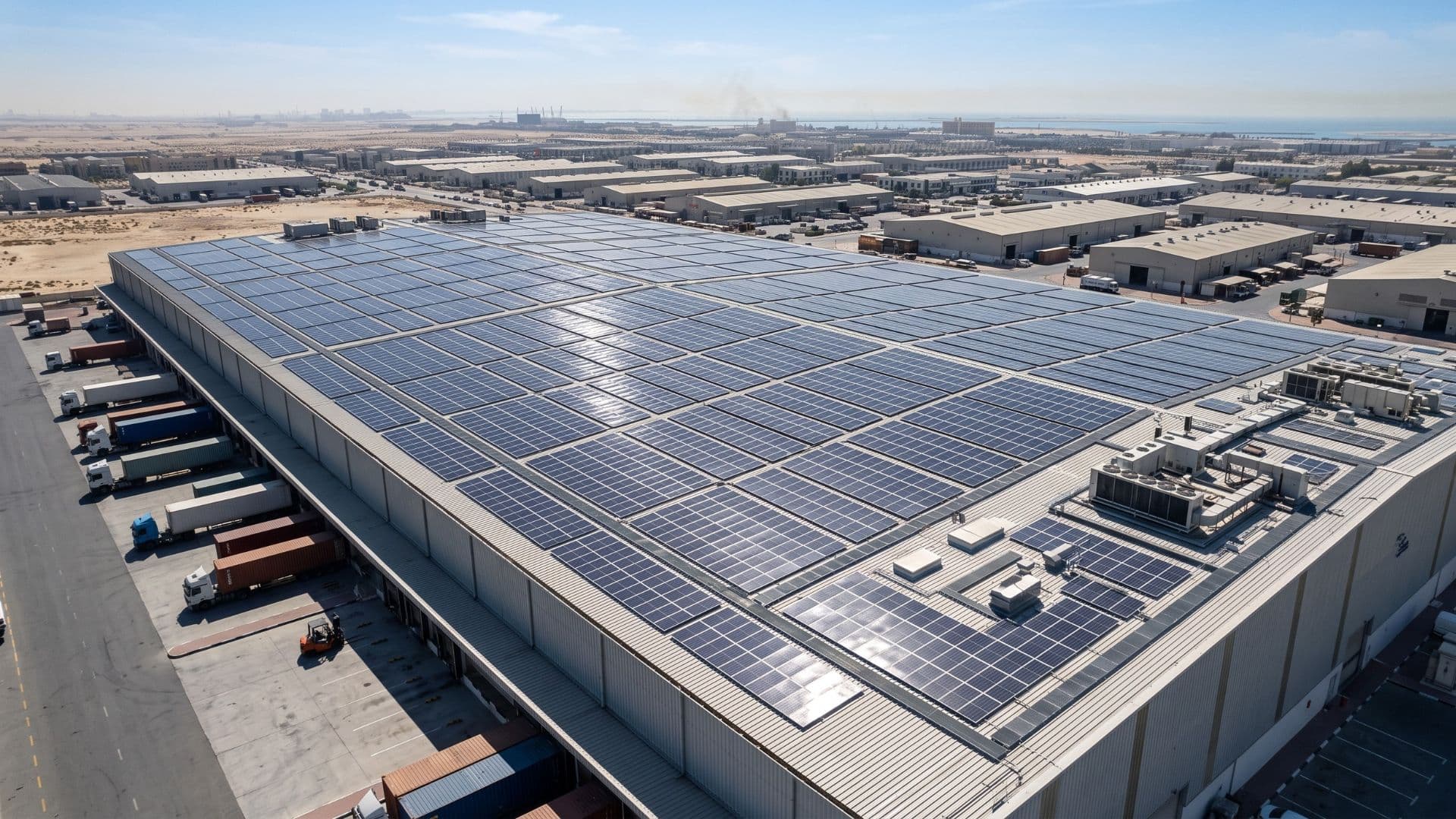
Real Dubai C&I projects range from under 100 kWp to multi-megawatt portfolios — SirajPower's DP World rooftop project alone hit 6.75 MWp across 110 buildings (Living Business, Feb 2020).
There's a hard 1 MW cap per plot under Shams Dubai, no ground-mount allowed, and surplus can't move between plots — know these limits before you design a system (DEWA DRRG Connection Conditions v4.1).
Qualifying industrial customers under Dubai's D33 policy can get paid cash for exported power — 10.5 fils/kWh — something ordinary commercial accounts do not get (DEWA D33 policy FAQs). Get commercial solar quotes now →
Why Commercial Solar Economics Beat Residential in Dubai
Here's the core argument for why a business should take solar more seriously than a typical villa owner: the tariff you're already paying makes the math better.
DEWA's official commercial/industrial slab tariff structure is as follows (DEWA Slab Tariff page, page updated 16 May 2026):
Band | Consumption (kWh)/month | Slab tariff (fils/kWh) |
|---|---|---|
Green | 0 – 2,000 | 0.230 |
Yellow | 2,001 – 4,000 | 0.280 |
Orange | 4,001 – 6,000 | 0.320 |
Red | 6,001 and above | 0.380 |
Industrial accounts have their own structure with a higher first band:
Band | Consumption (kWh)/month | Slab tariff (fils/kWh) |
|---|---|---|
Green | 0 – 10,000 | 0.230 |
Yellow | 10,001 and above | 0.380 |
On top of any slab, DEWA adds a fuel surcharge — currently 0.060 AED/kWh as of July 2026 — plus 5% VAT (DEWA Slab Tariff page).
The takeaway for any business with meaningful consumption: you're almost certainly consuming well past the top band every single month, meaning your marginal electricity cost is fixed at 0.380 AED/kWh plus the 0.060 surcharge — roughly 0.44 AED/kWh before VAT. That's a calculation from DEWA's own published rates, not a DEWA statement — but it's simple arithmetic. Compare that to a light residential user sitting in the lowest band at 0.230 + 0.060 = 0.29 AED/kWh, and it's obvious why commercial solar has a stronger payback case: every kWh your system generates displaces your most expensive electricity, not your cheapest.
Third-party sources corroborate the roughly 44-fils all-in figure. SurgePV states: "Commercial and industrial customers pay a flat rate of 38 fils plus 6 fils fuel surcharge, giving an all-in rate of approximately AED 0.44/kWh" (SurgePV, 25 April 2026). Installer Alsa Solar similarly states: "The rate of the Kwh in Dubai costs 0.445 AED/kWh for most of the commercial/industrial customers… This applies on industrial factories, warehouses in Jebel Ali Free Zone, Dubai's Investment Park, Dubai's Logistics City and Dubai's Industrial City" (Alsa Solar, installer marketing).
One honesty check worth stating upfront: there is no tax incentive for commercial or industrial solar in the UAE. DEWA's own FAQ confirms it plainly: "Are there any tax incentives available for commercial or industrial enterprises for installing solar panels? — No tax or other incentives are currently being offered" (DEWA Shams Dubai FAQ). The business case for commercial solar in Dubai rests entirely on the tariff arithmetic above, not on subsidies.
See what your business could save →
D33: The One Case Where DEWA Actually Pays Cash for Solar
There's an important exception most commercial solar content misses, and it's specific to industrial customers: Dubai's D33 Industry Friendly Power policy.
D33 exists to help Dubai "reduce cost of doing business," accelerate decarbonisation, and "make Dubai an attractive destination for manufacturing investments," with a stated goal of generating "an additional D 58 billion of Manufacturing-Value-Added by 2033" (DEWA D33 policy FAQs).
To qualify, "companies must obtain a D33 eligibility certificate issued jointly by Dubai Economy and Tourism Department (DET), Department of Finance (DOF) and DEWA. This certificate is available for industrial customers, Agri-tech enterprises and Data Centers" who are securing (or plan to secure) 100% of their energy needs from a mix of the DEWA grid and new captive PV solar generation (same source).
Here's the part that makes D33 genuinely different from standard Shams Dubai net metering: DEWA pays cash for exported power. "Feed-in power generated by D33 Companies will be procured and compensated by DEWA at a flat rate of 10.5 Fils/kwh, subject to certain conditions" (same source). There are limits — "no payment will be made for feed-in power during the winter season, (from December to February) or during emergencies or system maintenance/other grid constraints" — and the eligibility certificate is valid for 10 years from issuance, with a credit period of "2 years from the date of DEWA Estimate or until the date of connection/energization, whichever is earlier" (same source).
This is important to get right: D33's cash feed-in applies only to qualifying industrial customers, agri-tech, and data centers — not to ordinary retail shops, offices, malls, or general commercial accounts. Everyone else operates under standard Shams Dubai net metering, where there's no cash payout for surplus, only a bill credit (DEWA Shams Dubai FAQ). If your business is industrial and might qualify, ask your installer to walk you through the D33 certificate process specifically.
Real Commercial Solar Projects in Dubai
Numbers on a page mean more with real examples attached. All of the projects below come from company press releases or project pages — label them as installer/EPC marketing, not independent verification, but they illustrate the range of scale actually being built in Dubai today.
Project | Size | Source |
|---|---|---|
Al Tajir Glass Industries, Jebel Ali (SirajPower) | 2.9 MWp, ~4.6 GWh/yr | |
DP World staff accommodation, Jafza East & West (SirajPower) | 6.75 MWp across 110 buildings, >10.72 GWh/yr | |
Emerson, Jebel Ali South (SirajPower) | 2.6 MWp, 3.923 GWh/yr | |
Dubai Hills Mall (ALEC Energy) | 6.5 MWp rooftop + carpark | |
IKEA Supply (Middle East) warehouse, DWC (ALEC Energy) | 3 MWp | |
Nakheel portfolio (SirajPower) | 10 MWp across 9 sites | |
AMI ME Logistics Centre, JAFZA (Alsa Solar) | 615 kWp | |
Emirates School Establishment (Meagle Energy) | 100 kWp |
Note that the DP World figure (6.75 MWp) already exceeds Dubai's 1 MW-per-plot cap by a wide margin — that's only possible because it's spread across 110 separate buildings and, presumably, multiple plots/accounts, not one giant array under a single connection. More on that below.
What Does Commercial Solar Cost in Dubai?
There is no official DEWA cost-per-watt figure for 2026. DEWA's own FAQ does contain a cost estimate, but it's explicitly dated: "Currently (Q2 2021) typical system costs are in the 4,500-5,000 D/kWp range for small 'villa-size' systems and in the 3,500-4,000 D/kWp range or even below for larger ones" (DEWA Shams Dubai FAQ). That's stale pricing from five years ago — useful only as historical context, not a 2026 quote.
For current pricing, the market estimates below are the best available — and they disagree with each other by a wide margin, which is itself the honest takeaway:
Source | Commercial cost estimate | Note |
|---|---|---|
AED 1.70–2.20/W commercial (100+ kW as low as 1.70–1.95/W) | industry blog | |
AED 1.40–1.80/W for installations over 50 kW | installer marketing | |
Implies roughly AED 2.80–4.00/W (e.g., "1 MWp… AED 2.8M–4M") | vendor guide — notably higher than other sources | |
"AED 2.5 to 3.0 per watt for C&I rooftop in Dubai" | one individual's stated view — weakest source, use with caution |
Our honest read: published UAE market estimates for commercial rooftop solar in 2026 cluster roughly between AED 1.70 and AED 3.00 per watt installed, compared with roughly AED 2.00–2.60 per watt for residential systems. The spread is wide because roof type, height, structural reinforcement needs, and equipment tier move the number far more than raw system size does. There is no substitute for getting multiple quotes on your specific site.
Payback: again, no official DEWA figure exists. Vendor guide Quicknet estimates "5–8 year payback and 25+ year asset life" for commercial systems (Quicknet, April 2026). Treat any payback number you're quoted as a vendor estimate specific to your consumption profile and roof, not a guaranteed outcome.
Get commercial solar quotes now →
The Commercial Approval Process: Same Shams Dubai Framework, Extra Gates
Commercial solar in Dubai runs through the exact same Shams Dubai process as residential — engage a DEWA-enrolled contractor, apply for the (now-bundled) NOC and connection, get design approval, pay the connection fee, install, get inspected, connect. We cover that full sequence in our DEWA solar approval process guide. But commercial and larger systems trigger extra technical requirements that villa installs generally don't hit.
≥100 kW: mandatory performance test
"For PV plants of Maximum Capacity larger than or equal to 100 kW, DEWA issues a Preliminary Authorization to let the Applicant execute the performance tests as indicated in the Connection Standards… For installation above 100 kW, plant perfromance test should previously be completed successfully" (DEWA DRRG Connection Guidelines v2.0). By contrast, "for plants below 100 kW, no further tests or inspections are required" (same source).
>400 kW: possible MV connection and substation
Larger systems can trigger a medium-voltage grid tie-in: "PV plant with Maximum Capacity PMC > 400 kW to be connected to a new DEWA MV/LV substation" or "to a private MV substation and then to a new DEWA MV RMU substation," with the applicant required to submit substation approval information per DEWA's Distribution Substation Guideline (same source). This can also add cost: "For systems with an installed capacity of over 400KW, the cost of some dedicated equipment for grid integration might be added to the standard connection fee" (DEWA Connection Process page). Larger commercial applicants also need to provide an "undertaking letter stating that the load on each feeder shall not exceed 3MW (175A) in normal operation," relay coordination calculations, and a 24-hour emergency contact (DEWA DRRG Connection Guidelines v2.0).
Structural and fire safety
Structural drawings are a required design-approval submission for any system (DEWA DRRG Connection Guidelines v2.0), and DEWA has a dedicated fire-safety standard requiring roof-mounted PV modules to meet "a minimum fire resistance rating Class C" (DEWA "PV on Buildings and Fire Safety"). A Dubai-based consultancy also flags structural loading checks specifically for Trakhees zones — "structural loading check confirming roof slab can carry the panel dead load" (Dar Al Naseeb, May 2026) — worth treating as sensible practice, though it's a consultancy's own marketing page, not an authority statement.
Tenants need the landlord's NOC
If your business leases its premises — extremely common for warehouses and free-zone tenants — you'll need an "Owner's NOC (if tenant application)" before DEWA will process your inspection (DEWA DRRG Connection Guidelines v2.0, §3.4.2). Get your landlord's sign-off early — it's one of the most common causes of delay for commercial tenants.
The 1 MW Per-Plot Cap: What It Actually Means for Larger Sites
Dubai's Shams Dubai rules cap system size per plot, not per business: "the Maximum Capacity of Renewable Generators connected by the Producer at a certain Plot cannot exceed 1,000 kW" (DEWA DRRG Connection Conditions v4.1, §2.2). The cap scales with your plot's Total Connected Load rather than applying as a flat number to everyone.
Two other hard limits matter for larger sites:
No ground-mount systems. "A Renewable Generator should be located entirely in the Plot where the Hosting Account is located. Renewable Generators shall be installed on rooftops, facades, and other existing structures. Ground mounted installations are not envisaged" (DEWA DRRG Connection Conditions v4).
Surplus can't move between plots. "Surplus Electricity can only be offset against future electricity consumption of Consumption Accounts held by the Producer within the same Plot, and cannot, in any case: a. Be transferred for offsetting against electricity consumption of any other Person; b. Be transferred for offsetting against electricity consumption of the Producer under Consumption Accounts at a different Plot; c. Be used by the Producer to claim disbursement by the Authority of any monetary compensation" (DEWA DRRG Connection Conditions v4.1, §2.4).
What this means in practice, as a matter of reasoning rather than DEWA's explicit statement: a large industrial site with a roof that could physically support 3 MW of panels is still limited to 1 MW per plot under Shams Dubai. That's likely why DP World's 6.75 MWp portfolio across 110 buildings (Living Business) works the way it does — the scale comes from aggregating many separate plots and accounts, not one oversized array on a single connection.
If you do hold multiple consumption accounts on the same plot, there's a useful detail that's under-covered elsewhere: DEWA lets you nominate the order in which surplus offsets your other accounts. "For a Producer holding multiple Consumption Accounts within the same Plot, the excess of Export Electricity over the electricity imported from the Distribution System under the Hosting Account will be deducted from consumption readings of other accounts held by the Producer within the same Plot, following the sequence of accounts indicated by the Producer during the application process" (DEWA DRRG Connection Conditions v4.1, §2.4).
Two more details specific to larger commercial buyers:
Green certificates (I-RECs) must be self-redeemed. "Any I-RECs or other renewable energy certificates obtained by the producer for on-site clean energy generation shall be self-redeemed, without any sale or transfer to third parties" (same source). If sustainability reporting matters to your business, this is worth understanding — you can claim the environmental attribute yourself, but you can't sell or transfer it.
Multi-tenant buildings can't share generation with tenants. "Under current legislation, electricity produced by a PV system cannot be offset against electricity consumed by different customers. Offsetting is only permitted for electricity used in the building's common areas… Alternatively, individual tenants can instal solar systems for their own use" (DEWA Consumer FAQs).
Named EPCs Active in Dubai's Commercial Solar Market
The companies below are active in Dubai's C&I solar market based on public project pages and press coverage. This is not a ranking or endorsement — it's an illustration of who's building at scale, gathered from company marketing and press releases.
Company | What they do | Source |
|---|---|---|
SirajPower (Positive Zero's generation arm) | EPC + solar leasing; portfolio over 50 MWp under lease across the UAE | |
Yellow Door Energy | Solar lease/PPA developer, HQ in JLT Dubai; "over 100 solar projects in the United Arab Emirates, supporting over 50 different organizations" | |
ALEC Energy | EPC arm of the ALEC construction group; landmark Dubai projects including Dubai Hills Mall | |
Alsa Solar Systems | Shams Dubai enrolled contractor; over 100 projects across the UAE, Middle East, and North Africa | |
Meagle Energy | EPC based in Dubai (Motor City); active in both Shams Dubai and Abu Dhabi zero-export projects |
For businesses evaluating providers, the most useful next step is comparing multiple quotes side by side rather than picking the first name that comes up in a search.
Compare commercial solar quotes →
Quick Abu Dhabi Contrast
If your business also has premises in Abu Dhabi, the rules are different — and mixing them up is a costly mistake. Abu Dhabi is regulated by the Department of Energy (DoE) with distribution through ADDC/AADC, not DEWA, and it does not offer net metering. Its new self-supply policy states plainly: "Nothing in this Policy shall be construed as permitting net metering, cross-plot electricity sales, or any form of private wire arrangements unless explicitly authorised by the DoE" (Abu Dhabi DoE Self-Supply Policy, effective 5 Feb 2026). In practice, industry commentary interprets this as meaning "most projects will have to rely on zero export and self-consumption first economics which essentially also leads to sizing projects conservatively" (MESIA webinar, May 2026 — speaker interpretation, not regulation). In short: in Dubai, you can size a system to bank surplus as bill credit; in Abu Dhabi, you generally size to your daytime load because export isn't automatically credited. See our dedicated Abu Dhabi solar guide for the full picture.
The Bottom Line
Commercial solar in Dubai makes financial sense mainly because of where your business already sits on the tariff table — permanently in the most expensive slab. Real UAE projects prove the model works at every scale, from 100 kWp school installations to multi-megawatt logistics portfolios. But the process has real technical gates once you cross 100 kW and 400 kW, a hard 1 MW cap per plot, and cost estimates that vary widely by source. The only way to get a number specific to your building is to get quotes.