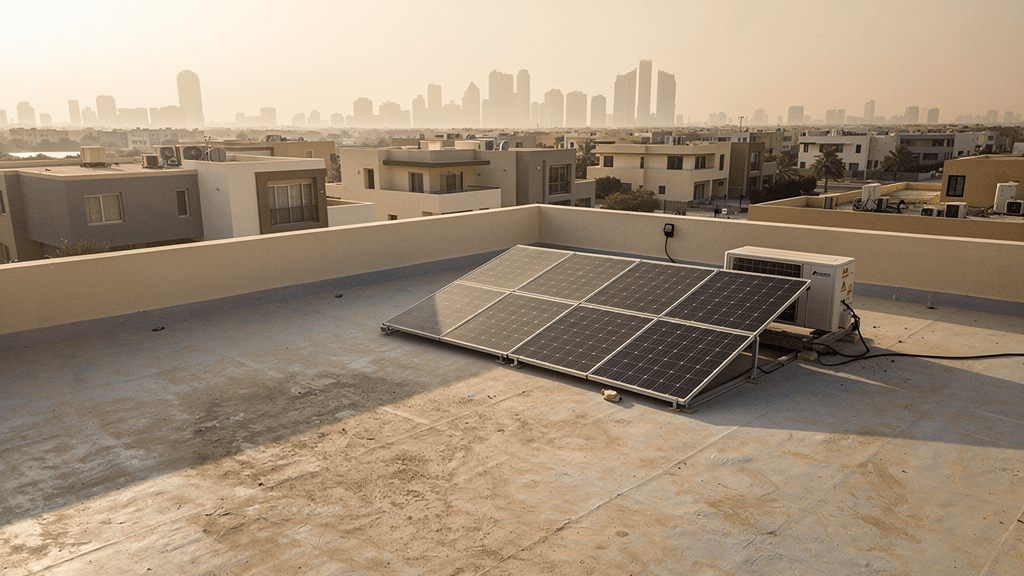
Illustration: a Dubai-style villa roof with solar panels and rooftop equipment. This is a generated image, not a photograph of a surveyed property; it does not show shade falling across the panel faces.
Short answer: Before choosing panels or paying extra for optimisers, ask a DEWA-enrolled solar contractor to show where shadows actually cross your proposed Dubai villa array, how that changes over the year, and what annual generation each sensible layout would deliver. A single sunny midday photograph is not a shade assessment. Neither is a promise that “smart panels” will make a poor roof good.
This guide is for an existing Dubai villa considering grid-connected rooftop solar under Shams Dubai. It is a pre-quote decision checklist, not a design or approval for a particular property. If your worry is roof penetrations or leaks rather than sunlight, start with the separate flat-roof waterproofing checklist.
Why a shade survey changes the quote
DEWA names roof orientation, shading and area as basic suitability factors, and specifically asks installers to consider potential shadow. It advises engaging an enrolled solar consultant or contractor to assess the premises. A villa roof can look open from the street but still have parapets, water tanks, AC equipment, pergolas or a neighbouring structure close to the proposed panel positions. The constraint is the proposed array footprint, not a generic average for the neighbourhood. See DEWA's Shams Dubai FAQ for its suitability guidance.
Shadows also move. A low morning or winter sun can reach a panel that is clear at noon on the day of the sales visit. Dust, heat, panel tilt and the electrical arrangement are separate losses; a credible production estimate should not bury them all under one unexplained “system loss” percentage.
What to ask the installer to put on paper
A marked-up roof plan. Show the proposed panel rows, parapets, AC units, tanks and any other obstructions, together with access and maintenance space. Identify which roof areas were excluded and why. For the roof-interface and drainage questions, use our Dubai villa roof checks.
A site-specific shade record. Ask how shadow was measured or modelled, at which panel locations and across which months and hours. Request photographs or a model view showing the obstructing objects. Ask whether the estimate includes future changes that you already know about, such as an approved extension or a growing tree. Do not assume the installer can predict unannounced construction next door.
Two comparable layouts. Request one sensible baseline that avoids the worst-shaded positions, then a second if the contractor proposes adding modules in those positions. Compare annual AC energy in kWh, not only installed kWp. A larger nameplate capacity is not automatically a better investment.
An electrical-design explanation. Ask which panels share a string or maximum-power-point-tracking input, and whether a different string arrangement, more suitable panel placement, module-level optimisers or microinverters change the result. Ask for the exact device models and confirm grid-connection eligibility with the contractor. Our UAE inverter guide explains those choices and the heat issue.
Assumptions, scope and a handover baseline. Request monthly and annual generation estimates with the shade, soiling and temperature assumptions separated, plus owner access to monitoring after commissioning. Compare the same assumptions across bidders using our 12-line-item solar quote checklist. Put any necessary roof changes and exclusions in writing.
Will optimisers or microinverters solve a shaded roof?
They can reduce some mismatch losses when one module is shaded differently from its neighbours; they cannot restore sunlight blocked by a wall or tank. In a controlled US laboratory comparison, microinverters improved modelled annual performance relative to a string inverter under the particular light, moderate and heavy shade scenarios tested. That is useful evidence of the mechanism, not a Dubai-villa savings prediction. The improvement depends on your actual shadow pattern, wiring and equipment. Read the NREL shade comparison if a salesperson gives you a universal percentage.
The best first move is often to omit a persistently shaded panel location or rearrange the array. If that leaves too little productive roof, ask for a smaller design and a candid payback comparison. If module-level hardware is proposed, ask for the extra installed cost, the modelled annual kWh gain for your roof, the warranty and the replacement-access plan. Avoid adding roof electronics merely because a brochure calls them smarter.
A copy-and-send request for three bidders
“Please survey my Dubai villa roof before giving a final solar production estimate. Mark the proposed panels and shadow sources on a roof plan; explain how shade was assessed across seasons; show monthly and annual AC kWh with shade, dust and heat assumptions; and compare a layout that avoids the worst shade with any proposed optimiser or microinverter alternative. Please identify the contractor responsible for the DEWA submission, the exact equipment, exclusions and my monitoring access after handover.”
If one bid supplies only an aerial-image panel count, treat it as a preliminary indication rather than a comparable final quote. Do not climb onto the roof or touch existing PV wiring to investigate shadows yourself. If you already own an array and output has fallen, use the safe monitoring and fault-check guide instead of assuming the original design was wrong.
Bottom line: buy a measured layout and a transparent annual-energy forecast, not the largest rectangle that fits on a drawing. Compare installer proposals only after they have answered the same shade questions.