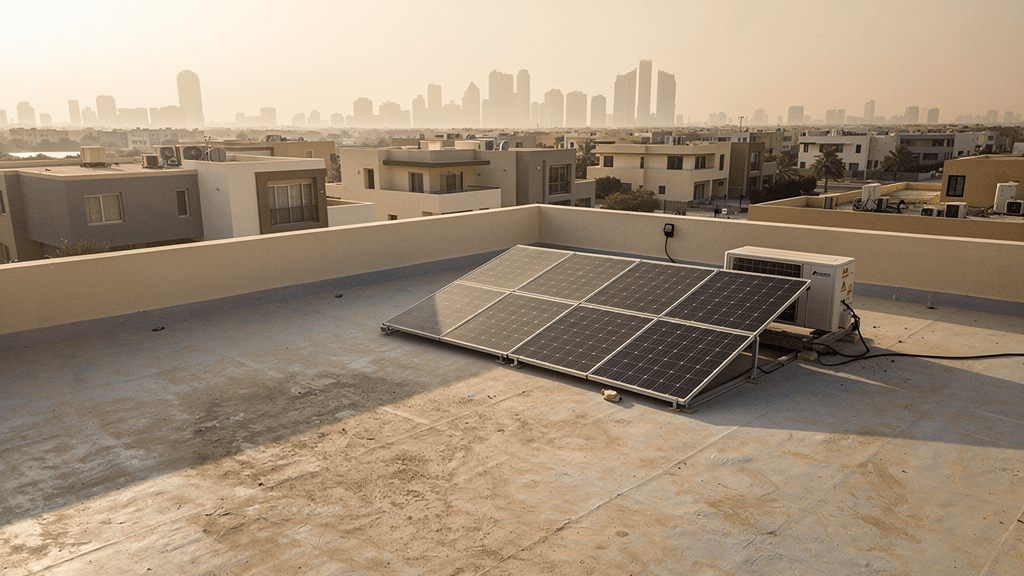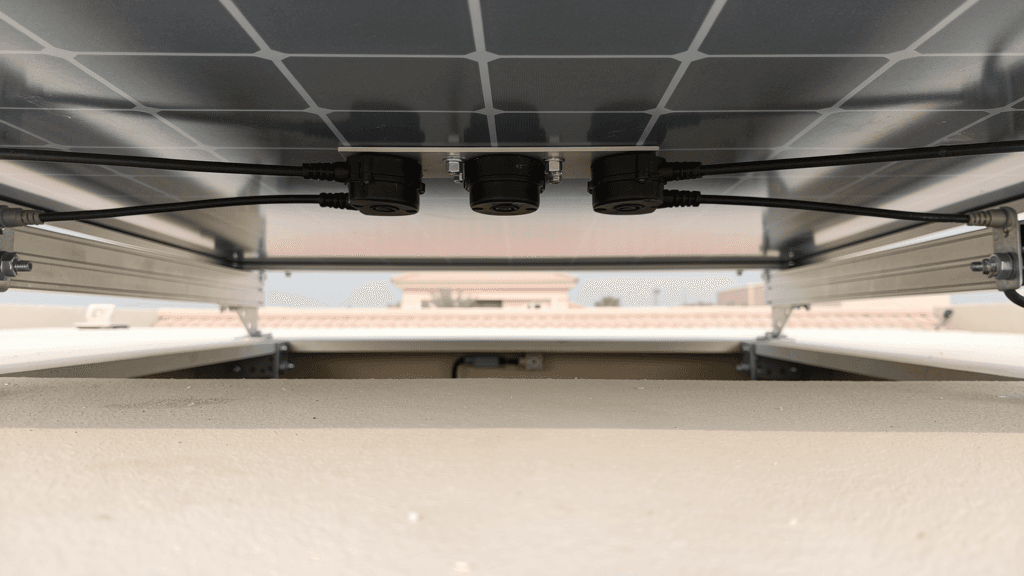
Illustration: the rear face of a bifacial solar module above a light-coloured roof, not a documented Dubai installation or mounting specification.
Short answer: Bifacial solar panels can make use of light reaching their rear face, but that does not give every Dubai villa a fixed extra percentage of electricity. Before paying a premium, ask for a roof-specific annual AC energy estimate with the rear contribution shown separately, and a conservative comparison with that contribution removed. Buy the better complete design, not the bigger brochure bonus.
This guide is for a Dubai villa owner comparing rooftop solar proposals. The narrow question is whether a claimed bifacial gain is credible on your actual roof. It is not a recommended mounting height, a community approval or a forecast for every UAE property.
What does “bifacial” actually add?
A monofacial module collects light through its front face. A bifacial module can also collect light through its rear face, including reflected light from the surface below and diffuse light from the sky. The rear does not need to face the sun in the same way as the front, but it does need useful light to reach it.
The important distinction is between bifaciality and bifacial energy gain. Bifaciality describes the module's rear-side response relative to its front-side response under comparable test illumination. It is not the percentage increase in your villa's annual generation. The installed energy gain also depends on how much light reaches the rear, and on losses.
Research by NREL and partners identifies clearance, row spacing, tilt and the reflectivity of the underlying surface as relevant variables in bifacial rear-irradiance modelling. Those studies explain the mechanism; they are not a measured Dubai-villa yield guarantee. Our guide to the main UAE solar-system components covers the broader equipment choices.
Why a white villa roof is not enough evidence
Albedo is the fraction of incoming light a surface reflects. A light-looking roof can be a useful starting point for a bifacial design, but its colour in a sales photograph does not establish the value to use in an energy model. Ask which roof finish the estimate assumes, how its reflectivity was established, and whether that condition is expected to persist.
Then ask whether the panel rear can actually see that surface. Close mounting, adjacent rows, support rails and other obstructions change the light reaching different parts of the rear face. A roof that is reflective outside the array does not necessarily deliver the same rear illumination beneath its centre.
Uneven rear illumination matters too. NREL's research on bifacial mismatch losses shows why averaging rear light across the module can miss additional electrical losses. You do not need to reproduce the simulation. You do need the installer to explain whether rear shading and mismatch were included rather than adding an unexplained bonus to a conventional forecast.
Front-side shading remains a separate check. Do not accept bifacial technology as a substitute for the villa roof shade assessment that identifies parapets, tanks and rooftop equipment.
The five things a bifacial proposal should show
The exact module and rating basis. Request the model-specific datasheet, module count and quoted DC capacity. Ask whether the quoted wattage is a front-side test rating or a value including an assumed rear contribution. Keep that basis consistent between bidders.
The actual geometry. Request a plan and section showing panel tilt, clearance above the finished roof, row spacing and the mounting arrangement. These are inputs to the estimate, not details to decide after the price is agreed.
A defensible roof-reflectivity assumption. Ask for the assumed albedo and its basis. If a new reflective coating is assumed, identify the product, preparation, cost, maintenance and roofing approval in the scope. Do not paint a roof or alter waterproofing simply to match a sales model.
A transparent energy forecast. Request monthly and annual AC kWh, the predicted rear-side contribution and the modelling method. Have the contractor identify rear obstruction/mismatch, front shading, soiling, temperature and inverter losses. Clarify where in the calculation the quoted “gain” is measured.
A conservative alternative. Request the same design modelled without rear contribution, plus a comparable monofacial proposal if one is available. If the layouts or front-side module capacities differ, require those changes to be stated so they are not mistaken for a bifacial benefit.
Use the 12-line-item solar quote checklist for the commercial comparison. The bifacial questions supplement it; they do not replace a named inverter, warranty documents and a clear installation scope.
Do not raise the array just to chase a rear-side bonus
More clearance can improve rear illumination in some configurations. That is not permission to choose a taller mounting system yourself. Have the designer assess the complete arrangement, including wind loading, structural suitability, roof interfaces, access and the applicable approvals.
If the proposal changes the roof coating or mounting, use the flat-roof waterproofing checks to allocate responsibility before signing. A theoretical energy improvement is not a good trade if the roof work or later maintenance has not been priced.
For the Dubai connection check, have the contractor confirm the exact equipment's eligibility using the current DEWA process. DEWA's eligible-equipment page says the old PDF list is obsolete and warns that eligibility is not an endorsement or performance warranty. “DEWA eligible” does not validate a salesperson's rear-gain forecast.
When is the premium worth considering?
A stronger case: the contractor has surveyed the roof, explained the reflective surface and layout, separated the rear contribution, priced any associated roof work and shown a useful improvement after system losses. Compare the resulting annual energy and complete installed/maintenance cost with the alternative.
A weaker case: the only evidence is a datasheet bifaciality figure, a utility-scale project example or a universal “extra output” claim. Ask for the missing roof-specific calculation before treating that gain as part of the investment case.
No separate premium: bifacial modules may simply be the supplied equipment. That is not a problem, but the absence of a premium does not make an optimistic production estimate reliable. Judge the model, front-side specification, warranties and whole design on their merits.
Our practical recommendation is to check whether the proposal still makes sense on its conservative front-only forecast. If the decision depends on rear gain, insist that the evidence and assumptions are explicit. There is no responsible universal percentage to insert for every Dubai villa.
A message to send to your installer
Please identify the exact bifacial module and explain the wattage basis in the quote. Show my proposed roof layout, tilt, clearance, row spacing and roof-reflectivity assumption. Please provide monthly and annual AC kWh with the rear contribution identified, and a conservative forecast with that contribution removed. State how rear shading/mismatch, front shading, dust, heat and inverter losses are treated. Price any roof coating, altered mounting and associated maintenance separately, and confirm the model-specific equipment eligibility and applicable approvals.
If you are still collecting bids, request Dubai solar proposals with the bifacial assumptions included. A clear comparison is more useful than three different headline bonuses.
Primary research and DEWA guidance checked on 8 October 2026. The research cited is not a new Dubai field trial; the buying checklist is editorial advice. Hero image is AI-generated and illustrative.