TL;DR - The inverter is the box that turns your panels' DC into usable AC. It is the component most likely to need replacing before the panels do, so it deserves more attention in a quote than it gets. - Heat is the UAE-specific issue. Most quality inverters are rated to +60 °C ambient, but several derate — quietly reduce output — well before that. Siting matters as much as the badge on the box. - DEWA already regulates this. Its connection guidelines require inverters to handle Dubai temperatures with limited derating and to be protected from direct sun, and only equipment enrolled on DEWA's Eligible Equipment List should be used for Shams Dubai installations. - You do not need to become an inverter engineer. A DEWA-enrolled installer selects, sizes and sites the inverter and handles the approval paperwork as part of a normal turnkey scope. - There is no single "best" brand. There is a right fit for your roof, your shading, your budget and how long you plan to own the property.
The inverter converts the direct current your panels produce into the alternating current your villa or building actually uses, and it manages the connection to the grid. It is roughly the size of a small suitcase, it is mounted on a wall, and it is the part of a solar system that thinks.
It is also the part most likely to fail first. Panels are glass and silicon with no moving parts. An inverter is power electronics, capacitors and often a fan, running eight to ten hours a day in a climate where the mean daily maximum in Dubai is 40.6 °C in July and 40.4 °C in August (World Meteorological Organization).
That is the whole story of this article. Everything specific to the UAE about inverter selection comes back to temperature — how much the unit derates when it gets hot, and where on your property it is mounted.
"Solar inverter" and its variants draw roughly 880 average monthly searches in the UAE in English (SolarQuote keyword analysis, Google Keyword Planner). Most of the results explain what an inverter is. Very few explain what happens to one in August.
The four types, and what each suits in the UAE
String inverters. One box, several strings of panels wired in series. Simple, proven, the cheapest per kilowatt and the default on most UAE villa quotes. The weakness is that a string's output follows its weakest panel, so heavy shading from a water tank, a parapet or a neighbouring tower hurts.
Hybrid inverters. A string inverter with battery management built in. If you are adding storage now, or realistically within a few years, a hybrid saves you buying a second box later. Deye, GoodWe, Sungrow, SMA, Fronius and Huawei all sell hybrid ranges. Note that some manufacturers give hybrids a shorter standard warranty than their plain grid-tied units.
Microinverters. One small inverter per panel or per pair of panels, mounted on the roof itself. Excellent for shaded, multi-facet or awkward villa roofs, and they give panel-level data. They also sit on the roof, in full sun, which is a genuine consideration here — Enphase rates the IQ8 series to an ambient range of −40 °C to 60 °C, with the IQ8A extending to 65 °C (Enphase).
Power optimisers. A middle path: a small DC device per panel plus one central inverter. SolarEdge is the best-known implementation. Its power optimisers are rated to a far wider ambient range than its inverters — −40 °C to +85 °C for optimisers versus up to +60 °C for the inverters (SolarEdge) — which is the point: the heat-exposed component is the rugged one, and the sensitive box goes in the shade.
For a clean villa roof with no shading, a string inverter is the sensible answer. For a roof carved up by AC units, tanks and pergolas, optimisers or microinverters earn their extra cost. For a commercial roof, string inverters in multiples are standard, and the design question shifts to plant room siting and ventilation.
Weighing up options? Request free quotes from installers covering Dubai and Abu Dhabi — one form, no markup, no obligation.
Heat derating: the part nobody explains
Every inverter has a maximum operating ambient temperature. Most quality units are rated to +60 °C. But the rating is not the same as the point at which the unit still gives you full power.
When internal component temperature rises past a threshold, the inverter deliberately reduces its output to protect itself. That is derating. It is a feature, not a fault — but it means a badly sited inverter can quietly cost you generation during exactly the hours your bill is highest.
Manufacturers describe this differently, and the honest summary is that most datasheets do not publish a clean derating curve. Some do state a threshold:
Huawei's SUN2000-5/6KTL-M0 datasheet states an operating range of −25 °C to +60 °C with "Derating above 45 °C @ Rated output power" (Huawei).
Deye's three-phase hybrid datasheet states −40 °C to +60 °C with ">45 ℃ Derating" (Deye).
SMA's technical note is the most candid. It explains that derating begins "when the permissible temperature on the monitored components is reached", and that the trigger point depends on DC operating voltage as well as air temperature. In its worked example, there is "no PV array operating point that requires the inverter to feed in at full power at temperatures above 31°C (at 800 V)" (SMA). That figure is specific to one example system in Australia, not a UAE rule — but it makes the principle unmistakable. Derating is not an exotic edge case at 59 °C. It is a normal summer behaviour that good design manages.
SMA also distinguishes passively cooled units, which shed heat through heat sinks, from actively cooled units with speed-controlled fans (SMA). Fans move more heat; fans are also a moving part that can fail and collect dust. Neither approach is automatically right for a Dubai roof.
Why siting is the cheap fix
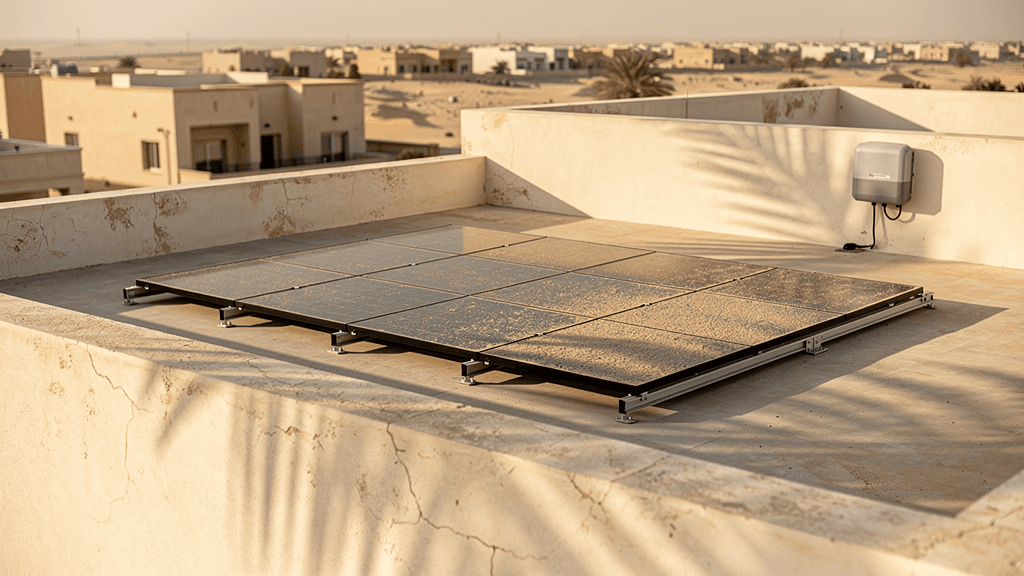
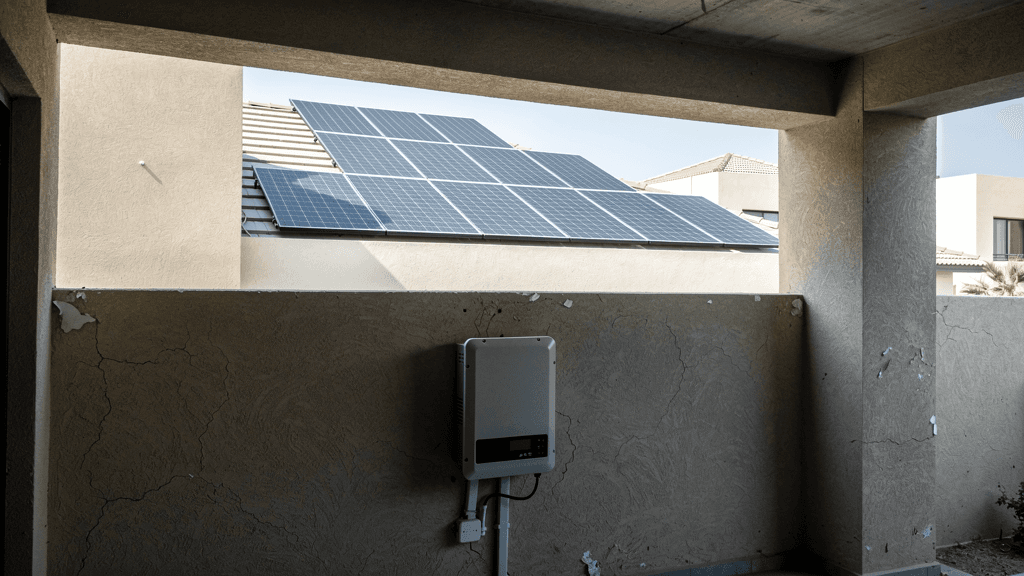
Air temperature is only part of it. An inverter bolted to a south or west-facing wall in direct August sun is sitting in a far hotter microclimate than the same unit on a shaded north wall with clear air behind it.
DEWA is explicit about this. Its Shams Dubai connection guidelines state that "provisions which prevent the increase of the internal heating of the inverters shall be taken for outdoor installation (e.g. protections against direct exposition to the sun)" (DEWA).
So: shade, ventilation, a north-facing or otherwise sun-protected wall, clearance around the heat sink, and not inside an unventilated cupboard. This costs almost nothing at design stage and is close to impossible to fix cheaply afterwards. It is a fair question to put to every installer quoting you.
What DEWA actually requires
Here is the reassuring part. Inverter compliance is your installer's job, not yours, and Dubai has a clear published framework for it.
DEWA's connection guidelines set a hard thermal requirement: "the inverter shall be able to withstand the maximum temperatures with effective heating dispersion and with a power derating smaller than or equal to 25 % of its rated power as determined for an ambient temperature of 50 °C at the DC design voltage." Inverters that cannot meet that must be placed "in cooled room or enclosures with effective ventilation" (DEWA). The same document requires an IP65 enclosure for outdoor installation and IP54 for indoor.
On equipment approval, DEWA publishes an Eligible Equipment List covering PV modules, PV inverters and interface protection. Manufacturers or their local authorised representatives register products through the DRRG Equipment Portal, compliance certificates "shall be issued from 3rd party ILAC-accredited labs according to the standard ISO/IEC 17025", and harmonic spectrum data is required for each inverter model (DEWA).
Two honest caveats. First, DEWA describes the list as a "non exhaustive list of eligible equipment based on manufacturers' submissions", based on type-test certification, and states that it does not constitute an endorsement or warranty (DEWA). Second, the old downloadable PDF list is obsolete: DEWA states that equipment listed before the web portal launched must be re-registered through the DRRG Equipment Portal (DEWA). If a quote names an inverter model, the check is against the live portal list, not an old PDF.
Abu Dhabi runs a different scheme — self-supply, not net metering — so confirm equipment requirements there with the Department of Energy and your distribution company rather than assuming DEWA's list applies. None of this is a reason to hesitate; it is a reason to work with a contractor who does it every week. Our guide to the Shams Dubai approval steps walks through the wider process.
Comparing inverter brands across quotes? Get free quotes from installers in Dubai and Abu Dhabi — direct from the installers, with nothing added on top.
Brand comparison
Every figure below comes from the linked manufacturer document. Ranges differ by model, so treat this as a starting point for the conversation, not a specification for your roof.
Brand | Type range | Datasheet ambient / derating spec | Standard warranty | Monitoring |
|---|---|---|---|---|
Huawei | String, hybrid, optimisers | −25 to +60 °C; "Derating above 45 °C @ Rated output power" on SUN2000-5/6KTL-M0 (datasheet) | 10 years on most SUN2000 residential series outside China/India/LATAM (policy) | FusionSolar app (datasheet) |
SMA | String, hybrid | −25 to +60 °C on Sunny Tripower Smart Energy (datasheet); derating tied to component temperature and DC voltage, not a single figure (technical note) | 5 years, free extension to 10 on registration (datasheet) | Sunny Design named on the technical note; app not published on datasheet |
Fronius | String, hybrid | −40 to +60 °C on Primo GEN24 Plus; derating graphs plotted at 30–50 °C (datasheet) | 10 years free for inverters under 50 kW on Solar.web registration; paid extension to 15 (Fronius) | Fronius Solar.web (datasheet) |
Sungrow | String, hybrid | −25 to +60 °C, natural cooling, IP65 on SG5.0–12RT (datasheet); derating threshold not published | 10 years for residential inverters up to 20 kW; 5 years for C&I distribution products; extension negotiable (warranty) | Not published on datasheet |
Growatt | String, hybrid | −25 to +60 °C, IP66 on MOD 10–15K TL3-X (datasheet); derating threshold not published | 10 years stated on that datasheet (datasheet) | ShinePhone app (Growatt server) |
Deye | Hybrid, string | −40 to +60 °C with ">45 ℃ Derating", IP65, intelligent air cooling (datasheet) | "5 Years/10 Years" stated on datasheet (datasheet) | Not published on datasheet |
Solis | String, hybrid | −25 to +60 °C, IP66, natural and intelligent fan cooling (datasheet); derating threshold not published | 5 years standard, extendable to 10, 15 or 20 years (warranty) | Not published |
GoodWe | String, hybrid, micro | −35 to +60 °C, IP66, smart fan cooling on ET 15–30 kW (datasheet); derating threshold not published | 5 or 10 years depending on series (warranty); extension to 10 years via SEMS registration and GoodWe PLUS+ installers (GoodWe EMEA) | SEMS portal (GoodWe EMEA) |
SolarEdge | Optimiser-based string, hybrid | Inverters −20 to +60 °C (−40 °C option), natural convection, IP65 (datasheet); optimisers −40 to +85 °C (brochure) | Inverters 12 years, extendable to 20; optimisers 25 years (brochure) | mySolarEdge (SolarEdge) |
Enphase | Microinverters | −40 to 60 °C ambient; IQ8A −40 to 65 °C (datasheet) | Not published on the IQ8 series datasheet | Not published on that datasheet |
Warranty terms vary by region, sales channel and date of manufacture. Ask for the warranty document that applies to your unit, in the UAE, in writing.
Sizing: why your array may be bigger than your inverter
If your quote shows, say, 12 kWp of panels feeding a 10 kW inverter, that is not a mistake. It is a DC:AC ratio of 1.2, and it is deliberate.
Panels almost never produce their rated output. They are rated at 25 °C cell temperature in laboratory light; on a Dubai roof in July they run far hotter and dustier than that. Oversizing the array relative to the inverter means the inverter spends more of the day near its efficient operating band instead of loafing at 30 % load.
Engineering guidance frames it this way: "It often makes sense to oversize a solar array, such that the DC-to-AC ratio is greater than 1", with designers traditionally using 1.1 or 1.2 and modern practice pushing higher; sizing for maximum specific yield points to "an ideal DC-to-AC ratio at or slightly below 1.2", while sizing for best financial return can justify 1.3 to 1.6 (ABB / Solar Power World).
The trade-off is clipping: on the brightest hours the inverter caps output and the surplus is lost. The same source notes that the workable oversizing ratio depends on "factors that affect the inverter's operating temperature and ability to cool, such as shading, mounting and elevation" — which is precisely why a ratio that works in Germany is not automatically right on a Dubai rooftop.
DEWA's guidelines recognise the distinction, defining maximum capacity as the sum of inverter AC ratings and noting that this "may also be lower than the sum of the power at STC of the photovoltaic modules" (DEWA).
Ask what DC:AC ratio your quote uses and why. A designer who has thought about it will answer instantly.
Efficiency: read the weighted number, not the headline
Brochures shout the peak figure — 98.6 %, 99.2 %. Peak efficiency occurs at one specific load and voltage. Your inverter almost never sits there.
The useful numbers are weighted efficiencies. European efficiency averages performance across six load points using weights derived from a middle-European climate, with the heaviest weight (0.48) on 50 % load (PVsyst). CEC weighted efficiency, developed by the California Energy Commission for higher-irradiance regions, is measured at 10, 20, 30, 50, 75 and 100 % of rated AC power across three DC voltage levels — 18 measurements — and puts its heaviest weight (0.53) on 75 % load (Sandia PVPMC).
For a high-irradiance market like the UAE, the CEC weighting is the closer analogue, because our inverters spend more time at high load. Most datasheets sold into this region publish European efficiency, not CEC. In the datasheets cited here the gap between peak and weighted is around one percentage point: Huawei's SUN2000-10KTL-M1 lists 98.6 % maximum against 98.1 % European (Huawei); Fronius's Primo GEN24 Plus lists 97.6 % maximum against European figures from 96.8 % (datasheet).
One percentage point of conversion efficiency is real but small. Correct siting and a sensible DC:AC ratio will move your annual yield more than choosing between two reputable brands.
Warranty: the inverter is the shorter-lived component
Modules commonly carry performance guarantees measured in decades — DEWA's own guidelines note manufacturers often guarantee 90 % efficiency after 10 years and 80 % after 25 (DEWA). Inverter warranties in the table above run from 5 to 12 years as standard.
That asymmetry is the point. On a system you expect to run for 20-plus years, plan on the possibility of an inverter replacement. Our guides to realistic panel lifespan in UAE heat and maintenance costs cover how to budget for that.
Extensions are widely available and often cheapest at purchase. Note the conditions: Fronius requires registration on Solar.web within 30 months of delivery, and its paid extension can only be bought within the first six months of the warranty period starting (Fronius). GoodWe's route to 10 years runs through SEMS registration and a GoodWe PLUS+ certified installer (GoodWe EMEA). Sungrow makes extended cover conditional on documented regular maintenance (Sungrow). If nobody registers your unit, you may simply not have the cover you think you have.
We do not publish inverter price ranges here, because installer-quoted inverter costs in the UAE are almost always bundled into a full system price rather than itemised. What drives the difference is brand tier, single-phase versus three-phase, hybrid versus plain grid-tied, warranty length included, and whether optimisers or microinverters add per-panel hardware. Ask for the inverter to be itemised so you are comparing like with like.
Monitoring: insist on your own access
Several manufacturers tie warranty cover to the unit being connected and registered on their platform, so monitoring is not optional anyway. Named owner-facing platforms include Huawei's FusionSolar app (Huawei), Fronius Solar.web (Fronius), GoodWe's SEMS portal (GoodWe EMEA), Growatt's ShinePhone (Growatt) and mySolarEdge (SolarEdge).
Insist on an owner-level account in your own name and email, not just installer access. At minimum you want daily and monthly generation, live power, fault and alarm history, and — where the technology supports it — panel-level data. mySolarEdge, for example, shows the full PV layout and flags underperforming modules (SolarEdge).
Without it, you have no way to notice that your system quietly dropped 15 % in the second summer.
Frequently asked questions
What is the best solar inverter for the UAE?
There isn't one. Fit-for-purpose beats brand ranking: a clean, unshaded villa roof suits a string inverter, a shaded or multi-facet roof suits optimisers or microinverters, and a home planning batteries suits a hybrid. Check the model is enrolled on DEWA's Eligible Equipment List (DEWA) and that the warranty on offer is documented in writing.
Do solar inverters lose output in Dubai's summer heat?
They can, through derating. Huawei's SUN2000-5/6KTL-M0 datasheet notes derating above 45 °C at rated output (Huawei), and Deye's three-phase hybrid states derating above 45 °C (Deye). Shaded, well-ventilated siting is the practical mitigation, and DEWA's guidelines already require protection from direct sun (DEWA).
Does DEWA have to approve my inverter?
DEWA maintains an Eligible Equipment List for PV inverters, populated by manufacturer submissions with type-test certificates from ILAC-accredited laboratories (DEWA). DEWA describes the list as non-exhaustive and not an endorsement (DEWA). Your enrolled contractor confirms the model against the live portal — you do not need to do this yourself.
String or microinverter for a Dubai villa?
String inverters cost less and are the default on unshaded roofs. Microinverters and optimisers cost more per panel but handle shading and complex roof geometry better and give panel-level visibility. If a water tank, parapet or tall neighbour shades part of your array for part of the day, the extra spend earns its place.
How long do solar inverters last in the UAE?
Manufacturers publish warranties, not lifespans. Standard terms in this article range from 5 to 12 years, with extensions to 15, 20 or 25 available on some ranges. Budget for the possibility of replacement within the life of the panels rather than assuming the inverter matches them.
What is a good DC:AC ratio?
Above 1. Sizing for maximum specific yield points to a ratio at or slightly below 1.2, and sizing for best financial return can support 1.3 to 1.6, depending on how well the inverter can cool (ABB / Solar Power World). Ask your installer which they used and why.
Three questions to put to every installer
You do not need to master any of the above. You need three questions, and you need consistent answers across the quotes you receive.
Where exactly will the inverter be mounted, and how is it shaded and ventilated? Point at the wall. Ask about afternoon sun.
Which model, what is its derating behaviour, and is it currently on DEWA's Eligible Equipment List? A DEWA-enrolled contractor will answer without hesitating.
What DC:AC ratio have you designed to, what warranty applies in the UAE, and who registers the unit for any extension?
If the answers are vague, that tells you something useful about the design work behind the number at the bottom of the page. If they are crisp, you can stop thinking about inverters and go back to comparing prices. For more on separating good contractors from good salespeople, see our guide to choosing a solar installer in the UAE, and for how the inverter sits alongside panels and batteries, see the right solar system for UAE heat.
Ready to compare? Request free quotes — one form, quotes direct from UAE installers, no markup and no obligation.