A solar inverter can make an audible fan or operating noise without being faulty. For a Dubai villa, the useful question is whether the exact model and mounting location are suitable for nearby bedrooms, home offices and outdoor seating. Do not accept “all inverters are silent”, and do not solve a noise complaint by enclosing the unit or blocking its cooling airflow.
This guide is for owners planning a Shams Dubai installation, or living with an existing inverter. It focuses on noise and siting, not a brand ranking, an electrical diagnosis or a statement of Dubai's legal noise limits.
Why a normally working inverter may be audible
Start with the manufacturer's manual, not a generic decibel range from a shopping page. Some inverters use fans; others rely on passive cooling. A fanless design removes fan noise, but does not promise that the installed equipment or the wall carrying it will be inaudible.
Fronius explains in its GEN24 operating instructions that cooling noise depends on factors including power, ambient temperature and soiling. It also warns that the actual sound pressure is affected by the installation situation, surrounding walls and room properties. Those are reasons to assess a model at its proposed location, not just compare a brochure number.
Mounting matters separately from cooling. The SMA Sunny Boy 3.0–5.0 operating manual calls for a solid support such as concrete or masonry and warns that drywall or similar materials can produce audible vibrations during operation. That is guidance for the models covered by that manual, not a universal wall specification for every inverter.
For the broader thermal design questions, our UAE inverter heat and siting guide explains why shade and ventilation belong in the proposal. A noise fix must preserve those requirements.
Where should the inverter go on a Dubai villa?
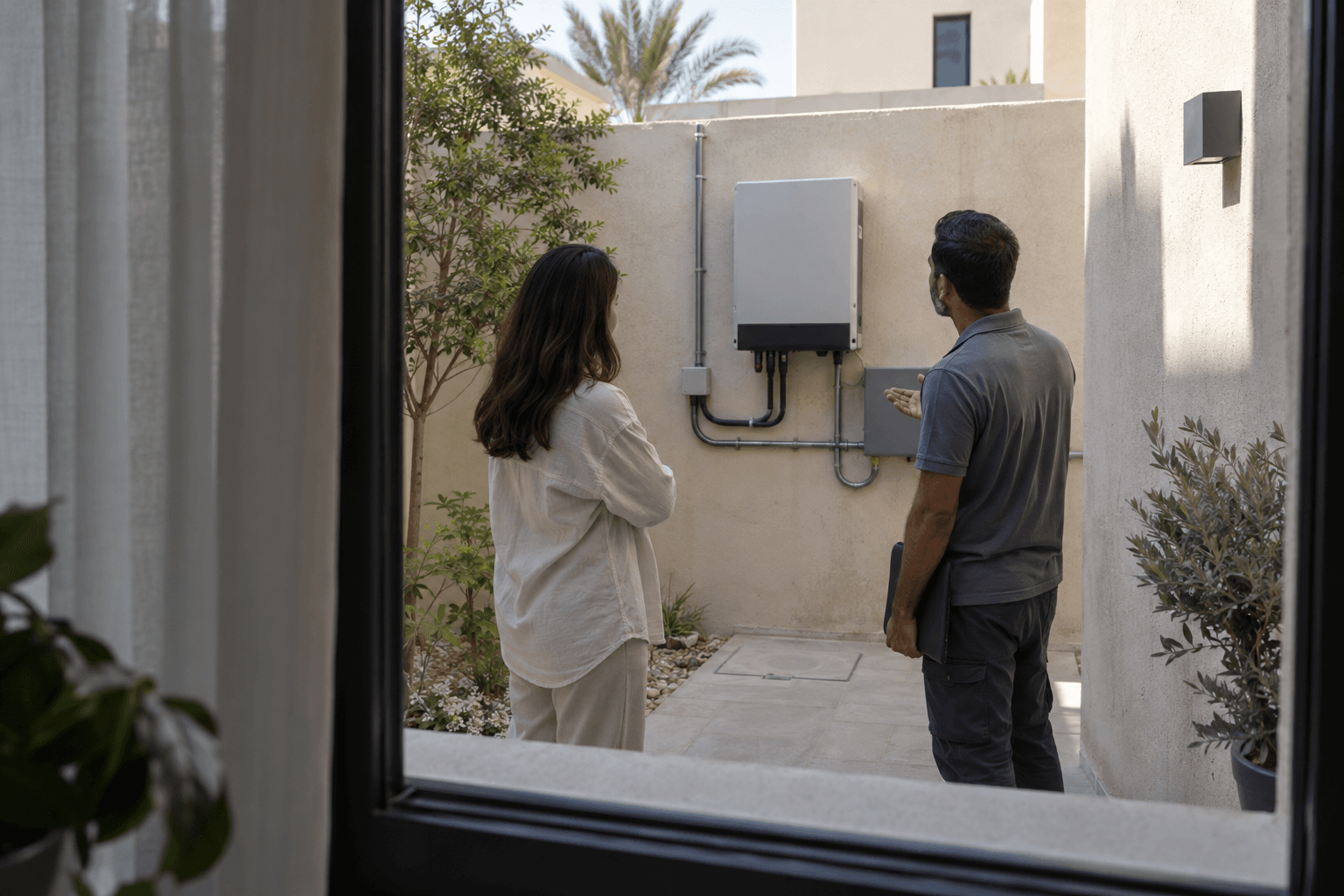
Choose the location before signing, not when the installation crew asks which wall is free. Ask the designer to mark the inverter on the property layout and walk through the nearby spaces with you. Identify bedroom and office walls, windows, outdoor seating and the neighbouring property's sensitive areas. Treat distance from those spaces as a design question, not a universal minimum-clearance rule.
The Fronius Symo GEN24 6–10 kW / Plus instructions say that the inverter can produce a slight noise during certain operating phases and should not be installed in an occupied living area. Check the instructions for the exact product being quoted; citing another model's manual does not establish suitability or DEWA eligibility.
A bedroom or home-office wall: flag it for an alternative-location review, especially where a lightweight wall could transmit vibration or a nearby window opens towards the unit. Do not assume outdoor mounting makes the noise irrelevant indoors.
A shaded service-area wall: ask whether it provides the manufacturer's required support, ventilation, clearances and safe access while separating the unit from regularly occupied spaces. “Service area” alone is not a technical approval.
A garage or utility room: review heat build-up, ventilation, access and stored materials. A room that looks convenient on the drawing can still be unsuitable for the selected equipment.
An exposed outside wall: assess sun protection and manufacturer environmental limits as well as noise. Moving the inverter away from a bedroom does not justify putting it in direct sun.
DEWA's published connection guidance requires measures to prevent extra inverter heating outdoors, including protection against direct sun. The practical design goal is therefore a location that works for both household comfort and equipment cooling. Your installer must resolve the electrical route, manufacturer instructions and applicable approval requirements together.
What to request when comparing noise specifications
A number labelled “typical noise” is not automatically comparable with a figure labelled “sound pressure level”, nor is either a promise about what you will hear inside your home. Request the manufacturer's original document and ask what operating condition and measurement basis the stated value represents.
Use these five questions in your itemised solar quote comparison:
What is the exact inverter model, and does it use a cooling fan?
What noise information does its manufacturer publish, and what conditions does that information cover?
Which wall is proposed, and what is on the other side or beside it?
How will the design preserve shade, ventilation, clearances and service access without creating a noise problem?
What review and remedy process is included if the installed unit causes an unexpected disturbance?
If the supplier offers a visit to a similar installation, use it as a practical listening check, with the occupier's permission. Record the model, location and operating conditions. A quiet unit at light load in mild weather is not evidence that the proposed installation will sound the same during a hot, high-output period.
Already installed and noisy? Gather evidence safely
Do not decide that the inverter needs replacing from the sound alone. Equally, do not dismiss a new or intrusive sound with “that is normal” before the maintenance provider has checked it.
Record when and where: note whether the sound is heard at the unit, through a wall, at a window or in another room, and when it starts and stops.
Capture the operating context: save the time, app power reading and any alarm or event message. Our safe inverter monitoring checklist helps separate current generation from a stale app reading.
Make a short recording from a safe location: keep clear of the equipment and do not open covers or approach exposed wiring. A phone recording can help explain the complaint; it is not a calibrated compliance measurement.
Describe the change: distinguish a familiar operating sound from a new rattle, repeated switching sound or a noise accompanied by alerts or lost generation. Ask the contractor to identify the cause rather than treating this list as a diagnosis.
Request a written finding: ask whether the source is normal operation, mounting-related transmission, cooling maintenance or a fault, and what manufacturer-supported remedy is proposed.
If there is smoke, a burning smell, visible damage or another apparent safety hazard, keep people clear and seek urgent professional assistance; use emergency services for immediate danger. Do not keep approaching the unit to collect better evidence.
Noise fixes that should not become owner DIY
Do not cover the inverter, obstruct vents, add an improvised acoustic box, disable fans or change operating settings to make it quieter. Ask the qualified contractor whether a revised mounting arrangement, an alternative location or manufacturer-directed maintenance is appropriate. The remedy needs to preserve cooling, safety, warranty conditions and the accepted system design.
DEWA's Connection Conditions, version 4.1, require all critical maintenance, including repairs and equipment replacements, to be performed only by a DEWA-enrolled Electrical and DRRG Solar PV Contractor. Keep electrical and equipment changes with that provider. Do not assume a relocation or replacement is exempt from project-specific design or approval checks.
After a remedy, request the dated service finding, work performed and any updated location or equipment record. Retain them with your solar owner handover pack, and agree how the contractor will confirm the complaint is resolved under representative operation.
A short siting request to send your installer
Please identify the exact inverter and its manufacturer noise information, mark the proposed location, and assess nearby bedrooms, offices, windows and neighbouring occupied spaces. Confirm the mounting surface, shade, ventilation, clearances and access requirements. Include the process for investigating an unexpected noise complaint and explain any proposed remedy before changing the equipment or accepted design.
If you are still planning the installation, compare Dubai solar proposals with the inverter location specified. The cheapest time to discuss an intrusive sound is before the wall has holes in it.
Primary manufacturer instructions and DEWA documents checked on 13 October 2026. Siting and complaint checklists are editorial recommendations, not a noise-limit ruling or electrical working procedure. Manufacturer examples do not establish UAE product availability or eligibility.
Hero image: AI-generated illustrative scene, not a real customer property or an approved installation design.