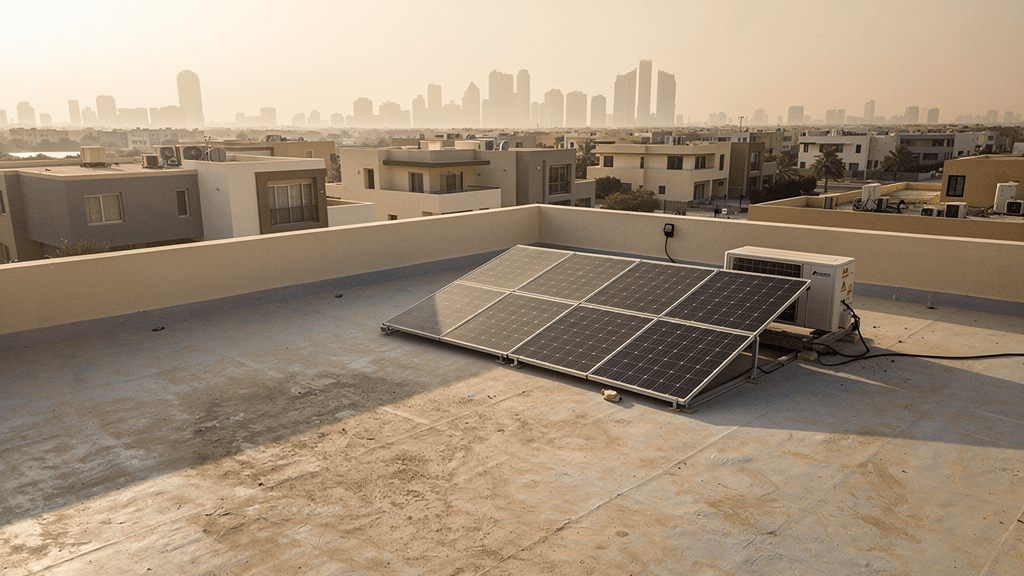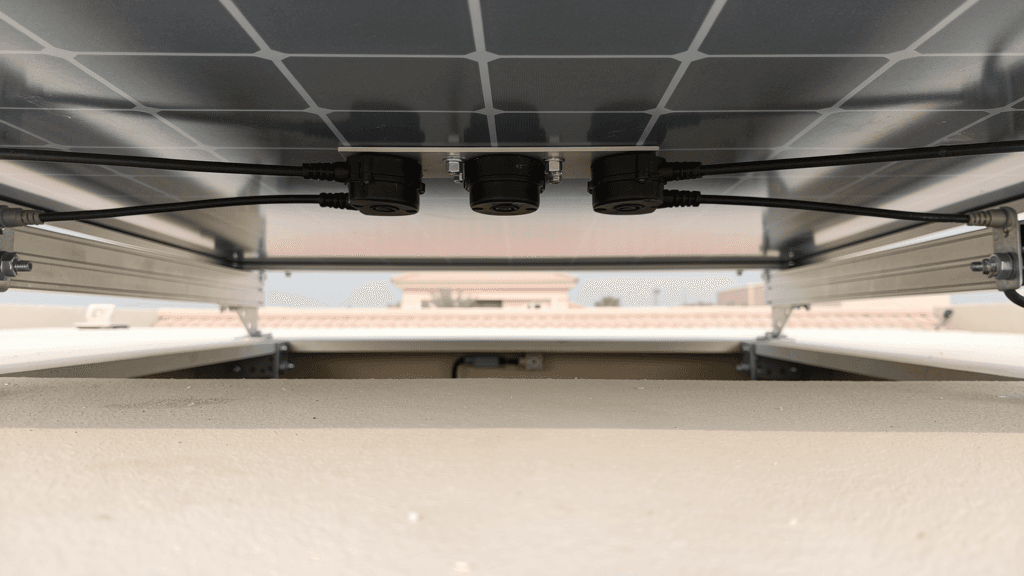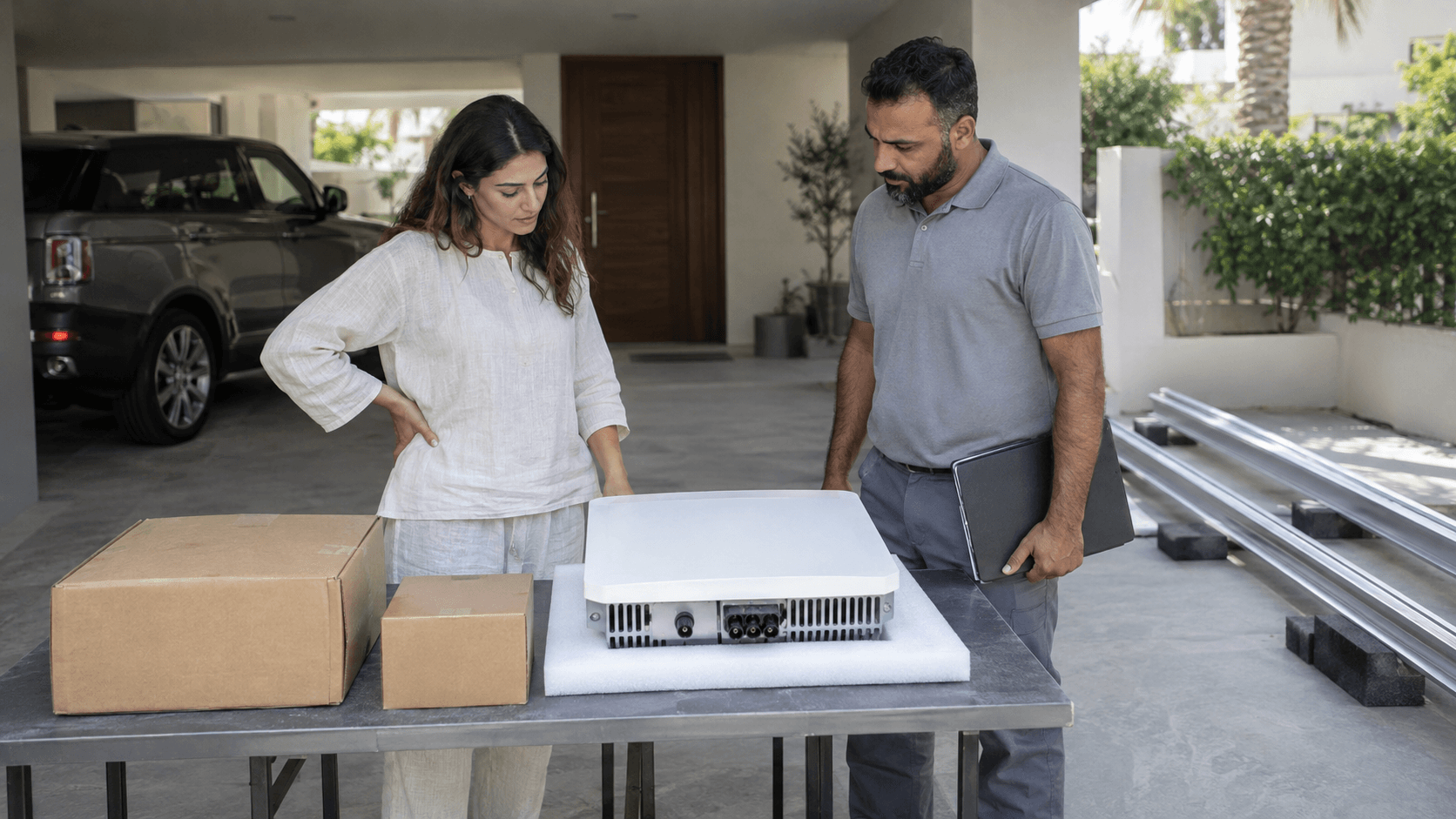
Illustration: an owner and contractor checking delivered solar equipment, not a real customer or delivery.
A sensible solar installation payment schedule in Dubai defines what you receive before each instalment becomes due. Before signing, separate the deposit, design and approval work, equipment delivery, installation, grid connection and owner handover. Ask for evidence for each trigger and written treatment of delays, rejected approvals and cancellation. A percentage split alone does not tell you whether a proposal protects you.
This guide is for a Dubai villa or business property owner buying a DEWA-connected rooftop system outright. It offers questions to negotiate before entering a contract, not a statutory payment schedule, a recommended deposit percentage or permission to withhold money already due. Solar leases and PPAs have different payment mechanics.
The question is not just “how much deposit?”
A contractor may need an advance for design work or equipment procurement. The useful question is what that advance commits the contractor to deliver, what has been checked before ordering, and what happens if the proposed system cannot proceed.
Two similarly priced proposals can leave you with different exposure. One may require most of the price before equipment reaches the property; another may link more of it to identifiable deliveries and completed work. Neither structure can be judged from the headline price alone. Start with the 12 line items that make solar quotes comparable, then examine when you will pay for that scope.
Ask each bidder for the amount due at every stage, the evidence that makes it due, and the cumulative amount paid at that point. Compare the cash exposure with the work and equipment you can actually identify. Do not accept “standard terms” as an explanation of an undefined milestone.
Keep utility approval separate from commercial payment
DEWA's Getting Solar Permits & Connections service distinguishes an application reference, approval, inspection results, and meter installation with solar connection activation. Only an enrolled solar consultant or contractor can submit the application. These are useful evidence points, not a DEWA-prescribed schedule for paying your installer.
The service bundles the Solar NOC and Solar Connection application. An application reference confirms submission; it is not the approved Solar NOC or design approval. Similarly, a requested inspection is not a passed inspection, and a scheduled meter visit is not activation.
DEWA states that the service application is free, but its journey also includes an estimate, an invoice and connection-invoice payment where applicable. Ask the installer to distinguish its own application-management charge from authority charges, identify what is included in the purchase price, and supply the actual authority invoice and payment evidence. “Free application” does not mean every connection-related cost is zero.
A milestone-to-evidence checklist to negotiate
The following is an owner comparison tool. It is not a mandatory sequence or a claim that every project must have six separate invoices. Agree the stages appropriate to your property and put them into the signed scope.
Deposit or paid design stage. State the scope purchased now: survey, design, application work or procurement. Request a dated deliverable and a deadline. Before a non-refundable equipment commitment, ask what feasibility and property-permission checks remain unresolved, who is responsible for them and how the advance is treated if they fail.
Design and approval milestone. Identify the exact approved document or status that triggers payment. Request the property-specific Solar NOC and design approval where that is the agreed trigger. List any separate property, community or competent building-authority permission still needed for your actual project; do not assume a DEWA approval resolves every other permission.
Equipment procurement or delivery. Distinguish “ordered”, “delivered to the contractor's warehouse” and “delivered to my property”. If paying before site delivery, ask for evidence of the named equipment allocated to your project, the agreed delivery date, storage and insurance responsibility, and what the contract says about ownership and cancellation. A purchase order is not site delivery. For a delivery trigger, request a delivery record identifying models and quantities, with serial records where available. Do not inspect a roof or handle electrical equipment yourself.
Physical installation complete. Define the included work and what counts as completion: mounting, agreed roof interfaces, cabling, equipment installation and required contractor checks, as applicable. Record any outstanding items and who will close them. Installed panels do not by themselves establish grid connection or useful operation.
Inspection and connection. If payment depends on approval, request the relevant inspection outcome, not merely the booking. DEWA's journey allows an approved result or a snag list, with rectification and resubmission if needed. If the trigger is connected operation, name the connection-activation evidence and any applicable tests. Ask your enrolled contractor to identify project-specific testing requirements, especially for larger business systems.
Commissioning and owner handover. Define the contractor's commissioning evidence, your working monitoring access, warranty records, maintenance arrangements and the close-out list. Use the Dubai solar owner handover checklist to specify the pack. If you want a final balance tied to that pack, negotiate it before signing, rather than inventing a new condition afterwards.
What happens if approvals or the project stall?
A schedule can be clear about successful work and silent about failure. Before paying, request written answers to four scenarios:
The proposed design is not approved. Does the contractor revise it within the agreed price? What happens if a smaller system is the only workable option or the project cannot proceed? Which design costs are earned, which sums are refundable, and what evidence supports any deduction?
Permission or owner information is outstanding. State who obtains each required permission or document, by when, and whether procurement waits for it. Agree the consequences of owner-caused delay separately from contractor-caused delay.
Equipment is delayed or substituted. Define how delivery dates change, whether a substitution needs your written agreement, and how a changed price, warranty or generation estimate is handled. “Equivalent” needs a specification, not just a reassurance.
Installation fails inspection or connection takes longer. Allocate responsibility for rectification, repeat visits and any additional cost. Separate an installer's unfinished work from a utility scheduling delay. Agree the notification and escalation process and any cancellation or long-stop provision, rather than assuming an automatic refund.
DEWA publishes stage delivery times on its service page. Those entries are not a complete installer-to-owner construction programme: your contract also needs to address design revisions, procurement, property permissions, site work and rectification. Ask for a dated programme with dependencies and responsible parties, not an unexplained promise to switch on by a particular weekend.
For the wider utility journey, see our Shams Dubai application and connection walkthrough. Check current requirements with your enrolled contractor and DEWA; do not turn an estimate of elapsed time into a guaranteed completion date.
Separate final payment from long-term performance
Releasing the final balance, accepting installation and obtaining a generation guarantee are different commercial questions. An annual generation estimate cannot be validated by a single sunny afternoon. If a proposal includes a contractual performance promise, ask for its measurement period, assumptions, exclusions, responsible party and remedy in a separate written clause.
Likewise, a long panel warranty is not a remedy for every installation or service problem. Define snag closure and workmanship cover separately, including who pays for a return visit. Our guide to who pays solar warranty repair labour explains why an equipment warranty and a service commitment should not be treated as the same promise.
Copy this request into your quote comparison
Please provide a payment schedule showing each amount, its due date or milestone, the evidence that makes it due and the cumulative amount paid. Define application, approval, delivery, installation, inspection, connection and handover separately where relevant. State the treatment of advances if approval fails, the system changes or either party cancels; equipment allocation and ownership before delivery; responsibility for delays and inspection rectification; included authority charges; and the process for agreeing variations. Please attach the relevant terms before I accept the proposal.
If an installer combines stages, ask it to explain what evidence closes the combined milestone and what remains outstanding. Clear terms are more useful than forcing every bidder into an arbitrary percentage template.
The buying decision
Compare the amount you are asked to pay with the evidence and obligations you receive, not just the deposit percentage. A proposal is easier to assess when approvals, deliveries, activation, handover and failure scenarios have explicit treatment. Missing terms are a reason to ask for a revised proposal before signing.
If you are still choosing a system for your Dubai property, request solar quotes with defined payment milestones and send the same questions to the responding installers. Compare equipment, complete scope and commercial terms together; the cheapest headline price is only one part of the decision.
Official DEWA service guidance checked on 14 October 2026. The commercial checklist is editorial guidance, not legal advice or an assertion of automatic refund, retention or withholding rights. For a contract already signed, follow its terms and obtain qualified advice before changing payment arrangements. Hero image is AI-generated and illustrative.