TL;DR
DEWA caps a plot at 1,000 kW of PV, but that ceiling rarely bites. The real constraint is a sliding scale tied to your Total Connected Load (DEWA).
The most common reason an industrial project changes shape is structural: steel portal-frame sheds have little spare roof capacity, and an engineer must assess it before anything is ordered.
If you lease — JAFZA, Dubai Industrial City, Dubai South, DAFZA — landlord and zone consent plus lease tenure versus payback decides the deal.
You do not run any of this. DEWA requires DEWA-enrolled consultants and contractors, and a competent EPC handles submissions, drawings and inspections.
Rooftop solar on Dubai warehouses and factories is well established, the approval route is defined, and your installer does the regulatory work. You decide three things: how big a system your electrical connection allows, whether your roof can carry it, and — if you are a tenant — whether your lease runs long enough to matter. The diligence is real engineering work rather than a site survey with a clipboard. Here is what an operations director or facilities manager should know before signing.
The 1 MW cap is real, but rarely the binding limit
DEWA's Connection Conditions allocate PV capacity in slabs against a plot's Total Connected Load, defined as the sum of Approved Load for the consumption accounts you hold within that plot (DEWA).
Total Connected Load slab | Share of that slab available for PV |
|---|---|
First 100 kW | 100% |
100–200 kW | 75% |
200–400 kW | 50% |
400–600 kW | 25% |
Above 600 kW | 5% |
DEWA states the share "is 100% for the first 100 kW of TCL, and gradually decreases for additional TCL slabs in excess of 100 kW", and that this "implies that the Maximum Capacity of Renewable Generators connected by the Producer at a certain Plot cannot exceed 1,000 kW" (DEWA).
Apply that to real sites and the picture changes. A plot with 500 kW of connected load reaches 300 kW of allowable PV; a plot with 1,000 kW reaches 345 kW. Because everything above 600 kW contributes at only 5%, the 1,000 kW ceiling suits very heavily loaded plots, not a single shed. Those two figures are our arithmetic on DEWA's table rather than DEWA examples — your consultant runs the exact number.
Two related rules matter commercially. DEWA restricts PV "to self-consumption only, without any supply to third parties", and states generators "shall be installed on rooftops, facades and other existing structures" while "ground-mounted installations are not envisaged" — spare yard space is no substitute for roof area (DEWA). DEWA can also set a lower limit where justified by "technical limitations" in grid integration (DEWA).
Sizing an industrial roof? Request free quotes from installers covering Dubai and Abu Dhabi — one business enquiry, quotes direct from installers, no markup.
The commercial approval path, and who does what
Producers must "rely on DEWA-enrolled Consultants and Contractors for the design, installation and verification of the Renewable Generator" (DEWA). The difference from a villa is depth, not principle: submissions include connected load and maximum demand schedules per connection point, production in kWp and kWh per annum, and a DRRG Solar NOC form. Plants above 400 kW can connect via a new DEWA MV/LV substation (DEWA).
Stage | What happens | Who does it |
|---|---|---|
Feasibility and load check | Load and capacity calculation, roof review | DEWA-enrolled consultant or contractor |
Structural assessment | Roof capacity, purlins, mounting, wind uplift | Structural engineer appointed by the EPC |
Permits and application | DRRG Solar NOC, site and design plans, equipment details | Consultant or contractor |
Landlord / free zone consent | Modification NOC, building-owner NOC, zone permit | You; contractor prepares drawings |
Civil Defence input | Fire risk assessment for the PV plant | Consultant |
Connection fee estimate | DEWA issues the applicable fee estimate | DEWA to the consultant |
Installation | Mounting, modules, inverters, cabling, labelling | Contractor |
Inspection and metering | Site inspection, connection agreement, meter fitted | Contractor coordinates; you sign |
Generation | System energised, exports metered and credited | DEWA offsets the bill |
DEWA is explicit that "the consultant or contractor will act as your agent" (DEWA). Your duties are short: supply account and consumption data, sign the application and connection agreement, obtain landlord consent, pay fees.
DEWA's Shams Dubai FAQ describes a one-off connection fee currently set at AED 1,500, mainly covering the generation check-meter, and notes grid-integration equipment may be needed above 400 kW and charged within those fees (DEWA).
For a shorter early-stage decision tool, see our warehouse rooftop feasibility checklist.
Roof structure: the section that decides your project
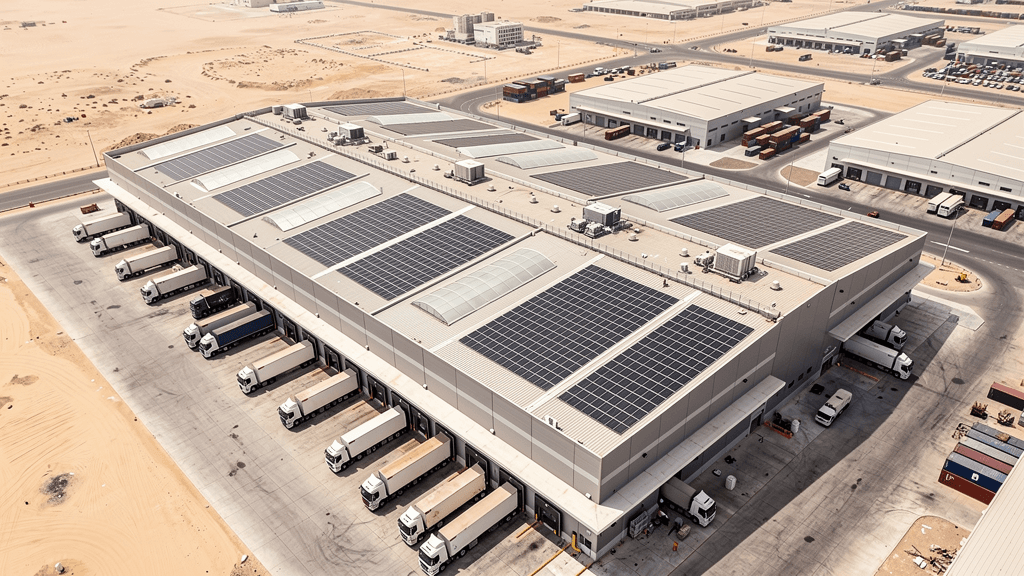
UAE logistics sheds and factories are overwhelmingly steel portal frames with profiled metal sheeting — designed to carry their own cladding and very little else. A UK structural practice specialising in PV roof assessments traces the load path from panel to mounting to sheeting to purlin to rafter to column to foundation, and notes purlins are "almost always the critical structural element in portal-frame solar PV assessments, rather than the primary frame" (Solar Surveys). That is UK practice rather than UAE code, but the physics travels.
DEWA is clear this must be engineered. Support structures "shall comply with applicable building code regulations and standards", modules "shall be rated for the maximum expected wind speeds in Dubai according to local codes", and "wind force applied to the PV array will generate a significant load for building structures" (DEWA). The Dubai Building Code covers changes to existing buildings, makes the Engineer responsible for superimposed dead loads, and states "loading plan drawings… should be submitted for approval" (Dubai Municipality). Adding an array is a structural change and is documented as one.
Wind loading on low-slope roofs
Dubai's wind code puts the basic wind velocity for Dubai at 30 m/s (108 km/h) on a 10-minute average, equivalent to 45 m/s (160 km/h) over 3 seconds, with a floor of 0.5 kN/m² for wind loads (Dubai Municipality). On a low-slope roof the problem is uplift rather than weight, and suction peaks at edges and corners.
Ballasted, mechanically fixed, or clamped to the seam
The Metal Construction Association defines "ballasted" as relying on gravity load, against "fixed" systems held mechanically or chemically, and notes ballast is more common on flat single-ply or built-up roofs. On metal roofs, modules can clamp directly to standing seams, eliminating rails, because concealed clips avoid penetrating the weathering membrane — adding as little as 15% of the rail weight (Metal Construction Association).
Three things decide the method: roof profile, whether penetrations affect the roofing warranty, and how much dead load the purlins accept. Ask which is proposed, why, and to see the structural report behind it.
Comparing EPCs on a live site? Get free commercial quotes — one enquiry, several approved installers, no obligation and no markup.
Usable area is smaller than gross roof area
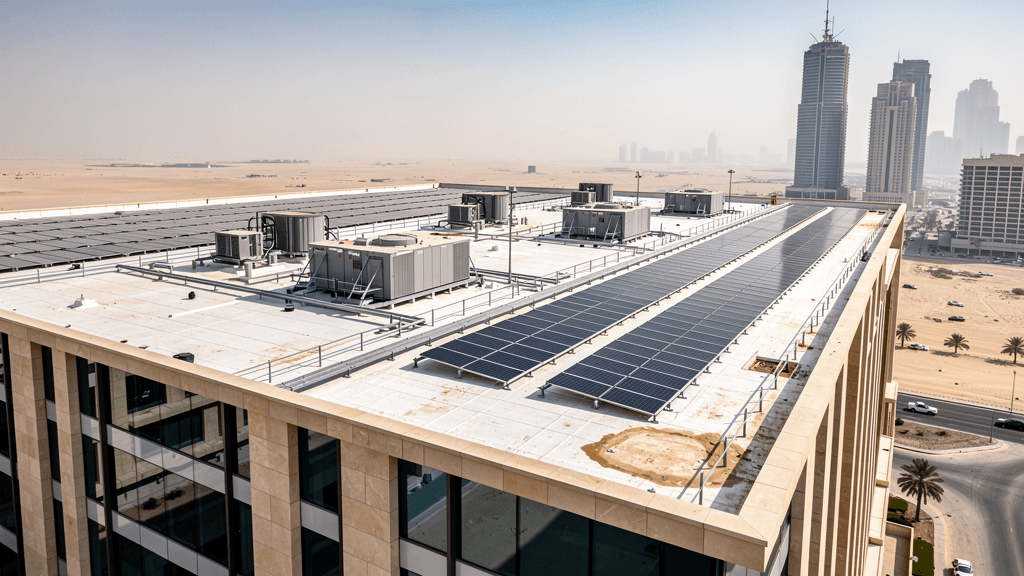
Nobody covers a warehouse roof edge to edge. DEWA's guidance says equipment "shall not cover any ventilation system on the roof, e.g. skylights, smoke extraction systems or chimneys", requires 1 m clearance from smoke extraction systems and 0.5 m from other openings, and sets a minimum module elevation of 50 mm. It also sets a minimum Class C fire rating for building-mounted modules and, for ordinary and high hazard buildings, manual emergency disconnection near external access plus a risk assessment for Civil Defence approval (DEWA). The UAE Fire and Life Safety Code of Practice is published by Civil Defence (Dubai Civil Defence).
Then add your own reality: chillers and AHUs and their shadows, ducting, roof hatches, walkways and future plant reservations. Insist the proposal shows an array layout over your roof plan, not a capacity derived from square metres. DEWA also recommends a minimum tilt of 10 degrees, since flatter modules collect more dust (DEWA).
Free zones and tenancy: raise this first
Most Dubai industrial occupiers do not own their roof. If you lease in JAFZA, Dubai Industrial City, Dubai South, DAFZA or a private estate in Al Quoz or DIP, the roof is the landlord's and the works need consent.
JAFZA requires a No Objection Certificate for "changes or upgrades to be done within and outside the leased unit", submitted via Dubai Trade with trade licence, modification permit, approved drawings and site photographs (Jafza). Its fit-out manual adds that major fit-out needs the JAFZA NOC, Civil Defence initial approval and TRAKHEES EHS and CED permits (Jafza Fit Out Manual).
In TECOM Group communities, which include Dubai Industrial City, the DDA building modification approval requires stamped and proposed drawings, an NOC from the building owner, an appointment letter, and structural calculations where applicable (Dubai Development Authority). Note the sequence: the owner's NOC comes before the authority reviews the design.
What none of these zones publishes is a standing tenant solar policy. JAFZA has announced operational net zero across DP World-owned and managed facilities but states this "does not include tenant emissions" (Jafza). We found no published tenant rooftop-solar policy for JAFZA, DAFZA, Dubai South or Dubai Industrial City, so treat consent as case-by-case and raise it early.
Then tenure. If your remaining lease is shorter than payback, capex is the wrong instrument however good the engineering. The fixes: extend the lease alongside the works, agree a landlord contribution or asset transfer at lease end, or go zero-capex.
Zero-capex routes: PPA, lease and ESCO
If the balance sheet or lease term rules out purchase, a power purchase agreement, equipment lease or ESCO arrangement lets a third party fund, own and operate the system while you buy the output. We cover the mechanics in our Dubai solar PPA and leasing guide.
One industrial point: DEWA ties PV to self-consumption without supply to third parties, and states renewable energy certificates "shall be self-redeemed, without any sale or transfer to third parties" (DEWA). Ask any counterparty to set out in writing how their contract sits with that rule and who holds the I-RECs.
Abu Dhabi: self-supply, not net metering
If your site is in KEZAD, Mussafah or ICAD, the framework differs in kind. Abu Dhabi's self-supply policy, effective 05/02/2026, covers PV with or without battery storage. This is not net metering, and the policy says so: export electricity is "metered separately from imported electricity and not subject to netting or offset", and "nothing in this Policy shall be construed as permitting net metering, cross-plot electricity sales, or any form of private wire arrangements unless explicitly authorised by the DoE". Its stakeholder annex also records "no new SS licenses for industrials consumers until threshold and framework approved", with a Self-Supply Committee to propose the framework (Abu Dhabi Department of Energy). The value case is avoided imports, sized to your daytime load — and industrial occupiers should confirm licensing status with DoE before building a business case around a date.
DoE's licensing guide sets an Instant Licence for up to 5 MWp at a single location, and a Self-Supply Licence above that with an AED 50,000 registration fee (Abu Dhabi Department of Energy). See our Abu Dhabi self-supply guide and the Dubai net metering explainer.
What it costs, and why industrial economics tend to be better
Neither DEWA nor DoE publishes commercial installation prices, so every figure in circulation is installer-published and indicative only — and two UAE sources give very different pictures. One puts commercial systems at AED 1.40–2.00 per watt installed, with 50 kW at AED 90,000–105,000 and 100 kW-plus industrial systems from AED 170,000–195,000 (Solar Panel UAE). Another quotes AED 200,000–280,000 for 50 kWp, AED 800,000–1.1m for 250 kWp and AED 2.8m–4m for 1 MWp (Quicknet). Those do not reconcile — roughly AED 1.80/W against AED 4.00/W at the same size — which shows how much scope, mounting method, roof condition and component tier move the number. Get itemised quotes on the same specification rather than using a per-watt rule of thumb.
What is structurally in your favour is load coincidence. DEWA puts summer peak-load hours in Dubai at 12:00 to 18:00 (DEWA) — the same window a single-shift warehouse runs lighting, chillers, compressors and materials handling, so generation lands on top of your own consumption rather than being exported. Where exports do occur, DEWA credits them with indefinite rollover, deducted before tariff slabs and fuel surcharges; producers are not paid money for surplus (DEWA). More detail in our commercial solar costs and payback guide.
Questions to ask before you commit
Lease tenure. Years remaining including options, does payback fit inside it, and do we have written landlord and zone consent?
Roof age. What is the sheeting's remaining life? If it needs replacing in seven years, who pays to remove and refit the array, and what happens to the roofing warranty?
Structural report. Who is the appointed engineer, and will we get a stamped assessment covering purlin capacity, dead load and wind uplift before procurement?
Metering and capacity. What are our Approved Load and Total Connected Load, what does the DEWA slab calculation allow, and has DEWA flagged a lower limit or extra grid equipment?
Layout. Can we see the array drawn over our roof plan with plant, skylights, smoke vents and fire clearances marked?
Scope. Are the DEWA application, drawings, Civil Defence risk assessment, inspection coordination and commissioning in the price?
Frequently asked questions
Can a warehouse in Dubai install a 1 MW solar system?
Only if the plot's Total Connected Load supports it. DEWA confirms a 1,000 kW ceiling, but load above 600 kW contributes only 5% towards allowable PV, so most single sheds land far below (DEWA).
Do I need my landlord's permission for solar on a leased warehouse?
Yes, in practice. JAFZA requires an NOC for changes within and outside the leased unit (Jafza), and the DDA modification approval used across TECOM communities lists an NOC from the building owner among required documents (Dubai Development Authority).
Will a steel warehouse roof take solar panels?
Often yes, but it must be verified rather than assumed. Purlins are commonly the governing element on portal-frame sheds (Solar Surveys), and DEWA requires support structures to comply with the building code and be rated for Dubai wind speeds (DEWA).
Does rooftop solar affect fire compliance on an industrial building?
It has to be designed around it. DEWA's guidance prohibits covering skylights, smoke extraction systems and chimneys, sets clearances of 1 m and 0.5 m respectively, and calls for a risk assessment approved by UAE Civil Defence (DEWA).
How long does DEWA commercial solar approval take?
DEWA publishes no approval service level for commercial connections, so treat any quoted timeline with caution. What is defined is the sequence: permits, inspection and connection, then generation (DEWA).
Start with the load data, not the roof photo
Put three things in front of experienced commercial installers: twelve months of DEWA bills, your Approved Load, and a roof plan with plant marked. From that, a competent EPC can tell you what capacity the rules allow, what the roof will take, and whether purchase or a PPA fits your lease. To sanity-check who you are talking to, see our industrial installers buyer's guide.
Ready to compare? Request free quotes for your warehouse or factory — one enquiry, quotes direct from installers, no markup and no obligation. Commercial enquiries go to a limited number of installers, so expect focused responses.