TL;DR
Most underperformance in Dubai and Abu Dhabi is dust, heat or a new shadow — not a broken system. Rule out the cheap causes before assuming a fault.
Summer output per kWp is lower than the sunshine suggests. PVGIS models a 12.4% loss from temperature and low irradiance on a Dubai array (PVGIS, European Commission JRC).
Your DEWA bill shows net energy, not generation. Comparing it to your inverter app without knowing that makes a healthy system look broken (DEWA).
In Dubai you are already required to hold a maintenance contract with a DEWA-enrolled solar contractor, and critical repairs must be done by one (DEWA). That contractor is your first call, not your last resort.
Gather monitoring exports, photos and dates before raising a claim. Evidence turns a disputed conversation into a straightforward process.
If your solar system feels like it is producing less than it should, the odds are in your favour: the cause is most often cheap, physical and fixable in an afternoon. Dust, a new shadow, a hot inverter cutting back, or a misread bill account for the bulk of "my system is broken" calls.
Real equipment failure exists, and this guide covers it. But rule out the mundane causes first, in order of likelihood and cost. You do not need to become a solar engineer — you need a diagnostic order, a benchmark, and a record of what you observed. Work down the list and stop when the numbers recover.
Step 1: Establish what "enough" actually means
The measure to use is specific yield — kilowatt-hours per kilowatt-peak installed, per year. Divide annual generation by system size in kWp and you have a comparable number. Using the European Commission's PVGIS tool, a 1 kWp array in Dubai at its optimal tilt of 26 degrees models at roughly 1,722 kWh per year, and one in Abu Dhabi at 30 degrees at roughly 1,753 kWh per year, assuming 14% system losses (PVGIS). A 10 kWp Dubai system therefore sits in the region of 17,000 kWh a year in a modelled, unshaded, well-maintained case.
Treat that as a reference point, not a promise — it is a model, not an official UAE figure. DEWA separately states that a south-facing array at about 24 degrees in Dubai receives annual irradiation of around 2,100 kWh per square metre (DEWA). Within roughly a tenth of your modelled figure, you probably have no fault. Thirty or forty per cent below it, something on this list is happening.
Step 2: Dust — check this first, every time
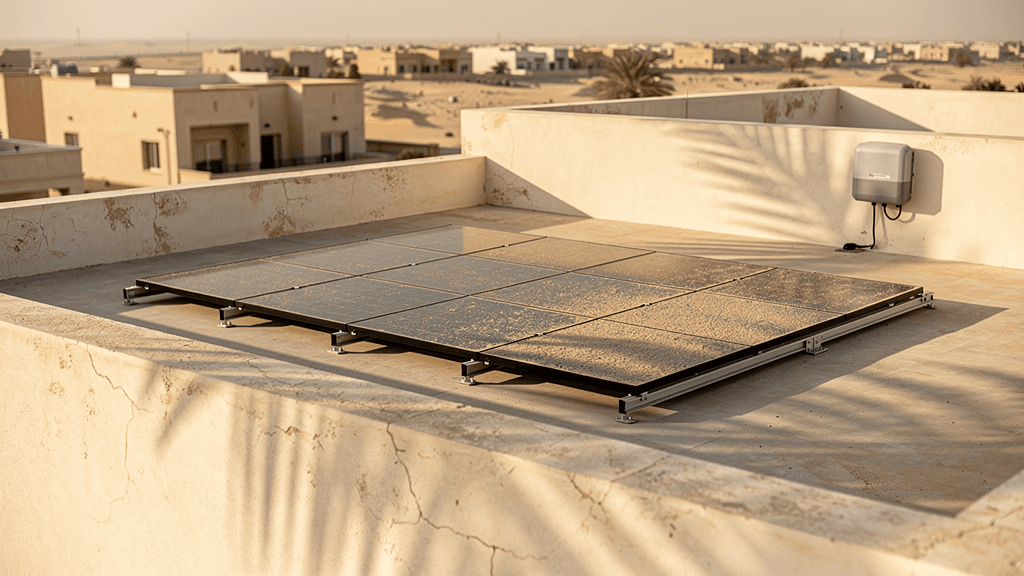
Soiling is the dominant Gulf-specific reason a healthy system underdelivers. The IEA PVPS Task 13 soiling report records performance losses "in the order of 1% per day in some deserts" and recommends a minimum weekly cleaning cycle in dusty desert environments, with cleaning immediately after dust storms (IEA PVPS).
Regional measurement supports it. At QEERI's outdoor test facility in Qatar, fixed-tilt modules showed an average soiling rate of 0.49% per day and around 13% loss in a month with no rain and no cleaning (PV Tech). A UAE field study measured 12.7% soiling loss over five months of outdoor exposure, with flatter modules collecting far more dust than steeply tilted ones (UAE University). DEWA is blunt about it: dust deposits reduce panel efficiency noticeably, Dubai is prone to dust accumulation, and panels should be cleaned frequently (DEWA).
The test is simple. Log a week of output, have the array professionally cleaned, log the next comparable week. Our guide to solar panel cleaning in Dubai covers frequency and safe methods.
Thinking about remediation or extra capacity? Request free quotes from installers covering Dubai and Abu Dhabi — one form, no markup, no obligation.
Step 3: Heat — why June is not your best month
Module power falls as cell temperature rises. A Jinko Tiger Neo N-type module lists a temperature coefficient of Pmax of −0.30% per °C, with a nominal operating cell temperature of 45 ± 2 °C (JinkoSolar). Rated power is measured at a cell temperature of 25 °C (JinkoSolar warranty). On a July roof, cells run far above that, and every degree costs 0.30% of nameplate power.
At system level, PVGIS attributes a 12.4% loss to temperature and low irradiance for Dubai and 10.5% for Abu Dhabi (PVGIS). Modelled monthly output for a tilted Dubai array is therefore close to flat across the year, with June landing slightly below March and October despite far more sun.
A summer dip in kWh per kWp is physics. A summer dip that never recovers in autumn is not. Component choice matters here — see choosing components for UAE heat.
Step 4: Seasonal variation versus a real fault
Compare like with like: this month against the same month last year, or your array against a similar neighbouring array. Not June against February, and not one cloudy Tuesday against your best day ever. Year-to-year variability is real — PVGIS reports a standard deviation of about 28 kWh on that 1,722 kWh Dubai figure (PVGIS).
A fault looks like a step change — output drops on a date and stays down — or a partial drop, where one string or MPPT input reads roughly half its twin. Seasonality looks like a smooth curve.
Step 5: Shading — small shadow, large loss
Shading losses are not proportional to shaded area. Because cells and modules are wired in series, power loss is significantly higher than the shaded fraction (IEA PVPS).
NREL measured a commercial array where 12.5% string shading coincided with a 30% morning power loss, and found that reducing one cell's irradiance by 25% can switch on a bypass diode and electrically remove a whole substring (NREL). IEA PVPS puts cumulative annual shading losses at 1–5% for well-planned systems, rising to 20–30% for some rooftop and façade installations (IEA PVPS).
On a Dubai or Abu Dhabi villa, the new arrivals are a neighbour's extension, palm fronds grown since commissioning, a satellite dish, a relocated AC condenser or a water tank. DEWA advises avoiding shadow on panels because it causes a significant performance drop and may damage the module (DEWA). Photograph your roof at 08:00, noon and 16:00 on a clear day — shadows show up instantly.
Step 6: Inverter behaviour, error codes and clipping
Open the app and read the event log before concluding anything. Manufacturers publish what their codes mean. Huawei's SUN2000 residential manual lists alarm 2063 for cabinet overtemperature from poor ventilation or high ambient temperature, 2034 for grid overvoltage, 2062 for low insulation resistance and 2011 for a reverse-connected string, and states the unit runs from −25 °C to +60 °C with derating above 45 °C (Huawei).
SMA explains the mechanism: derating begins once the permissible temperature on monitored components is reached, complete shutdown can occur in extreme cases, and derating is more common when the inverter is undersized relative to the array (SMA). Clogged heat sinks and fan guards make it worse.
So an inverter in an unventilated store room or in afternoon sun will cut back harder than the same unit in shade with airflow. And a flat-topped midday curve can be ordinary DC-to-AC clipping on a deliberately oversized array — worth confirming with your installer rather than treating as a fault. Repeated grid overvoltage events are a network and wiring conversation, not a panel problem.
Want a second opinion? Compare quotes from multiple installers for remediation, repair or expansion — free to use, quotes direct from the installers.
Step 7: String and DC-side faults
If output halved and stayed halved, suspect a dead string. On a two-string system, losing one input to a blown fuse, a tripped DC isolator or a failed connector shows as a partial, persistent drop. Connectors deserve particular attention in this climate. IEA PVPS documents cross-mating of DC connectors from different manufacturers as a frequent defect causing contact corrosion, burnt connectors, arcing and, commonly, no current flowing at all — problems that develop over time through rising contact resistance rather than appearing on day one, and that often show as hot spots under infrared thermography at an early stage (IEA PVPS). NREL's connector reliability work found field-installed homerun connectors have the highest failure rate of any category, with ground faults, burning and melting the most commonly recorded conditions in O&M tickets (NREL).
This is where you stop and call someone. In Dubai, critical maintenance including repairs and equipment replacements must be performed by a DEWA-enrolled Electrical & DRRG Solar PV Contractor (DEWA). That is protection, not an obstacle.
Step 8: Monitoring misreads and bill confusion
A real share of "underperformance" is a measurement problem. Either the monitoring gateway drops off the Wi-Fi and under-reports while the system produces normally, or the owner compares inverter generation against a DEWA bill and concludes the numbers do not add up.
Under Shams Dubai, they are not meant to add up. DEWA states that solar output is used on site first, only surplus is exported, exported units are credited against future bills rather than paid in cash, and the monthly bill reflects only the net energy consumed (DEWA). Surplus rolls over indefinitely, and exports plus carried-forward credits are deducted before DEWA's tariff slabs and fuel surcharges are applied, pushing residual consumption into lower slabs. Credits cannot transfer to a new owner or tenant if the property changes hands.
So your bill can fall while generation stays flat, and the reverse. Read the two separately. Our Shams Dubai net metering explainer walks through the bill line by line.
Abu Dhabi works differently. The Department of Energy's self-supply policy is not net metering. Export electricity must be metered separately from imports and is expressly "not subject to netting or offset"; net metering is not permitted unless explicitly authorised by DoE; and exports are allowed only where expressly authorised and licensed (Abu Dhabi DoE). Detailed metering and settlement guidelines are still to be issued, so if your Abu Dhabi bill treatment looks unclear, confirm it with DoE and your distribution company rather than assuming a Dubai-style credit. See our Abu Dhabi self-supply guide.
Step 9: Was the system ever big enough?
The least comfortable possibility is that nothing is broken — the system was sized to deliver less than the offset you were promised. Check the sizing assumptions in your original proposal against your actual consumption. If it assumed lower consumption than you really have, or an unshaded roof that is not unshaded, the shortfall is a design gap. The fix is an expansion, worth pricing against several installers rather than only the original one.
The diagnostic table
Symptom | Most likely causes | How to check | Who fixes it |
|---|---|---|---|
Gradual decline over weeks, recovers after rain | Soiling | Clean, then compare a week before and after | Cleaning service or AMC contractor |
Lower kWh per kWp in June–August, recovers in autumn | Temperature derating | Compare same month year-on-year | No fix needed — expected behaviour |
Sharp drop on one date, stays down | Failed string, blown fuse, tripped DC isolator, failed connector | Compare MPPT inputs in the app for one near zero | DEWA-enrolled solar contractor |
Output roughly halved and flat | One of two strings offline | Per-string current in monitoring | DEWA-enrolled solar contractor |
Morning or late-afternoon dip that worsened over a year | New shading — construction, palm growth, dish, AC unit | Photograph the roof at 08:00, noon, 16:00 | Installer — re-layout, trimming or optimisers |
Inverter shows fault or shutdown events | Overtemperature, grid overvoltage, low insulation resistance | Read the event log against the manufacturer manual | Inverter manufacturer via installer |
Flat-topped midday curve | DC-to-AC clipping | Compare inverter AC rating to array kWp | Installer — confirm design intent |
App shows zero, bill looks normal | Monitoring gateway offline | Check gateway Wi-Fi and last-seen timestamp | Installer, or reset it yourself |
Bill savings lower than expected, generation fine | Net metering misread, slab or consumption change | Read net figures, not gross | No fault — read the bill correctly |
Below modelled yield since day one | Undersizing or design mismatch | Compare proposal assumptions to actual use | Independent assessment, then expansion quotes |
Warranties: three separate things
Owners often say "it is under warranty" as if that were one document. It is three, plus your installer's own cover.
Module product warranty covers defects in the panel. JinkoSolar's limited warranty sets 144 months — 12 years — for its Tiger Neo series, and 300 months for certain N-type all-black modules (JinkoSolar).
Module performance warranty is separate and covers gradual power loss. The same document guarantees monofacial N-type modules at no more than 1% degradation in year one and 0.4% a year thereafter, ending at no less than 87.4% of nominal output after 30 years, measured at standard test conditions (JinkoSolar). Note the measurement basis: a hot, dusty panel producing less on a July afternoon is not a performance claim. Only a standard-conditions measurement is.
Inverter warranty is shorter. DEWA states inverters have a general warranty of 10 years (DEWA), and manufacturer terms differ. SMA offers a five-year factory warranty, a further five years free on registration for home inverters commissioned on or after 1 October 2021, and paid extensions to 10, 15 or 20 years (SMA). Check whether yours was ever registered.
Workmanship warranty covers the installation — mounting, cabling, connectors, labour. That comes from your installer, and its length is whatever your contract says.
In practice you claim through your installer for almost everything, since manufacturers process module and inverter claims through the installing contractor. DEWA states plainly that it is not responsible for substandard designs or installation delivered by enrolled consultants and contractors (DEWA), so your contract is the document that matters most.
What to gather before you complain
Walk in with this and the conversation changes character. Every item is an hour's work at most.
Monitoring export — daily and monthly kWh over at least 12 months, as CSV where the portal allows.
The date the drop started, and what changed around it: cleaning, a storm, construction next door, a power cut, an AC replacement.
Per-string or per-MPPT data, so a half-system fault is visible.
Inverter event log, with code numbers and timestamps.
Roof photographs at 08:00, noon and 16:00 on a clear day.
Close-ups of discolouration, cracked glass, browning cells or scorched connectors, taken from a safe position.
Original proposal and contract, including promised annual generation and the sizing assumptions behind it.
Commissioning and handover pack. IEC 62446-1 defines verification as inspection, testing and reporting, and lists string I-V curve measurement and PV array infrared camera inspection among its category 2 tests (IEC 62446-1:2016). Your original results are the baseline any new test is compared against.
Twelve months of DEWA bills, or your Abu Dhabi equivalent.
Maintenance contract and every visit report.
Your AMC is doing more work than you think
In Dubai this is not optional, and that works in your favour. DEWA's connection conditions require the producer to hold a valid maintenance contract with a DEWA-enrolled Electrical & DRRG Solar PV Contractor, and to ensure routine general maintenance at least once a year including panel cleaning (DEWA).
The required 12-monthly scope maps almost exactly onto the faults above: visual checks of panel condition and obstructions, tightening of mounting structures and string cables, inverter preventive maintenance and air filter replacement, inverter electrical performance testing, string-level voltage and current testing, verification of fuses, insulation resistance measurements, verification of system performance to detect failures, and a written report documenting findings with pictures (DEWA).
If you hold those reports, you have a documented history. If you do not, booking the AMC visit is the fastest route to a diagnosis. Our solar maintenance cost guide covers what these contracts include.
When to bring in an independent assessor
Most installers investigate their own work properly — warranty claims are routine business, and a competent contractor would rather fix a fault than argue about it. Start with yours. An independent second opinion earns its cost in narrower cases: your installer has attended more than twice without resolving it, the disagreement is about system design rather than a component, the original installer is no longer trading, or you are preparing a formal claim and want results that did not come from the party being claimed against.
What you are buying is measurement — string I-V curve tracing and infrared thermography under IEC 62446-1's category 2 tests, producing a report you can hand to a manufacturer (IEC 62446-1:2016). In Dubai, the test engineer performing DRRG testing must be a contractor, consultant or licensed engineer certified by DEWA (DEWA), so check credentials before booking.
Frequently asked questions
Why is my solar output lower in summer in Dubai?
Module power falls as cell temperature rises. A Jinko Tiger Neo module loses 0.30% of rated power per °C above the 25 °C standard test condition (JinkoSolar), and PVGIS models a 12.4% temperature and low-irradiance loss for a Dubai array (PVGIS). A dip that recovers in autumn is expected.
How much output do dirty panels lose in the UAE?
Enough to matter. IEA PVPS records desert performance losses in the order of 1% per day in some environments and recommends at least weekly cleaning in dusty desert conditions (IEA PVPS). A UAE study measured 12.7% soiling loss over five months of exposure (UAE University).
My DEWA bill did not drop as much as expected — is the system faulty?
Not necessarily. DEWA bills the net amount of energy consumed after exports and carried-forward credits are deducted, and those deductions are applied before the tariff slabs (DEWA). A change in your own consumption can mask solid generation. Compare inverter kWh year-on-year first.
Does a shadow on one panel really matter?
Yes, disproportionately. Because modules are wired in series, power loss is significantly higher than the shaded area (IEA PVPS). NREL recorded a 30% morning power loss at a site with 12.5% string shading (NREL).
How long is an inverter covered?
DEWA puts the general inverter warranty at 10 years (DEWA), though manufacturer terms differ and some require registration. SMA provides five years as standard with a further five free on registration for qualifying home inverters (SMA).
Your next three moves
Book a professional clean and log a week of output either side of it. Pull your inverter event log and per-string data. Photograph the roof at three times of day.
If that restores your numbers, you are done and it cost very little. If it does not, you now hold exactly the evidence pack your installer, AMC contractor or a manufacturer needs, and the claim becomes a process rather than an argument. And if the honest answer is that the system is simply smaller than your consumption warrants, treat it as a sizing question rather than a failure, then price the expansion properly.
Ready to fix it or grow it? Get free comparison quotes for repair, remediation or expansion from installers working across Dubai and Abu Dhabi. One form, quotes direct from installers, no markup and no obligation.