TL;DR
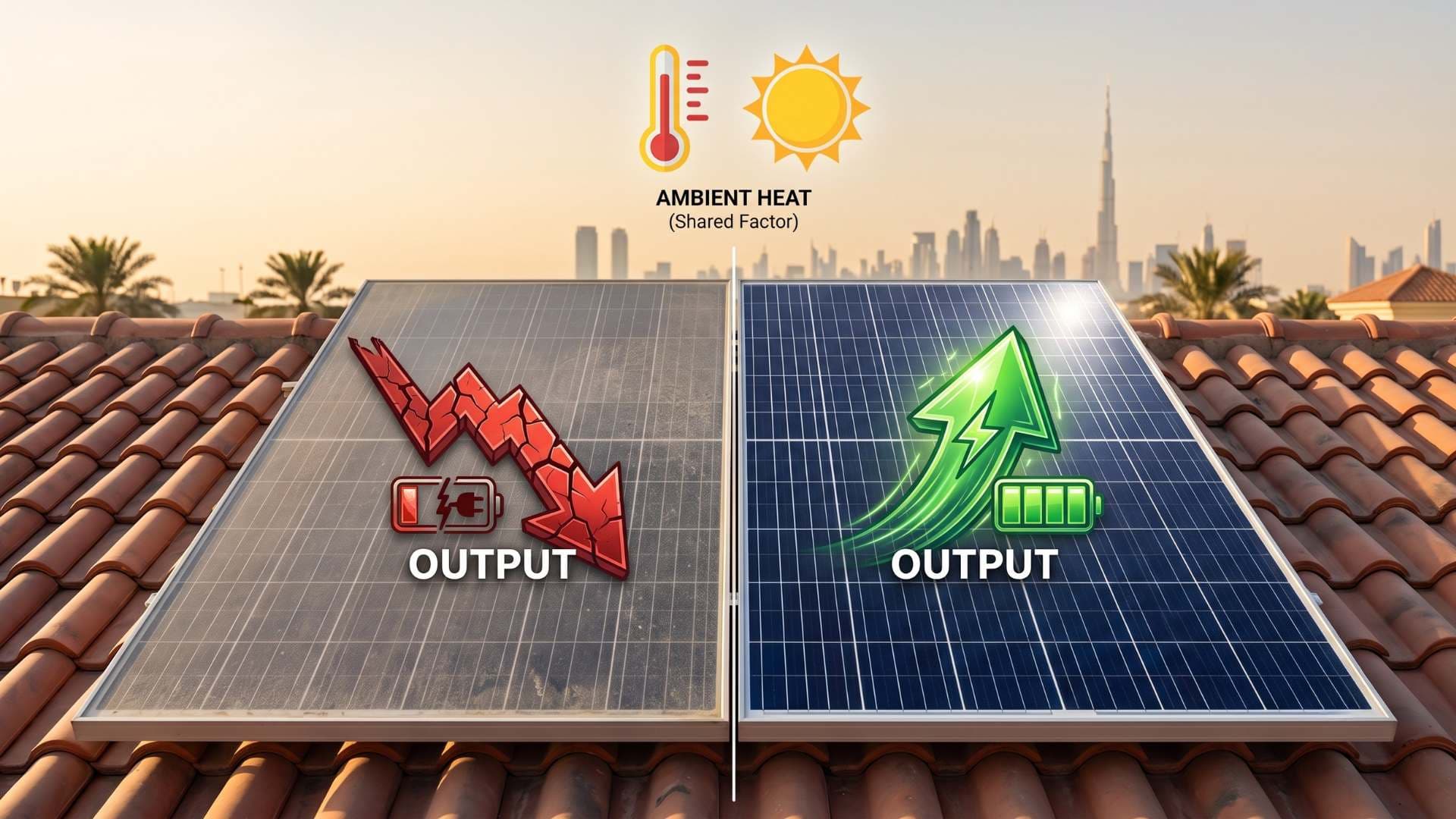
Two separate mechanisms cost you output — and only one is fixed by cleaning. Dust soiling is reversible; high-heat derating is physics and is not.
UAE-specific studies are real and peer-reviewed. A Sharjah study measured ~8.5% output loss over 41 days and recommended cleaning "every two weeks" (IJECE 2021). A KAUST model puts Arabian Peninsula soiling at ~12% per week (IEEE 2023).
Heat stacks on top. In UAE summer, cell temperatures hit 65–80°C, causing a ~20–28% efficiency drop versus standard test conditions (IASJ 2025) — and cleaning does nothing for this.
Forum figures (5–50% loss) are anecdotal, not engineering data. Treat them as user reports, never as verified specs.
Practical cadence: roughly monthly to quarterly for villas, with a clean within 72 hours of any sandstorm (DubaiClean). Professional cleaning runs ~AED 150–400 per session (market estimate).
Two losses, only one you can wash off
Most "solar panels get dirty" articles muddle two distinct effects. They behave differently, and confusing them leads to bad maintenance decisions.
1. Dust soiling — reversible
Dust accumulating on the glass blocks light and cuts output. It builds up fast in the UAE, and it is fully reversible: clean the panel, recover the loss. A Qatar/Gulf-focused study from Hamad Bin Khalifa University frames the two together: "two major environmental factors affect drastically the performance of photovoltaic (PV) panels in the Gulf region, namely the dust accumulation (soiling) and the temperature-induced voltage decrease leading to a power loss" (HBKU, 2016).
2. Heat derating — physics, not dirt
Solar cells lose efficiency as they get hot. This is the temperature coefficient (a negative %/°C figure on every datasheet). It is not caused by dust and is not fixed by cleaning — it happens whenever the cell is hotter than the 25°C standard test condition. In a UAE summer, that's always.
Knowing which is which matters: if your output drops in July and you clean the panels and it barely recovers, the culprit is probably heat, not dust.
What the UAE and Gulf studies actually show (peer-reviewed)
These are the figures to anchor on — labelled by evidence type.
Sharjah, UAE (IJECE 2021) — peer-reviewed:
Loss rate: "the power losses are linearly related to the dust accumulated density… with a slope of 1.27% per g/m²."
Outdoor result: "the absolute reduction in output power increased by 8.46% after 41 continuous days with one low-intensity rainy day" (~0.21%/day).
Recommendation: "a regular cleaning process every two weeks is recommended to maintain the performance and to avoid the soiling loss." (IJECE 2021)
Sharjah, UAE (second study, 2023) — peer-reviewed:
Loss rate: "a linear relationship between the dust density and the normalized PV power with a drop of 1.7% per g/m²."
Outdoor: "the soiling loss increased by 12.7% while the dust density increased by 5.44 g/m² for a period over 5 months."
Cleaning recovery: "improvements in Pmax after cleaning ranged from 3.5% to 19.4%, with an average value of 9.8%." (2023 study)
Extreme case (heavy dust, 70 days no rain): "reduced the power production capacity by up to 58%" — this is an end-state, not a typical figure.
Arabian Peninsula (KAUST / Stenchikov et al., IEEE 2023) — peer-reviewed model:
"The average soiling losses over the Arabian Peninsula are accumulating at about 12% per week, while on the east coast, it reaches 30-35%." (IEEE 2023) — abstract-sourced; re-verify full text before quoting in formal material.
Other Gulf/desert benchmarks (peer-reviewed):
Saudi Arabia (Madinah): "28% of losses in output power… during 60 days of dust accumulation" (IJPEDS 2018).
100 MW desert plant: losses "from ~2% to ~16%" across dusty vs least-dusty months; "up to 13% of power losses… for panels that remained dusty for 3 months," down to 4% with 15-day cleaning (Semantic Scholar PDF).
Kuwait: monthly losses without washing of 8.7–15% depending on month (Bunyan et al., SGRE 2016).
Global benchmark: the IEA estimates soiling causes a "loss of annual solar energy production of 3 to 5 percent worldwide, and arid regions like the UAE are hit hardest" (IEA PVPS, via Twin Cleaners Dubai).
The honest synthesis: peer-reviewed Gulf data supports a roughly 8–17% loss over weeks-to-months without cleaning in normal conditions, with extreme prolonged no-rain conditions reaching 28–58%. The round-number "10–30% loss" you see in marketing is best read as the spread across these conditions, not a single verified villa figure.
The heat penalty that stacks on top
Manufacturer temperature coefficients (from datasheets):
LONGi Hi-MO 7 (TOPCon): −0.29%/°C (LONGi).
Typical ranges: HJT −0.24 to −0.26%/°C; TOPCon −0.29 to −0.32%/°C; Mono-PERC −0.34 to −0.40%/°C (SurgePV).
Peer-reviewed hot-climate measurement (Iraq, comparable to UAE summer):
"At peak summer temperature (ambient temperatures ≥45°C), the temperature of PV cells can reach up to 75–80°C, causing a reduction in efficiency in the range of 20–28% compared to STC" (IASJ 2025).
A composite-climate rooftop study found cell temps peaking at 64°C causing a "12.0% average daily efficiency reduction" and "maximum losses of 20.4% observed under combined thermal stress and soiling" (Scientific Reports 2025).
The key point for owners: in hot Gulf conditions comparable to a UAE summer, you can lose ~14% to heat alone (a −0.35%/°C panel at 65°C cell temp), before any dust is added. Cleaning won't recover that — it recovers only the soiling portion. This is why a freshly cleaned panel in August still underperforms its January output.
Forum-reported figures (use with care)
These are anecdotal user claims — present only as "users report," never as engineering data:
r/dubai (a solar installer commenting, 2019): "Once a month is more than sufficient" (r/dubai).
r/solar: "a decrease in power output ranging from 5% to 15% due to accumulated dust" (r/solar, 2025); "when they get dusty, their efficiency drops by about 10-15%" (r/SolarDIY); one user reported "30% to 50%" drops in a dusty LA climate (r/solar, 2022).
MIT (institutional, citable): "the accumulation of dust… can reduce the output of photovoltaic panels by as much as 30 percent in just one month" at utility scale (MIT News, 2022).
The commonly-repeated "10–30% loss without cleaning" framing is best supported by the lower-mid peer-reviewed range (~8–17% over weeks/months) plus MIT's 30%/month utility-scale figure at the top. Never present it as a single verified villa number.
Want a maintenance plan that fits your system? Get quotes from installers who understand total cost of ownership, not just the install. Get quotes →
How often should you actually clean in Dubai?
The practical UAE consensus: roughly monthly to quarterly for residential villas, more often during dust-storm season.
DubaiClean: summer (Jun–Aug) every 2–3 months; winter quarterly; and after each sandstorm in March, April, and September — "after any sandstorm, clean within 72 hours to prevent surface abrasion" (DubaiClean, 2025).
Twin Cleaners (Dubai): schedule around "the dustier parts of the year, particularly after spring dust storms and again before the peak summer cooling season," with "a quick monthly glance from the ground" (Twin Cleaners).
Peer-reviewed cadence: the Sharjah study recommends every two weeks (IJECE 2021); a desert cleaning-frequency study found 15-day cleaning most feasible, dropping losses to ~4% (Semantic Scholar PDF).
A practical read: heavier users and systems in dustier/exposed locations lean toward monthly; well-rained or sheltered setups can stretch to quarterly. The non-negotiable rule is post-shamal: clean within 72 hours of a dust storm. And note the paradox — "a single dusty shower can leave them dirtier than before" (Twin Cleaners), so rain is not a substitute for cleaning in the UAE.
Manual cleaning vs. automated robots
For a villa, manual professional cleaning is the realistic option. Robotic cleaning systems (like Ecoppia's water-free, self-powered robots) are utility- and commercial-scale — Ecoppia "signs first landmark deal in the UAE" and markets systems as "water-free and energy independent certified" (Gulf News). They're relevant to the C&I audience, not a villa.
Power-draw caveat: Ecoppia markets its robots as "energy independent" (solar-powered, water-free), implying negligible net grid draw, but no independent measured parasitic-power figure was found — a gap. For commercial operators considering non-self-powered systems, expect a small parasitic draw against the labour and water savings. Robot/cleaning-machine prices in the UAE range from ~AED 3,000 (handheld) to AED 80,000–250,000+ (autonomous utility-scale) per unit (fyind.com UAE — vendor listing, indicative).
What professional cleaning costs in Dubai
DubaiClean: "expect AED 150–400 per session depending on roof size and system complexity" for a ~20-panel system (30–60 min); DIY free–AED 30 (DubaiClean).
Twin Cleaners: solar cleaning is "custom-quoted by panel count and how often you want it done" (Twin Cleaners).
Best estimate: ~AED 150–400 per session (DubaiClean — a single published UAE range, so treat as a market estimate and confirm at quote stage). For context only, US pricing runs ~$5–15/panel (~$100–300 for 20 panels) (SolarReviews) — non-UAE, do not present as local.
The bottom line
Solar panels in the UAE get dirty fast because of dust soiling — and they underperform in summer because of heat derating. Cleaning fixes the first and does nothing for the second. Peer-reviewed Gulf data suggests you can lose ~8–17% to soiling over weeks-to-months without cleaning, recoverable with a regular clean (monthly to quarterly, plus a 72-hour post-storm rule). Heat adds another ~14–20%+ on the worst summer days that no amount of washing will recover. Budget ~AED 150–400 per professional clean, clean after every shamal, and don't panic when a freshly cleaned panel still reads low in August — that's physics, not dirt.