You may be able to add panels to an existing Dubai commercial solar installation, but unused roof space is not approval and a bigger electricity bill is not a design brief. Start by establishing what the operating system already produces, what capacity and equipment changes are permitted, and whether the extension earns its own return. Do not pay for new panels using savings that your existing panels already deliver.
This guide is for warehouse, factory and commercial property owners or authorised occupiers with an existing Shams Dubai installation. It covers a possible expansion within that framework, not a DIY modification or an automatic move to a different electricity arrangement.
First establish whether you need more solar or a repair
A bill can rise because the business uses more electricity, the system produces less, or both. Those are different purchasing decisions. Compare recent consumption and generation with a representative earlier period, allowing for operating hours, seasonal demand, shutdowns and changes to the building.
If output has fallen, commission a diagnosis and price restoring the current installation separately. Replacing failed equipment should not become an unexplained capacity upgrade. Our guide to inverter replacement versus a system change explains that boundary.
If the plant is operating as expected but you have added production machinery, refrigeration or another shift, ask for an expansion assessment using that new load profile. Distinguish an installed, operating load from a business-growth forecast. Have bidders show what happens if the forecast arrives later than planned.
Calculate the remaining allowance for the plot, not a fresh allowance for the extension
Section 2.2 of DEWA's Shams Dubai Connection Conditions, version 4.1 applies its capacity limit to the sum of the producer's renewable generators at a plot. The allowance depends on the applicable share of Total Connected Load, with a ceiling of 1,000 kW and any stricter technical limit DEWA specifies. An additional inverter does not receive a separate fresh allowance simply because it is new equipment.
Two distinctions matter when comparing offers:
Panel capacity and connection capacity are not the same measure. The conditions define Maximum Capacity by the maximum active power deliverable by the inverters on the AC side. Ask bidders to state the existing and proposed panel kWp, inverter AC capacity and combined totals separately.
A higher bill does not establish a higher Approved Load. Total Connected Load is based on DEWA-approved load for the relevant accounts, not a consumption figure selected from a bill or monitoring app. Ask the consultant to reconcile the accounts and actual approval records.
Request a written capacity calculation showing the current installation, all proposed additions and the remaining headroom, subject to DEWA confirmation. Do not assume that keeping the existing inverter's AC rating unchanged makes added DC panels exempt from design or compliance review.
Compare three scopes before selecting equipment
DEWA's Shams Dubai FAQ describes modular systems as potentially extendable. That is not a promise that any newer panel can be attached to any older installation. Use the following procurement comparison; these are practical options to investigate, not authority-defined approval categories.
Option | What the proposal must establish | What to price separately |
|---|---|---|
Keep the existing system | A credible no-expansion baseline, with required maintenance or fault repairs identified. | Necessary existing-plant work, rather than attributing its whole cost or benefit to the extension. |
Add modules using existing conversion equipment, if suitable | Manufacturer-supported compatibility, available input capacity, expected extra output and the project-specific compliance route. | New modules and mounting, design changes, associated electrical work, testing and any expected interruption. |
Add separately designed conversion equipment | How old and new equipment operate within one coordinated site design, aggregate capacity limits and the required connection arrangement. | Additional inverter equipment, protection, metering or monitoring changes, integration, approvals and commissioning. |
“Separately designed” does not mean outside DEWA's rules or entitled to a second generator under the same hosting account. The connection conditions state that one consumption account cannot host more than one Renewable Generator, while that generator can comprise multiple generating units. Have the consultant define the arrangement rather than treating the table as a wiring prescription.
For an older installation, ask the designer to check the exact existing equipment, manufacturer instructions, available records and condition. Do not accept “same brand” or “higher wattage” as the compatibility assessment. Owners should not open enclosures, disconnect modules or change protection settings.
Ask what changes across the whole operating plant
Section 2.7.1 of DEWA's DRRG Standards, version 3.0 requires compliance throughout the facility's lifetime and gives DEWA the right to request tests and simulations after modifications or equipment replacements that may affect compliance. That is not a published universal extension fee, timeline or exemption.
Before ordering, ask the enrolled consultant or contractor to identify the revised submissions, applicable authority permissions, inspection and testing requirements for the actual combined proposal. If unclear, obtain DEWA clarification. A previous approval records the previous project; it is not a blanket authorisation for additional work.
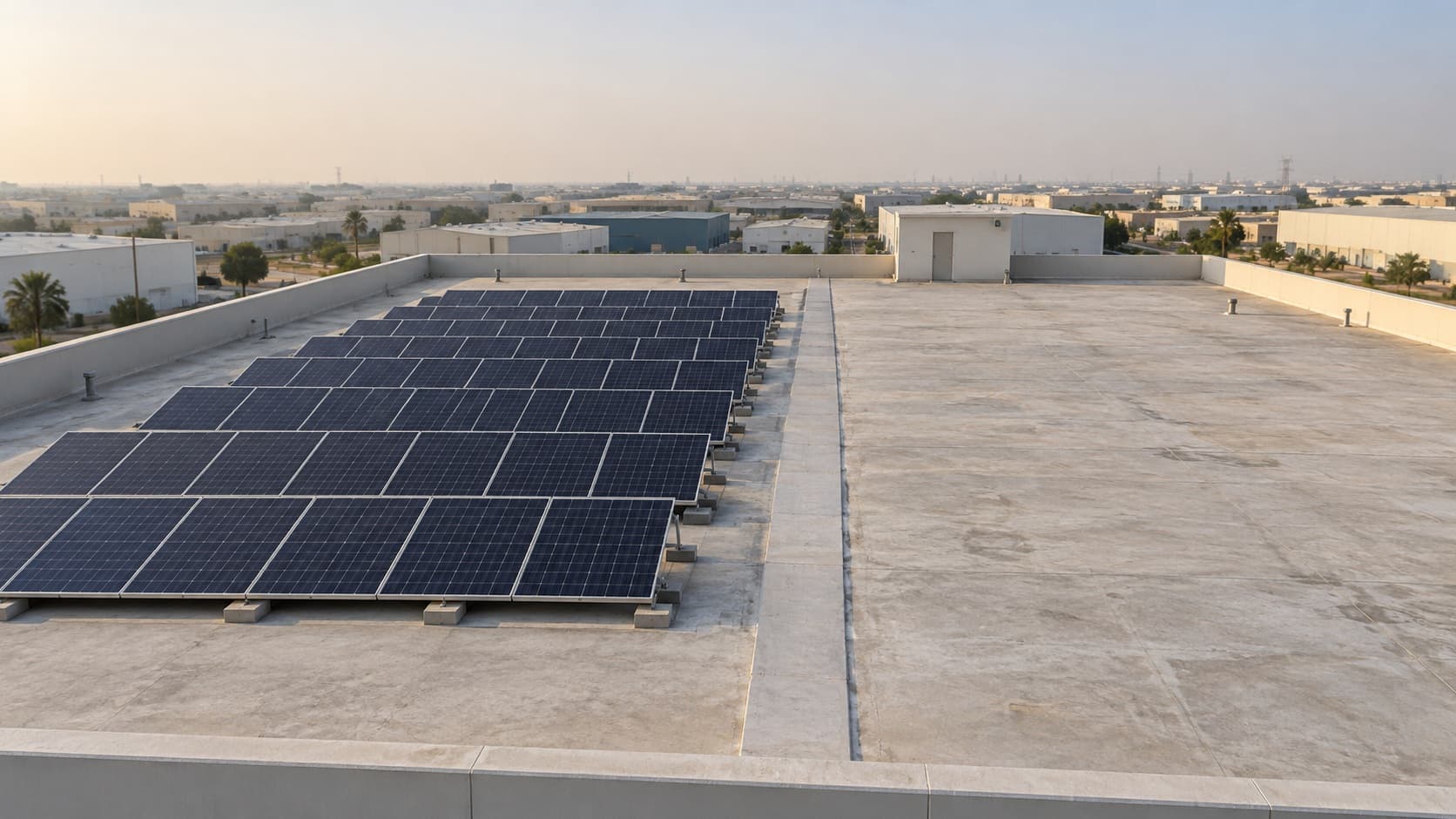
Also require a roof-and-access review that includes the existing array as well as the proposed area. Empty-looking roof can still serve drainage, equipment access, fire-safety or future maintenance needs. Our warehouse rooftop feasibility checklist sets out the wider assessment, but the new brief must show how the two installations fit together.
Ask who carries responsibility for the interface with existing roof warranties, mounting, equipment warranties and maintenance arrangements. Where another party owns the operating plant, obtain its agreement to the proposed changes before procurement. Do not assume a new installer's warranty absorbs the original installer's obligations.
Make the extra investment earn the extra savings
Request two projections using the same business demand and tariff assumptions: keep the existing system, and operate the existing system plus the proposed extension. Model generation, imported electricity, exports and banked credits month by month. Under Shams Dubai, surplus is a future consumption credit, not cash paid for exports. An accumulating credit balance therefore needs a realistic future-use explanation.
Incremental annual benefit means the difference between those two projections, less additional operating costs and any relevant lost existing-generation value. Do not multiply every new kWh by an assumed top tariff or add the old plant's savings to justify buying the extension. Keep tax and financing treatment consistent across the alternatives.
For illustration only, suppose an extension costs AED 60,000 and adds AED 12,000 of annual net savings compared with keeping the current system. Simple payback is five years. If the existing plant already saves AED 20,000 annually in either option, dividing the extension cost by the combined AED 32,000 would misleadingly suggest about 1.9 years. Those are invented arithmetic inputs, not Dubai prices, savings estimates or a forecast for your site. Simple payback also omits financing, later replacements and the time value of money.
Include design, access, roof works, electrical integration, required authority-related work and recommissioning in the additional budget. Identify any temporary loss of existing generation during works, avoid counting it twice, and test lower new demand or generation. If a proposal involves changing the electricity framework, use the separate guide to moving an existing Shams Dubai system to D33; that is a different decision, not an assumption within this comparison.
The expansion brief to send bidders
Provide the existing connection and as-built pack, equipment schedule, warranty and maintenance documents, plus any known alterations. Flag missing records rather than guessing.
Supply recent bills, available generation and interval-consumption history, operating hours, current credit balance and evidence of new loads. Share sensitive account documents through an agreed private channel.
Request a keep-existing baseline and separately priced feasible expansion options, with old and new capacities, layouts and additional annual output clearly distinguished.
Require the combined-system capacity calculation, compatibility assessment, permission route, expected interruption and responsibility for interfaces and tests.
Specify updated drawings, owner-controlled monitoring with identifiable old/new performance where practical, commissioning evidence and clear maintenance and warranty boundaries. Use the owner's solar handover checklist to update the existing record rather than leave two conflicting packs.
Decision takeaway: proceed when the operating baseline is sound, the combined design and permission route are established, and the extra investment works on extra savings. Spare roof and a cheap batch of panels are not enough.
Preparing a genuine commercial expansion? Request comparable solar proposals for your Dubai property and state that an existing Shams Dubai system is involved. Include the property type, approximate current capacity and intended increase in demand. SolarQuote is a comparison and installer-matching platform; assessment and responses depend on project suitability and installer availability.
Official DEWA sources checked on 26 October 2026. This is an owner procurement guide, not a site-specific approval, electrical design or investment guarantee. Hero image is AI-generated and illustrative, not a documented property or approved expansion layout.