Short Summary:
Dubai villas using more electricity in summer move into higher DEWA tariff slabs, so the last kWh consumed can cost more than the first.
Shams Dubai solar credits are deducted from grid imports before DEWA applies tariff slabs, which can reduce exposure to the Orange and Red rates.
Third-party models put villa summer bills well above winter bills, but DEWA does not publish average villa bills and actual costs vary widely.
Solar savings depend on the roof, shading, system size and household consumption; use 12 months of DEWA bills to model your own case.
The August Bill: Why Dubai's Biggest Villa Electricity Users Also Have the Most to Gain From Solar
A four-tier pricing system rewards conservation and punishes peak summer cooling load — which is exactly why the heaviest consumers get the best economics from rooftop solar.
The bill that ruins August
Every August, a familiar ritual plays out across Dubai's villa communities: someone opens the DEWA app, sees a number two or three times higher than what they paid in February, and assumes it's a billing error. It usually isn't. It's air conditioning, running nearly around the clock against outdoor temperatures that push well past 45°C, colliding with a pricing structure that charges more per unit the more a household consumes.
Utility bill shock in Dubai is real enough to make local news — one Damac Hills 2 resident's utility bill spiked past AED 20,000 in a single month, driven mostly by a garden leak but including AED 1,383 in electricity charges alone, a reminder of how fast utility costs escalate at a villa once consumption climbs (Khaleej Times). For most villa households, the trigger isn't a leak — it's the compressor.
Why this matters now
Dubai just posted record electricity demand. DEWA reported that annual peak power demand hit 11.39 gigawatts in 2025, up 5.83% from the year before, and said the jump in group revenue to AED 32.84 billion was "primarily driven by rising demand for electricity, water and cooling services" (DEWA 2025 annual results). That is the macro version of what every villa owner feels on their own meter each summer.
Because DEWA prices electricity in rising tiers rather than a flat rate, the households consuming the most — typically larger villas running multiple AC units and pools — pay DEWA's highest marginal rate on their peak summer kWh. That fact, once understood, changes how a homeowner should think about solar: a rooftop system doesn't offset a bill at some average blended rate. It offsets the most expensive electricity first.
How DEWA actually prices a kWh
We modeled DEWA's own published slab tariff against the economics a high-consuming villa faces. The tariff is structured in four consumption bands for residential and commercial customers (DEWA Slab Tariff):
Consumption (kWh/month) | Slab | Rate (AED/kWh) |
|---|---|---|
0–2,000 | Green | 0.230 |
2,001–4,000 | Yellow | 0.280 |
4,001–6,000 | Orange | 0.320 |
6,001 and above | Red | 0.380 |
On top of the slab rate, DEWA applies a fuel surcharge that moves with global fuel prices — set at AED 0.060 per kWh for August 2026 — plus 5% VAT on the combined tariff (DEWA Slab Tariff). A household that stays within the first 2,000 kWh pays roughly 29 fils per unit once VAT and surcharge are folded in; one that pushes past 6,000 kWh — not unusual for a large villa with a pool running full AC load in August — pays roughly 46 fils on every kWh in that top band, before water, sewerage and the municipal housing fee, which are billed separately and unaffected by electricity use.
The key point: DEWA's price curve steepens as use climbs. A villa's most expensive electricity, fils-for-fils, is the electricity it uses at the peak of summer — precisely when air conditioning is doing the most work. For a fuller explanation of the tariff bands, see DEWA tariff slabs explained: how to avoid higher rates in Dubai.
The size of the summer swing — and the caution it requires
DEWA's own tariff page does not publish an "average villa bill" figure, so any specific bill range for a 3, 4 or 5-bedroom villa is necessarily a third-party estimate, not an official DEWA number.
Independent Dubai cost-of-living guides that model DEWA's published tariff against typical villa consumption patterns put a mid-size villa's summer bill meaningfully higher than its winter bill:
Property scenario | Summer bill estimate | Winter bill estimate | Source status |
|---|---|---|---|
3-bedroom villa | Roughly AED 1,500–2,500 | AED 700–1,000 | Third-party model |
Larger 4-to-5-bedroom villa with a pool | AED 2,500–4,000-plus | AED 1,000–1,500 | Third-party model |
Two-bedroom villa or townhouse on split AC | AED 1,500–3,500 | Not stated in this model | Third-party model |
Larger four-bedroom-plus villa at peak consumption | AED 3,500–8,000 | Not stated in this model | Third-party model |
Vestadoc cites the first two ranges (Vestadoc). A separate breakdown from Dubai Practical models the latter two ranges (Dubai Practical). The two estimates do not align exactly, which is itself instructive: actual bills vary enormously with villa size, pool presence, AC type, insulation and habits, and neither source is DEWA's own reported average.
What both agree on directionally is the shape of the curve — a two-to-three-fold jump between winter and summer is a plausible, commonly cited pattern, not an official DEWA statistic. Air conditioning is the reason; independent guides estimate cooling drives roughly half to three-quarters of a Dubai household's summer electricity draw, though DEWA does not publish its own villa-level breakdown by end use. Before considering solar, it is also worth checking the non-solar steps that can cut cooling load in our guide to what actually works to cut a Dubai AC bill.
Solar and the “most expensive kWh first” mechanic
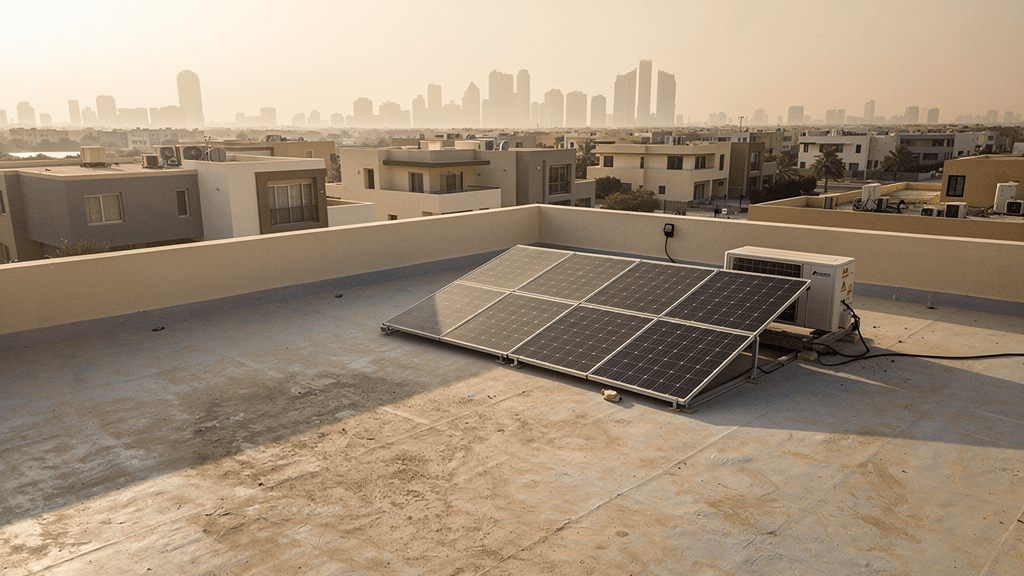
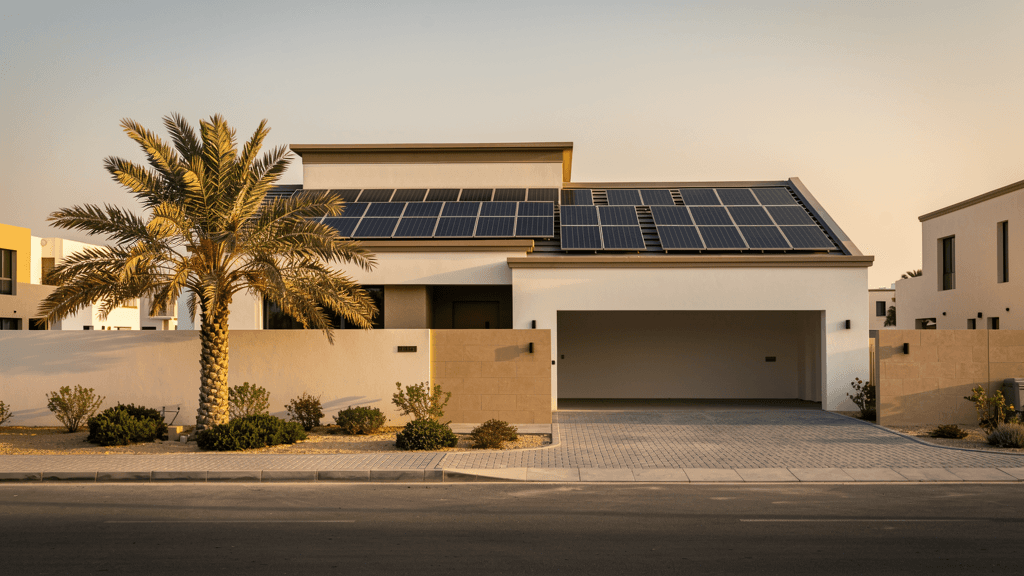
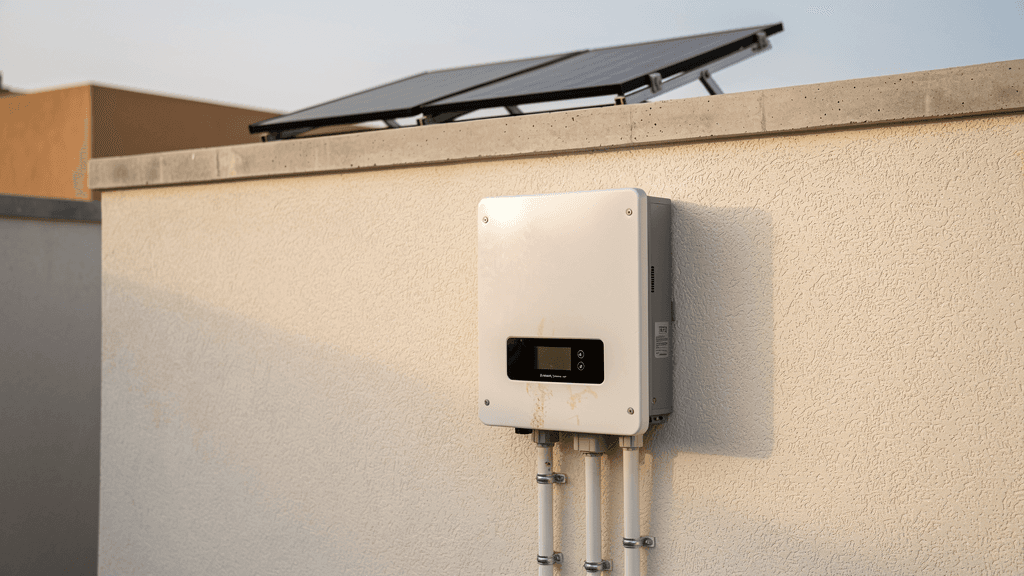
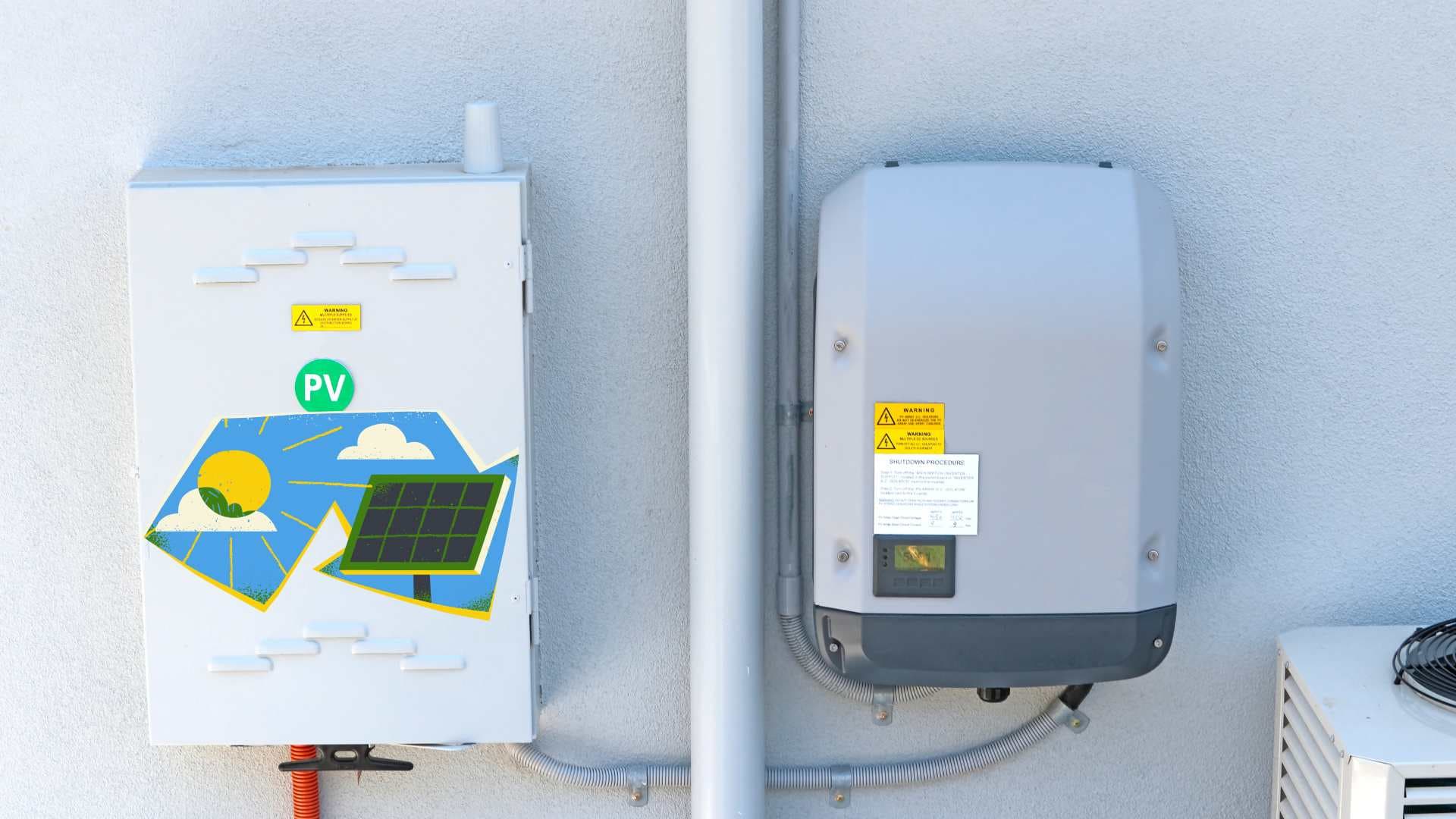
This is where Dubai's Shams Dubai net metering program becomes genuinely relevant to the tariff structure, rather than just a general sustainability nice-to-have. Under Shams Dubai, a home's rooftop solar system feeds surplus generation back into DEWA's grid. DEWA's own FAQ describes exactly how that surplus is treated:
“the quantity exported to the DEWA grid is monitored by the meter so that you can be credited on your future electricity bills”
“electricity exports within the billing period and electricity credits carried forward from previous billing periods are deducted from the electricity imported from the grid, and only then are DEWA tariff slabs... applied to calculate the bill”
“residual consumption is billed at lower slab rates”
There is no cash payout for exported power. DEWA cites Resolution No. 46 of 2014, which states:
“stipulates that the producer shall not be paid any money for the excess electricity”
“the incentive is therefore the savings on the electricity bill”
Unused credit rolls forward indefinitely, though it cannot transfer to a new owner or tenant if the property changes hands (DEWA Shams Dubai FAQ).
The mechanical consequence matters more than it sounds. Because exported solar generation is subtracted from a household's grid-imported kWh before DEWA calculates which slab applies, solar does not just erase kWh at whatever average rate a homeowner happens to be paying — it can pull remaining billed consumption out of the Orange or Red slabs entirely, lowering the marginal rate applied to every kWh still on the bill.
Dubai-based solar developer Enerwhere describes the practical version of this strategy: customers with heavy AC loads often aim to cover a large share of their consumption with solar specifically “because this means that every kWh from solar saves kWh in DEWA's most expensive red tariff slab,” adding that over a full year this can let a typical customer offset around half of total consumption (Enerwhere). The villa paying 38 fils per unit at the top of its bill is the villa with the most to gain, fils-for-fils, from every panel on its roof — a direct byproduct of DEWA's own tariff design, not a marketing claim.
Want numbers based on your own consumption rather than a generic villa average? Get matched with vetted installers and see your own numbers at solarquote.ae/get-quote.
DEWA has previously signaled the scale of what is achievable: a DEWA strategy executive told Khaleej Times that rooftop solar could meet “20 to 50 per cent” of a building's power needs — though that figure is more than a decade old, and actual savings depend heavily on roof space, shading, system size and consumption pattern (Khaleej Times).
The caveat — and the point
None of this guarantees any specific villa will see its bill cut in half, or that a given system pays for itself in a set number of years. Those figures vary by roof orientation, system size, shading, and household AC habits, and should be modeled against a homeowner's own trailing 12 months of DEWA bills rather than a generic average.
Market data here is directional, not definitive: independent UAE solar calculators modeling Shams Dubai's mechanics put typical offset ranges at roughly 30–70% of a bill depending on roof space, orientation and system sizing relative to a home's consumption (Electrician Dubai solar savings calculator) — broadly consistent with, though not identical to, DEWA's own historical guidance. For the variables behind a realistic return estimate, read Solar panel payback period in Dubai: the full 2026 guide.
What's verifiable and DEWA-sourced is the mechanism, not the magnitude: a slab tariff that charges progressively more per kWh as consumption rises, a net-metering scheme that applies solar credits before that slab calculation happens, and a documented surge in system-wide peak demand that tracks with the same cooling load driving individual villa bills skyward every August.
For Dubai's highest-consuming households, that combination means the arithmetic of going solar gets better, not worse, the bigger their AC bill already is — the opposite of how most household economics work.
Get a solar estimate built around your villa's roof and trailing DEWA bills. Get matched with vetted installers and see your own numbers at solarquote.ae/get-quote.