TL;DR
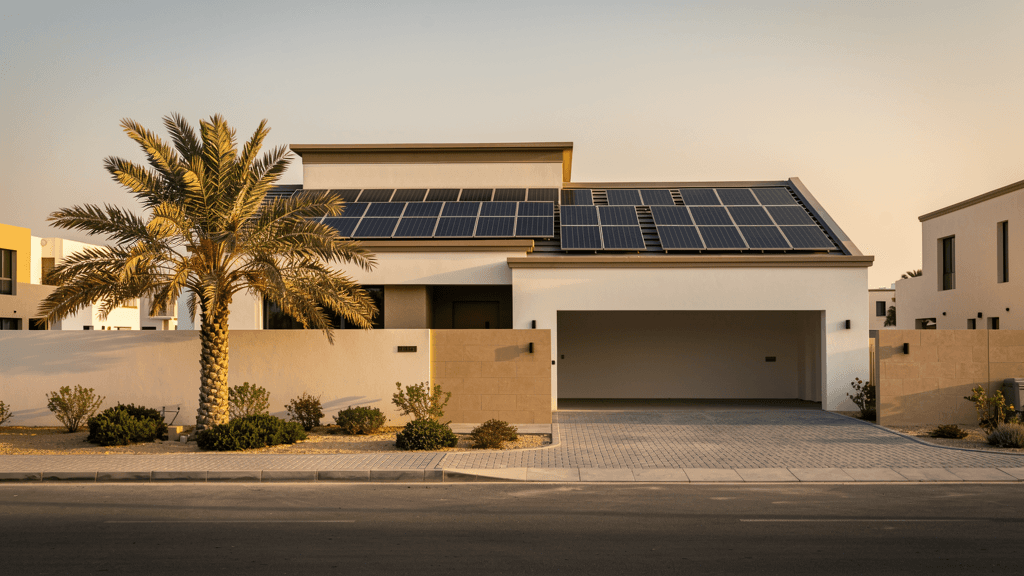
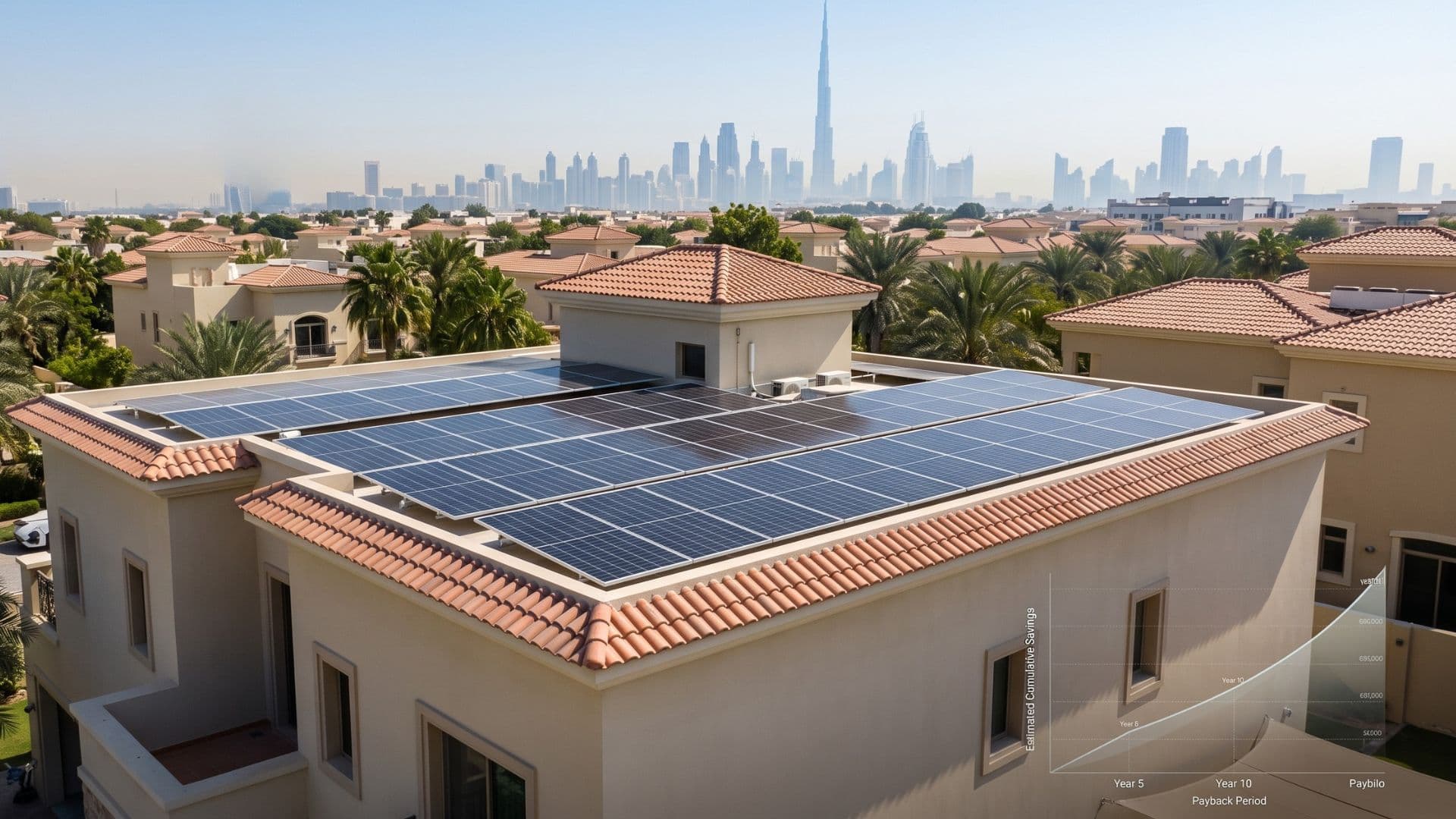
A correctly sized Dubai villa solar system typically pays for itself in 4–8 years, based on independent estimates ranging from 4–10 years down to a real homeowner's ~3-year break-even (UAE Contractors Hub, First Unicorn, UtilityBillUAE, Khaleej Times).
The single biggest lever isn't panel quality — it's which DEWA tariff slab your consumption sits in. A kWh displaced from the Red slab (6,001+ kWh/month) is worth roughly 52% more than one displaced from the Green slab (DEWA Slab Tariff).
DEWA deducts your solar credits before applying the slabs — meaning your saved units always come off the most expensive part of your bill first (DEWA Shams Dubai FAQ).
If you're a UAE national on the subsidised residential tariff, the math changes dramatically — your payback period stretches out by a multiple. This guide is built for expat freehold villa owners paying the full DEWA slab rate.
Waiting doesn't help — every month on the Orange or Red slab without solar is money that never comes back. Get free quotes compared side-by-side to see your actual numbers.
How Long Does Solar Actually Take to Pay for Itself in Dubai?
If you own a villa in Dubai and you're on DEWA's standard residential tariff, the honest answer is: somewhere between 4 and 8 years, with the exact number driven almost entirely by how much electricity you use and which tariff slab that puts you in.
That's not a marketing number — it's the range that emerges when you line up the independently published estimates:
Source | Payback Estimate | Label |
|---|---|---|
4–10 years | Market estimate | |
4–7 years (villa); 3–5 years (commercial) | Installer estimate (vendor-reported) | |
5–7 years | Market estimate (modelled) | |
5–8 years | Market estimate (dated) | |
7–10 years (battery-inclusive systems) | Vendor-reported | |
7–8 years | Market/case-study estimate | |
6–8 years (5 kW system) | Market estimate | |
~3 years + a few months | Homeowner-reported (2018) | |
~10 years | Forum estimate (tiny, poorly sized system) |
Strip out the outliers — a single homeowner with unusually favourable conditions on one end, and a tiny under-sized system dragged down by fixed permit costs on the other — and you land on a credible working band: 4–8 years for a correctly sized villa system without a battery. Systems bundled with batteries tend to land in the 7–10 year range instead, because the added battery capex takes longer to earn back (Dubai Smart Home).
No installer or comparison site can hand you a single guaranteed number — anyone who does is skipping the variables that actually matter. Get quotes from multiple installers and use the framework below to sanity-check whatever numbers they give you.
What Actually Drives Your Payback Period
1. Which DEWA Slab You're In
DEWA bills residential customers on a four-tier slab system, and where your consumption sits determines how valuable each solar kWh is to you.
Slab | Monthly Consumption (kWh) | Rate (AED/kWh) |
|---|---|---|
Green (G) | 0 – 2,000 | 0.230 |
Yellow (Y) | 2,001 – 4,000 | 0.280 |
Orange (O) | 4,001 – 6,000 | 0.320 |
Red (R) | 6,001+ | 0.380 |
Source: DEWA Slab Tariff, which also confirms 5% VAT applies on top. As of July 2026, DEWA also applies a fuel surcharge of AED 0.060/kWh on all electricity consumption, regardless of slab (DEWA Slab Tariff) — DEWA revises this figure periodically, so treat it as a July 2026 snapshot.
Add the fuel surcharge to each slab and you get the effective all-in marginal rate before VAT:
Green: 23 + 6 = 29 fils/kWh
Yellow: 28 + 6 = 34 fils/kWh
Orange: 32 + 6 = 38 fils/kWh
Red: 38 + 6 = 44 fils/kWh
This is why a villa that regularly tips into the Red slab in summer sees dramatically faster payback than a smaller household that never leaves Green — the exact same solar panel is worth roughly 52% more per kWh to the Red-slab villa (derived from DEWA's published rates: 44 fils vs. 29 fils). DEWA itself makes this point in its own FAQ: "the business case for clients with larger consumption and the possibility to install bigger systems is currently more attractive than for clients with low consumption and smaller systems" (DEWA Shams Dubai FAQ).
2. The Slab-Deduction Insight (This Is the Part Most People Miss)
Here's the mechanic that makes Dubai solar math better than it looks on paper: DEWA deducts your solar exports and any rolled-over credit before applying the tariff slabs, not after. DEWA's own FAQ states this explicitly:
"electricity exports within the billing period and electricity credits carried forward from previous billing periods are deducted from the electricity imported from the grid, and only then are DEWA tariff slabs (and any applicable fuel surcharges) applied to calculate the bill. This means more savings for customers, as residual consumption is billed at lower slab rates." — DEWA Shams Dubai FAQ
In practice, this means your solar output is always subtracted from the top of your consumption stack — the most expensive units — not spread evenly across all four slabs. A household consuming 5,000 kWh/month before solar pays Green rates on the first 2,000, Yellow on the next 2,000, and Orange on the final 1,000. If solar knocks net grid consumption down to 2,200 kWh, almost everything left falls into the two cheapest slabs (SurgePV). A real Dubai homeowner described this directly: solar let him "permanently remove consumption in the highest slab (red, 38 fils/kwh) and move down to the second slab pricing (yellow, 28 fils/kwh)" during his highest-consumption months (Khaleej Times, 2018).
This is also why annual modelling — not a single month's snapshot — is the right way to estimate your payback, because DEWA applies an indefinite rollover on unused credit: "Any surplus of electricity will be offset from your bills in the following months. An indefinite rollover is applied, so any surplus will be carried forward to the next bill" (DEWA Shams Dubai FAQ). Winter surpluses (lower AC load, same solar output) bank as credit and get drawn down against summer consumption.
Worth noting: solar output in Dubai is close to flat across the year on a per-kW basis (PVGIS modelling puts it in the 131–155 kWh/kWp/month range) — it's your consumption that spikes in summer, not your generation. The rollover mechanism is what bridges that gap, not seasonal generation swings.
3. System Cost Per Watt
Installed cost per watt is the other half of the equation, and current published UAE figures cluster around AED 2.00–3.50 per watt for villa-scale systems, with turnkey quotes commonly landing at AED 15,000–40,000 for a 5–10 kW system:
Source | Cost/W or system price |
|---|---|
AED 2.10–2.60/W residential | |
AED 2.15–2.50/W (5 kW mono) | |
AED 2.50–3.50/W installed | |
AED 1.9–3.6/W (10 kW build-up incl. permits) | |
~AED 2.5–4.4/W (vendor-reported price list) | |
AED 18,000–35,000 typical villa system |
For context, DEWA's own FAQ still quotes system costs of AED 4.50–5.00/W, but that figure is explicitly dated to Q2 2021 and is well above what installers are quoting today — useful mainly to show how far prices have fallen (DEWA Shams Dubai FAQ).
On top of hardware cost, budget for:
A one-off DEWA connection fee of AED 1,500 per renewable generator, which "can be reduced if no Generation check-meter is required" (DEWA Shams Dubai FAQ)
Annual operating expenditure of roughly 5% of your initial investment, covering inspection, panel cleaning, and part replacement — this is DEWA's own guidance, not a vendor estimate (DEWA Shams Dubai FAQ)
A likely inverter replacement around year 10–15, budgeted at roughly AED 500–1,500 per kW plus 10–20% installation costs (GoSwitchgear, PAS Solar) — this happens after payback but still affects lifetime ROI
Every quote is different, which is exactly why comparing several matters. Compare DEWA-enrolled installer quotes free rather than accepting the first number you're given.
4. Consumption Level
The more electricity your household uses — and the higher up the slab ladder that pushes you — the faster your payback, because each solar kWh displaces a more expensive unit. This is precisely why DEWA states larger consumers have "a more attractive" business case (DEWA Shams Dubai FAQ). A small, efficient household that never leaves the Green slab will see genuine but modest savings and a longer payback than a large villa running heavy air conditioning through summer.
5. Subsidised vs. Unsubsidised Tariffs — The Caveat Most Guides Skip
This is arguably the most important honesty check in this entire guide, and it's officially documented.
Dubai runs two entirely different residential tariff schedules. The general residential category — which covers expat freehold villa owners — pays the 23/28/32/38 fils slab rates shown above. But UAE nationals' private residences and farms are billed on a separate, heavily subsidised schedule: 7.5 / 9.0 / 10.5 / 12.5 fils per kWh across the same four consumption bands, and they're also exempt from the fuel surcharge entirely (Executive Council Resolution No. (16) of 2011).
That's roughly a third of the general residential rate. Independent confirmation: "These rates apply to expatriate residents; UAE nationals receive subsidized rates… Expatriates pay the full commercial slab rates" (UtilityBillUAE), and a GCC-wide policy comparison notes Dubai is the only emirate where nationals still pay slab-banded (rather than flat) rates, starting from roughly $0.02/kWh (KAPSARC).
What this means practically: if you're a subsidised UAE national household, the same solar system saves far fewer dirhams per kWh displaced, and your payback period stretches out by a multiple compared to the numbers in this article. The 4–8 year band described here applies to expat freehold villa owners on the standard residential tariff — which is also the population this article, and SolarQuote, is built for.
(Note: ignore unofficial tariff tables that contradict DEWA's published slab tariff and Executive Council Resolution No. 16 of 2011 — the official source is DEWA's Slab Tariff page.)
Worked Example: A 7,000 kWh/Month Villa
Here's an illustrative calculation using DEWA's published rates — this is SolarQuote's own arithmetic on official inputs, not a quote or a guarantee.
Baseline villa bill at 7,000 kWh/month (a red-slab summer profile):
Line | Calculation | AED |
|---|---|---|
First 2,000 kWh @ 0.230 | 2,000 × 0.230 | 460 |
Next 2,000 kWh @ 0.280 | 2,000 × 0.280 | 560 |
Next 2,000 kWh @ 0.320 | 2,000 × 0.320 | 640 |
Final 1,000 kWh @ 0.380 | 1,000 × 0.380 | 380 |
Energy charge subtotal | 2,040 | |
Fuel surcharge @ 0.060 (July 2026) | 7,000 × 0.060 | 420 |
+ 5% VAT | (2,040 + 420) × 1.05 | AED 2,583 |
(Water, sewerage, meter charges and the housing fee sit on top of this to reach a full ~AED 3,000 bill, but those don't move with solar — see DEWA Slab Tariff.)
Add a 10 kW system, generating roughly 1,167–1,500 kWh that month (based on 1,400–1,800 kWh/kW/year — UAE Contractors Hub), and taking net billed consumption down to 5,500 kWh:
New electricity charge with VAT: ≈ AED 1,921.50
Saving: AED 661.50/month — a 25.6% cut to the electricity charge, from removing just 21.4% of the units. Those 1,500 kWh come off the Red and Orange slabs, not the Green slab — worth roughly 44 fils/kWh rather than 29 fils.
Running the payback on that system (AED 20,000–26,000 install cost + AED 1,500 connection fee, less 5% annual opex):
Scenario | Gross annual saving | After 5% opex | Payback (AED 21,500 build) | Payback (AED 27,500 build) |
|---|---|---|---|---|
Low: 14,000 kWh/yr @ 29 fils | AED 4,060 | AED 2,985 | 7.2 years | 9.2 years |
Mid: 15,000 kWh/yr @ 34 fils | AED 5,100 | AED 4,025 | 5.3 years | 6.8 years |
High: 16,000 kWh/yr @ 44 fils | AED 7,040 | AED 5,965 | 3.6 years | 4.6 years |
(Inputs: DEWA Slab Tariff, DEWA Shams Dubai FAQ, UAE Contractors Hub.)
This is exactly why the published payback range is so wide: the same hardware pays back in roughly 4 years for a Red-slab villa and roughly 9 years for a Green-slab household. Your actual number depends entirely on your consumption pattern and system size — which is exactly what a proper quote comparison should model for you. Request quotes and get your own numbers run.
What Happens After Payback
Once you cross break-even, you're not done benefiting — you've got 18–21 more years of near-free electricity ahead, since panels are typically warrantied for 25–30 years and modern N-type panels are expected to perform well beyond that (First Unicorn, manufacturer datasheets from Trina and LONGi). Budget for one inverter swap somewhere around year 10–15 — inverters typically last 10–15 years versus 25–30 for panels (PAS Solar) — but that's a small dent in decades of essentially free power once the system has paid for itself.
There's also no cash payout for excess generation under Shams Dubai — DEWA is explicit that "the producer shall not be paid any money for the excess electricity" — the entire benefit comes from reduced bills via credit rollover (DEWA Shams Dubai FAQ). That means oversizing your system well beyond your consumption doesn't generate extra income — it just banks credit you may never fully use. Size to your actual annual usage, not your roof's maximum capacity.
How to Calculate Your Own Payback
Pull your last 12 months of DEWA bills to find your actual average and peak monthly consumption in kWh.
Identify which slabs you're hitting using the table above — this tells you the marginal value of each solar kWh you'd displace.
Get quoted system sizes and installed costs from multiple DEWA-enrolled contractors — cost per watt varies significantly by brand, roof complexity, and inverter choice.
Add the AED 1,500 connection fee and budget 5% of system cost annually for opex.
Model annually, not monthly — because credits roll over indefinitely, your winter surplus offsets summer demand, so a single month's bill won't tell the real story.
Compare multiple quotes before committing — installed cost per watt is the variable you have the most control over.
The fastest way to do steps 3–6 properly is to get several real quotes side by side rather than guessing off national averages. Get free, no-obligation solar quotes for your villa and see where your actual payback lands.