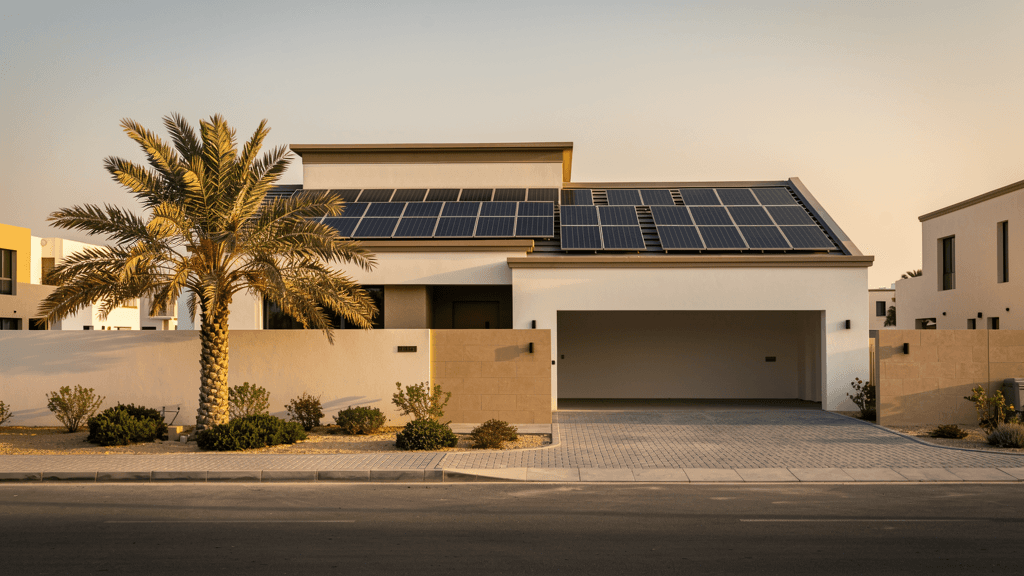
If you own a villa or another property in Dubai and are considering rooftop solar, net metering is the rule that determines what happens to every unit of electricity your system produces. The basic idea is straightforward: your property uses its own solar electricity first, while any surplus goes to the DEWA grid and becomes a credit against electricity you import later.
That makes rooftop solar useful even when nobody is home during the sunniest part of the day. But it is important to understand what the credit is, how it affects your bill, and why a larger system is not automatically a better investment.
What net metering means in Dubai
Dubai’s grid-connected rooftop solar programme is known as Shams Dubai. It allows homes and buildings with an approved solar photovoltaic system to use the electricity generated on site and export surplus electricity to Dubai Electricity and Water Authority’s network.
During daylight hours, the solar system supplies the property’s electrical loads. If the panels are generating less than the property needs, the shortfall comes from the grid as usual. If the panels are generating more than the property is using, the surplus flows into the grid.
A bi-directional smart meter records electricity moving in both directions:
Imported electricity is the energy the property draws from DEWA.
Exported electricity is surplus solar energy sent to DEWA’s network.
A battery is not required for this arrangement. The grid accepts the surplus, while DEWA’s billing system records the corresponding energy credit. A battery may still have other uses, but it is a separate decision from participating in Shams Dubai.
What happens when your panels produce too much electricity
Suppose your solar system is producing strongly at midday while the villa is using relatively little electricity. The property consumes the solar electricity it needs at that moment, then exports the balance.
DEWA does not pay cash for that exported electricity. Instead, it credits the surplus energy to the relevant account so that it can offset future electricity consumption. This distinction matters: Shams Dubai is designed to reduce future electricity bills, not to create an income stream from selling power.
DEWA states that surplus credits are carried forward indefinitely from one billing cycle to the next. If you build up credit during lower-consumption months, it can therefore be used against later net consumption rather than expiring at the end of the month or year.
There are limits to how portable those credits are. Under DEWA’s published rules, accumulated surplus is forfeited when the hosting account is closed and cannot be transferred to a new owner or tenant. If you expect to sell, move or change the account holder, that is another reason not to size a system around permanent overproduction.
How imports, exports and credits affect your DEWA bill
DEWA calculates the electricity portion of the bill after accounting for solar exports and any eligible credit carried forward. In practical terms, three outcomes are possible during a billing cycle:
You import more than you export. Exports and available credits reduce the imported electricity, and the remaining net import is billed under the applicable tariff structure.
You import and export the same amount. The net electricity consumption for the cycle is zero.
You export more than you import. The invoiced electricity consumption for that cycle is zero, and the remaining surplus is carried forward as an energy credit.
DEWA’s guidance says exports and carried-forward credits are deducted before tariff slabs and applicable fuel surcharges are applied to the remaining imported electricity. Your bill will still contain any other charges that apply to the property or account; net metering concerns the electricity-energy calculation rather than making the entire DEWA bill disappear.
Where a producer has more than one eligible consumption account on the same plot, DEWA’s rules allow solar production to be allocated across those accounts in a defined order. A DEWA-enrolled consultant or contractor can confirm how this applies to the exact property and account structure.
Why self-consumption still matters
Although exported electricity becomes a useful credit, solar normally makes the strongest practical sense when the system is matched to the property’s own demand. Electricity used directly on site offsets grid imports immediately. Exported surplus only becomes credit, and that credit has value only if the account later imports enough electricity to use it.
This is why “fill every available square metre with panels” is not a sound sizing strategy on its own. A system that generates a large unused balance year after year may leave capital tied up in credits that the property never consumes.
The role of a DEWA-enrolled solar contractor
Grid-connected solar in Dubai is not a normal home-improvement job that any electrical installer can complete. DEWA states that only enrolled Electrical and Distributed Renewable Resources Generation solar photovoltaic consultants and contractors are authorised to install, operate and maintain systems connected under Shams Dubai.
The enrolled contractor or consultant acts as the customer’s agent. They assess the site, prepare the technical design, use eligible equipment, submit the necessary documents, coordinate inspections and help complete the connection process. Without an authorised contractor and the required approvals, the system is not eligible for DEWA grid connection or net metering.
Before accepting a quotation, check that the company appears on DEWA’s current list of enrolled consultants and contractors. Enrolment is the starting point, not a substitute for comparing design quality, warranties, maintenance arrangements and commercial terms.
Approval, connection and commissioning
DEWA describes the Shams Dubai connection journey in three broad stages: permits and connection application, inspection and connection, then generation.
Site assessment and design: the enrolled consultant or contractor reviews the property, consumption, roof and electrical connection, then prepares the proposed system design.
Application and approvals: the contractor submits the solar permits and connection application, including the required technical drawings and documents. Other building approvals may also be needed from the authority responsible for the property.
Installation: work should proceed against the approved design using equipment that meets DEWA’s requirements.
Inspection and metering: once the installation is ready, the contractor requests inspection. DEWA coordinates the connection agreement, metering and grid connection after the applicable requirements are satisfied.
Generation: only after approval, inspection and connection is the system commissioned to generate for the property and export eligible surplus to the grid.
The exact journey can vary with the property, connection and system size. Treat any installer’s promised completion date as an estimate until the design and authority requirements have been reviewed.
How to choose a sensible system size
A good proposal should begin with evidence, not a panel count. Ask the contractor to explain the recommended size using:
at least twelve months of electricity consumption, including the difference between summer and winter demand;
the property’s daytime load, when solar generation is available;
usable roof area, orientation, tilt, shading and access for cleaning and maintenance;
the condition and capacity of the electrical connection;
DEWA’s capacity limits and any site-specific technical constraints;
expected annual generation, shown with clear assumptions; and
your likely ownership horizon and ability to use carried-forward credits.
Be cautious with a quotation that promises a zero bill without examining actual consumption and the non-energy charges on the account. Also ask to see expected monthly generation rather than only an annual total. A system can look well matched over a full year while still creating a large credit balance that is slow to use.
A practical way to evaluate net metering
Net metering in Dubai is best understood as an accounting system for energy, not a cash purchase scheme. Solar electricity used on site reduces imports immediately. Surplus exported through the approved connection becomes credit, and that credit offsets future imports under DEWA’s rules.
For a property owner, the sensible next step is to gather recent DEWA bills and compare proposals from qualified installers on the same assumptions. Focus on realistic consumption, usable roof space, equipment quality, maintenance and the amount of generation you are likely to use, not simply the largest system that will fit.