TL;DR
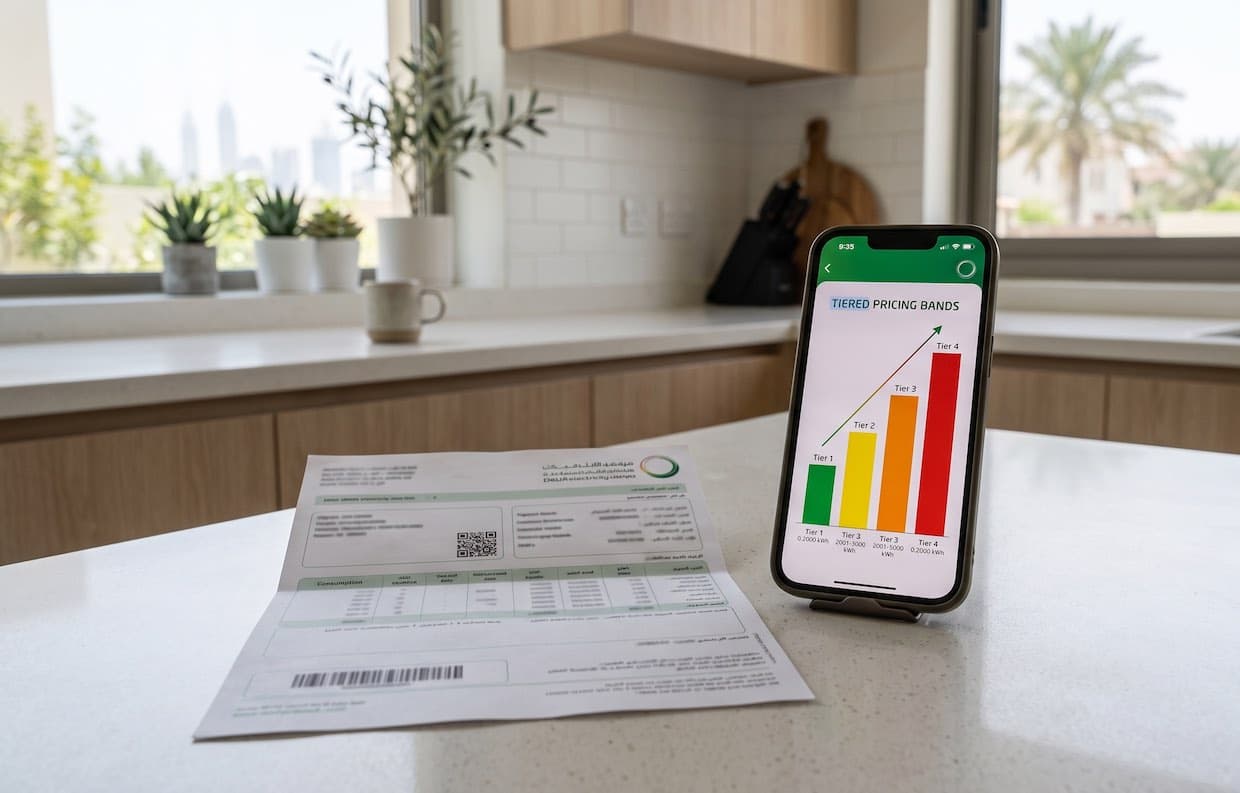
DEWA charges electricity on a four-band "slab" system that gets progressively more expensive as you consume more — from 0.230 AED/kWh up to 0.380 AED/kWh, plus a fuel surcharge and 5% VAT (DEWA — Slab Tariff).
Your bill is more than just electricity: housing fee, water, sewerage, meter charge, fuel surcharge, and district cooling all stack on top — and solar only touches the electricity line (DEWA — Understand Your Bill).
UAE nationals pay a heavily subsidised 7.5–12.5 fils/kWh with no fuel surcharge — which means a much longer solar payback for that segment than for standard-tariff residents (Executive Council Resolution No. 16 of 2011).
Solar credits are deducted before DEWA applies the slabs — meaning your displaced kWh are often worth more than the average rate, because they come off your most expensive slab first (DEWA — Shams Dubai FAQ).
Want to know exactly what slab you're paying and what solar would save on your real numbers? Get free quotes from DEWA-enrolled installers.
What is a DEWA tariff slab?
DEWA prices electricity (and water) using a slab, or tiered, system: the rate you pay per kWh increases as your monthly consumption climbs through defined bands. DEWA states this directly:
"In line with the decision of Dubai Supreme Council of Energy, slab tariff and fuel surcharge are applied on monthly electricity & water consumption." "In slab tariff, price increases progressively with the increase of electricity and water consumption." (DEWA — Slab Tariff)
This system has been in place since 2011, under Executive Council Resolution No. 16 of 2011, which set out the original tariff schedule for electricity and water in Dubai (Executive Council Resolution No. 16 of 2011 (PDF)).
Current DEWA residential electricity slabs (verified July 2026)
These are the live, published rates as of July 2026 (DEWA — Slab Tariff):
Slab | Monthly consumption (kWh) | Rate (AED/kWh) |
|---|---|---|
🟢 Green | 0 – 2,000 | 0.230 |
🟡 Yellow | 2,001 – 4,000 | 0.280 |
🟠 Orange | 4,001 – 6,000 | 0.320 |
🔴 Red | 6,001 and above | 0.380 |
On top of these rates:
Fuel surcharge (as published for July 2026): 0.060 AED/kWh. DEWA states this "vary[s] based on increase or decrease in fuel prices supplied to DEWA generation plants" and is republished periodically — always check the live DEWA Slab Tariff page for the current month's figure before budgeting.
5% VAT applies on top of these tariffs (DEWA — Slab Tariff).
Meter service charge, billed monthly: Type 1 = AED 5, Type 2 = AED 6, Type 3 = AED 35 (DEWA — Slab Tariff).
Commercial customers use the identical four-band schedule. Industrial customers use a simpler two-band structure:
Slab | Monthly consumption (kWh) | Rate (AED/kWh) |
|---|---|---|
Green | 0 – 10,000 | 0.230 |
Yellow | 10,001 and above | 0.380 |
(DEWA — Slab Tariff; Executive Council Resolution No. 16 of 2011)
A commercial site consistently drawing above 6,000 kWh/month sits permanently in the Red slab — effectively around 0.462 AED/kWh once the fuel surcharge and VAT are included on marginal units. This is a large part of why commercial solar economics in Dubai tend to be stronger than residential: every solar kWh generated displaces the most expensive slab of consumption. Compare commercial solar quotes for your business →
Does the higher rate apply to your whole bill, or just the extra units?
This is the single most misunderstood part of the DEWA tariff — and it matters enormously for how you think about savings.
Here's what's verifiable: DEWA's tariff schedule is published band by band ("From 2,001 to 4,000 kilowatt-hours — 28 fils," and so on) rather than as a single rate that applies retroactively once you cross a threshold (Executive Council Resolution No. 16 of 2011). DEWA also describes the pricing as increasing "progressively" with consumption (DEWA — Slab Tariff), and your actual bill itemises a "Slab Tariff calculation of Electricity current period consumption and bill amount" as a distinct line (DEWA — Understand Your Bill, page 2).
To be transparent about the limits of this: DEWA does not publish a single sentence explicitly stating "the higher rate only applies to units above the threshold." But taken together — the band-by-band schedule, the "progressive" wording, and the slab-by-slab calculation shown on your bill — the evidence points to a marginal (tiered) system: only the kWh that fall inside each band are charged at that band's rate, not your entire month's consumption at the top rate you reached. This is the standard way slab/tiered utility tariffs work internationally, and it's consistent with everything DEWA publishes, but we're flagging it clearly as our reading of the published structure rather than a direct DEWA quote. Check your own bill's slab breakdown, or run your numbers through the DEWA Tariff Calculator, to confirm how it applies to you.
Worked example: a 6,500 kWh summer month
To show how this plays out, here's an illustrative calculation using the verified July 2026 rates and the marginal-slab reading above. This is our own worked example, not a DEWA-published one — treat it as illustrative, not as a guarantee of your bill.
Villa consuming 6,500 kWh in a month, no solar:
Slab | kWh in this band | Rate | Cost |
|---|---|---|---|
Green | 2,000 | 0.230 | AED 460.00 |
Yellow | 2,000 | 0.280 | AED 560.00 |
Orange | 2,000 | 0.320 | AED 640.00 |
Red | 500 | 0.380 | AED 190.00 |
Energy charge total | 6,500 | AED 1,850.00 |
Fuel surcharge: 6,500 × 0.060 = AED 390.00
Meter service charge (Type 1): AED 5.00
Subtotal: AED 2,245.00
5% VAT = AED 2,357.25
Blended rate before VAT: ≈ AED 0.345/kWh — well above the Green slab rate, because the top 2,500 kWh were charged at Orange and Red rates.
This alone shows why "average cost per kWh" numbers you see quoted online can be misleading — the rate that matters is the one on your last kWh, not your first.
How solar changes this calculation — and why it's better than a simple average
Now the same villa, with a solar system that nets off 2,500 kWh that month (net import drops to 4,000 kWh). Per DEWA's own Shams Dubai FAQ, exports and any carried-forward credit are deducted before slabs are applied:
"Electricity exports within the billing period and electricity credits carried forward from previous billing periods are deducted from the electricity imported from the grid, and only then are DEWA tariff slabs (and any applicable fuel surcharges) applied to calculate the bill. This means more savings for customers, as residual consumption is billed at lower slab rates." (DEWA — Shams Dubai FAQ)
Slab | kWh in this band | Rate | Cost |
|---|---|---|---|
Green | 2,000 | 0.230 | AED 460.00 |
Yellow | 2,000 | 0.280 | AED 560.00 |
Energy charge total | 4,000 | AED 1,020.00 |
Fuel surcharge: 4,000 × 0.060 = AED 240.00
Meter service charge: AED 5.00
Subtotal: AED 1,265.00
5% VAT = AED 1,328.25
Saving: AED 1,029.00 on the pre-VAT electricity subtotal (~45.8%) — from a 38.5% cut in kWh consumed. The displaced 2,500 kWh worked out to roughly 0.412 AED/kWh in value (1,029 ÷ 2,500) — higher than any single slab rate on its own, because those units were shaved off the top of the bill: the Orange and Red slabs plus their fuel surcharge and VAT (calculation based on DEWA Slab Tariff rates).
This is the core mechanic behind DEWA's own claim that solar delivers "more savings for customers, as residual consumption is billed at lower slab rates" (DEWA — Shams Dubai FAQ) — and it's why a rough "solar saves X% off my bill" estimate based on an average tariff usually understates the real number for high-consumption villas.
Caveats on this example: it assumes marginal slab application (see the section above), the July 2026 fuel surcharge of 0.060 AED/kWh, a Type 1 meter, no district cooling charge, and excludes housing fee, water, and sewerage. Every villa's numbers will differ — get a quote sized to your actual consumption rather than relying on averages.
What's actually on your DEWA bill
A common misconception is that solar wipes out your entire DEWA bill. It doesn't. Your full residential bill is made up of (DEWA — Understand Your Bill, page 1; page 2):
Component | What it is | Does solar reduce it? |
|---|---|---|
Electricity (slab tariff) | Your metered kWh, charged band by band | Yes |
Fuel surcharge | Per-kWh surcharge tied to generation fuel costs | Yes (fewer imported kWh = less surcharge) |
Meter service charge | Flat monthly fee per meter type | No |
Water | Metered water consumption | No |
Sewerage | Charged per gallon of water consumed | No |
Housing fee | 5% of your annual rent, divided into 12 monthly instalments, collected via DEWA on behalf of Dubai Municipality | No |
District cooling | Where applicable, billed per the relevant provider's rate (e.g. Nakheel) | No |
DEWA is explicit that the housing fee is "5% of the annual rent amount divided in 12 monthly instalments" (DEWA — Understand Your Bill) — it has nothing to do with your electricity usage, and no amount of solar generation will touch it. If someone promises solar will "cut your whole DEWA bill in half," ask them which line items they mean.
Why UAE nationals see a very different tariff — and a very different solar payback
DEWA's tariff schedule includes a heavily subsidised rate for UAE nationals' private residences and farms, set out in the same 2011 resolution:
Category | Slab (kWh) | Rate (fils/kWh) |
|---|---|---|
Residences & farms of UAE nationals | 1 – 2,000 | 7.5 |
Residences & farms of UAE nationals | 2,001 – 4,000 | 9.0 |
Residences & farms of UAE nationals | 4,001 – 6,000 | 10.5 |
Residences & farms of UAE nationals | over 6,000 | 12.5 |
(Executive Council Resolution No. 16 of 2011 (PDF))
Compare that to the standard residential schedule of 0.230–0.380 AED/kWh (230–380 fils, note the different unit) plus the fuel surcharge. UAE nationals are also explicitly exempt from the fuel surcharge:
"The monthly bills of UAE nationals' private residences and farms will not be subject to the fuel surcharge." (Executive Council Resolution No. 16 of 2011, Article 2(f))
What this means for solar economics: a solar system displaces grid electricity at whatever rate you actually pay. A standard-tariff villa paying 0.230–0.380 AED/kWh plus the fuel surcharge is displacing roughly 3–5 times more value per kWh than a UAE-national household paying 0.075–0.125 AED/kWh with no fuel surcharge. This is straightforward arithmetic based on the published rates, not a DEWA statement — DEWA's own guidance on this is simply that "the investment return and savings depend on how much electricity you currently use, and the tariff you are paying" (DEWA — Shams Dubai FAQ). The practical consequence is that payback periods are materially longer for subsidised-tariff households — we're not publishing a specific year figure here, since that depends on your system cost too, but it's an important expectation to set before you request quotes.
Don't confuse peak-hour advice with a cheaper rate
DEWA frequently asks residents to shift heavy appliance use out of the 12pm–6pm window during summer, for grid-load reasons:
"The Peak-Load campaign... encourages users to limit their use of devices that use a lot of power... during peak consumption hours from 12-6pm." (DEWA news, August 2014)
This is not a time-of-use tariff. The published slab schedule applies the same AED/kWh rate no matter what time of day you consume it (DEWA — Slab Tariff). If you read advice telling you to "shift usage to off-peak to cut your DEWA bill," that's an assumption imported from markets like the UK or US that do have time-of-use pricing — it doesn't apply to Dubai's residential tariff as currently published.
How to check your own numbers
Pull your last 12 months of bills (or check the DEWA app) to see your actual monthly kWh and which slabs you're hitting.
Run your numbers through the DEWA Tariff Calculator or the guest calculator.
Check the current fuel surcharge on the live DEWA Slab Tariff page — it changes periodically.
If you're consistently in Orange or Red territory, that's exactly where solar delivers the most value per displaced kWh, per the worked example above.