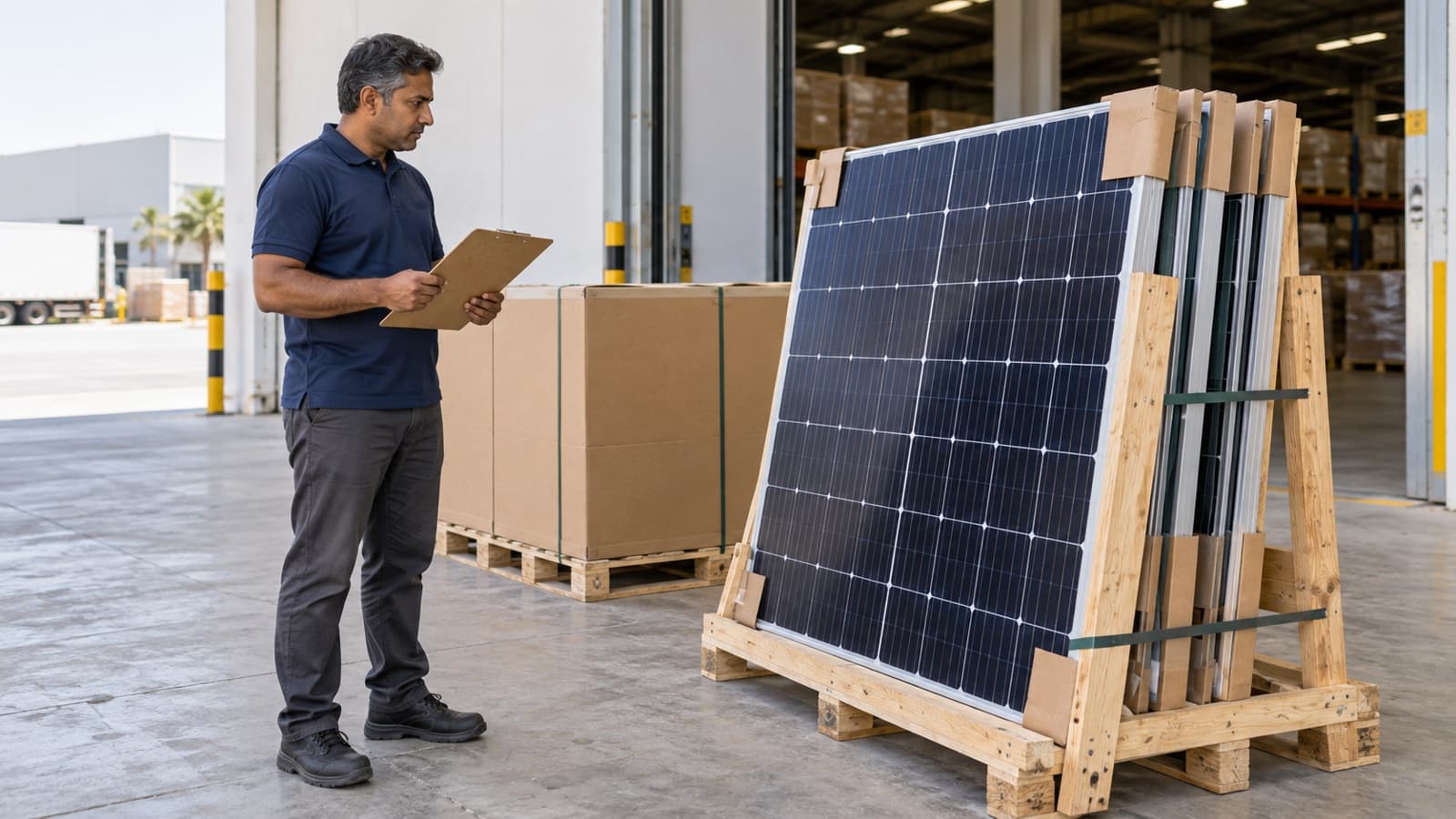
AI-generated illustration of a commercial solar delivery check; not a real supplier, customer or documented installation.
VAT charged on a commercial solar installation is not automatically a permanent cost, and it is not automatically recoverable either. For a UAE business, the right comparison separates the amount paid to the supplier, the input VAT the business is entitled to recover, and the timing of that recovery. A proposal that simply removes VAT because “you are a company” has skipped the important part.
This guide is for commercial property owners, factory operators and authorised finance or procurement teams buying a solar system. It explains what to establish before approving the budget, including the supplier-verification decision effective from 1 October 2026. It is a procurement checklist, not a tax opinion or a promise that a particular project qualifies.
Start with the purchasing entity and the use of the system
Under the UAE VAT Decree-Law, the standard rate is 5%, subject to its zero-rating and exemption provisions. Article 54 links recoverable input tax to goods and services used or intended for qualifying supplies, including taxable supplies. Article 55 sets documentary and payment-related conditions, while Article 58 addresses expenditure serving both qualifying and other activities.
For a solar purchase, ask your tax adviser to establish the following before treating the VAT as recoverable:
Who is receiving the supply? Identify the actual contracting and purchasing entity and its VAT position. The property owner, electricity-account holder, operating business and company paying the invoice may not all be the same person.
What activity does the solar expenditure support? Explain how the system serves the business and whether the relevant activity gives a right to input-tax recovery. Having a business licence alone is not the answer.
Is there mixed use? Flag any exempt activity, private use or shared use across entities. Obtain an adviser-approved attribution or apportionment approach rather than selecting a recovery percentage to make the payback attractive.
What evidence and timing apply? Have finance check the tax invoice, the recipient details, payment conditions and the correct recovery period. Do not assume signing a quotation creates an immediately recoverable amount.
A landlord-funded array serving a tenant, or a group company paying for another entity's premises, deserves explicit review. Ask for the contractual and tax position to be resolved together. An invoice addressed to the wrong entity is not something to leave until after commissioning.
Compare cash paid with cost after eligible recovery
Request three figures from every bidder: the price excluding VAT, the VAT amount and the total payable. Keep the equipment and installation scope comparable using our solar quotation line-item checklist. Then let your finance team add a separate, supported recovery assumption.
The following is arithmetic only, not a UAE solar price quotation. Assume an illustrative purchase of AED 100,000 excluding VAT, with 5% VAT charged correctly, and no other project costs:
Illustrative tax position | Payment to the supplier | Eligible VAT recovery assumed | Purchase cost after that recovery |
|---|---|---|---|
Full recovery confirmed | AED 105,000 | AED 5,000 | AED 100,000 |
50% recovery, solely to illustrate partial recovery | AED 105,000 | AED 2,500 | AED 102,500 |
No recovery available | AED 105,000 | AED 0 | AED 105,000 |
The supplier's gross payment is unchanged in all three examples. Recovery changes the eventual cost, not the amount that this example requires you to fund at payment. The 50% assumption is not an FTA default or a method for allocating mixed-use solar expenditure.
Ask finance to show the expected recovery timing separately in the cash-flow model and to test a delayed-recovery case. Article 53 calculates net VAT by offsetting recoverable input tax against output tax; Article 74 provides for excess-tax carry-forward and refund arrangements. Recovery therefore should not be modelled as a guaranteed same-day cash refund.
Break down roof repairs, structural work, access equipment, installation, maintenance and any other separately supplied items. Your adviser should assess the actual supplies, not apply one unsupported tax assumption to an entire project budget. Use the installation payment-milestone guide to align the commercial schedule with evidence of delivery and completed work; it is not a substitute for determining the VAT tax point.
Check the supplier and the delivery, not just the invoice
The FTA publishes Decision No. 13 of 2026 on verifying suppliers and supplies, issued on 22 July 2026 and effective from 1 October 2026. Its Articles 3 to 5 cover supplier identity and business premises, risk indicators, the commercial substance and payment conditions of the transaction, the authenticity and origin of goods, and documented verification responsibilities. Article 6 contains exceptions with transaction and aggregate-supplier conditions; have finance check the actual applicability rather than assuming every small invoice is outside the decision.
Article 54 BIS of the VAT law addresses denial of input-tax deductions for supplies connected with tax evasion where the taxable person knew, or should have known, of that connection. This is not a finding about any solar company. It is a reason to make supplier checks part of procurement before relying on a VAT-recovery assumption.
For a solar project, build a file that connects the commercial promise to the actual supply:
Entity and authority: supplier incorporation or licence information, authorised representative and the contracting name, with any brand or group-company differences explained. Handle identity evidence through your controlled finance process, not a public quotation form.
Business and payment trail: supplier premises, proposed beneficiary and payment method. Record a reasonable commercial explanation for an intermediary or unusual payment arrangement. Ask finance whether additional bank-confirmation requirements apply.
Goods and services received: purchase order, exact equipment schedule, delivery records, relevant equipment identifiers, installation acceptance and the associated tax invoices. A legitimate design change should leave a documented trail, not a mismatch nobody owns.
Review responsibility: name the person checking the supplier, the person accepting the delivery or work, and the finance reviewer approving the recovery treatment. Retain the checks and supporting records.
This is a solar-specific preparation list, not a reproduction of every requirement or a safe-harbour certificate. Tax verification and technical installer approval are separate checks. Neither a tax registration number nor a utility contractor listing establishes the other.
Use the same VAT basis for electricity savings
VAT can also distort the annual savings side of the proposal. DEWA's published tariff page states that 5% VAT applies to its tariffs. If your business can recover the VAT on its electricity purchases, a reduction in the gross electricity bill is not necessarily the same as the reduction in its eventual electricity cost.
For example, assume a modelled electricity-charge reduction of AED 20,000 before VAT, with AED 1,000 less VAT on those charges. If that electricity input VAT would otherwise have been fully recoverable, the benefit after allowing for the lost recovery is AED 20,000, not AED 21,000. If none would have been recoverable, the benefit in this simplified example is AED 21,000. These are illustrative calculations, not a generation forecast, current bill estimate or recovery ruling.
Ask finance to reconcile the installation VAT, ongoing maintenance VAT and avoided utility VAT on a consistent basis. Do not remove recoverable VAT from the purchase price while counting recoverable VAT on displaced electricity as an extra lasting saving. The wider commercial solar feasibility and payback guide provides project context; the final model still needs your actual consumption, tariff, operating costs and tax position.
Questions to resolve before authorising the solar order
Which entity will contract, receive the supply, pay and claim any eligible input tax?
Does the adviser confirm full, partial or no recovery, and what evidence supports that position?
Are the quotation, tax invoices and payment schedule consistent, including variations and separately supplied roof or maintenance work?
Have the applicable supplier and supply checks been completed and retained, with responsibility clearly assigned?
Does the budget show gross payments and recovery timing separately, without assuming an immediate refund?
Are electricity and maintenance savings measured on the same tax basis as the investment?
Does the project's treatment under the Capital Assets Scheme need assessment, and could a later change of use require an adjustment? Article 60 addresses that scheme; do not assume every solar system has identical treatment.
If the VAT position remains unresolved, keep a conservative no-recovery case visible and show the potential recovery separately as conditional. That lets you assess the project without disguising a tax assumption as a discount from the installer.
A brief to send with your quotation request
We are assessing solar for a UAE commercial property. Please provide the exact contracting entity, an itemised equipment and installation scope, the price excluding VAT, VAT amount and gross total, and the proposed payment and invoicing schedule. Identify separately supplied roof works, maintenance and exclusions. We will confirm our input-tax recovery position with our adviser; please do not deduct assumed VAT recovery from the amount presented as payable. Please also support our supplier and delivery-verification process.
Decision takeaway: compare the same technical scope first, then distinguish gross cash funding from cost after eligible recovery. A documented tax position is a budgeting input, not a solar subsidy or a guaranteed return.
When the site and purchasing entity are clear, request comparable commercial solar quotations through SolarQuote, subject to project suitability and installer availability. Include the emirate, property type, ownership or landlord authority, operating hours and electricity bills. Keep tax-registration evidence and sensitive finance documents within your own adviser and procurement process.
Primary sources checked on 25 October 2026. Federal VAT principles apply across the UAE; the utility example is Dubai-specific and does not establish another emirate's solar connection or billing rules. The FTA-hosted decision labels its English text an unofficial translation, and the legislation portal states that Arabic prevails in interpretation. Obtain project-specific advice before claiming tax or committing funds.