Short Summary:
Dubai's Shams Dubai programme uses net metering: surplus solar becomes a bill credit that rolls forward indefinitely, but cannot be cashed out.
Abu Dhabi's 2026 residential self-supply policy does not net or offset exported electricity, so systems need to be sized closely to daytime use.
The same rooftop panels can therefore produce very different savings logic in the two emirates.
Check the rulebook before relying on a payback estimate: DEWA and Abu Dhabi's Department of Energy regulate different frameworks.
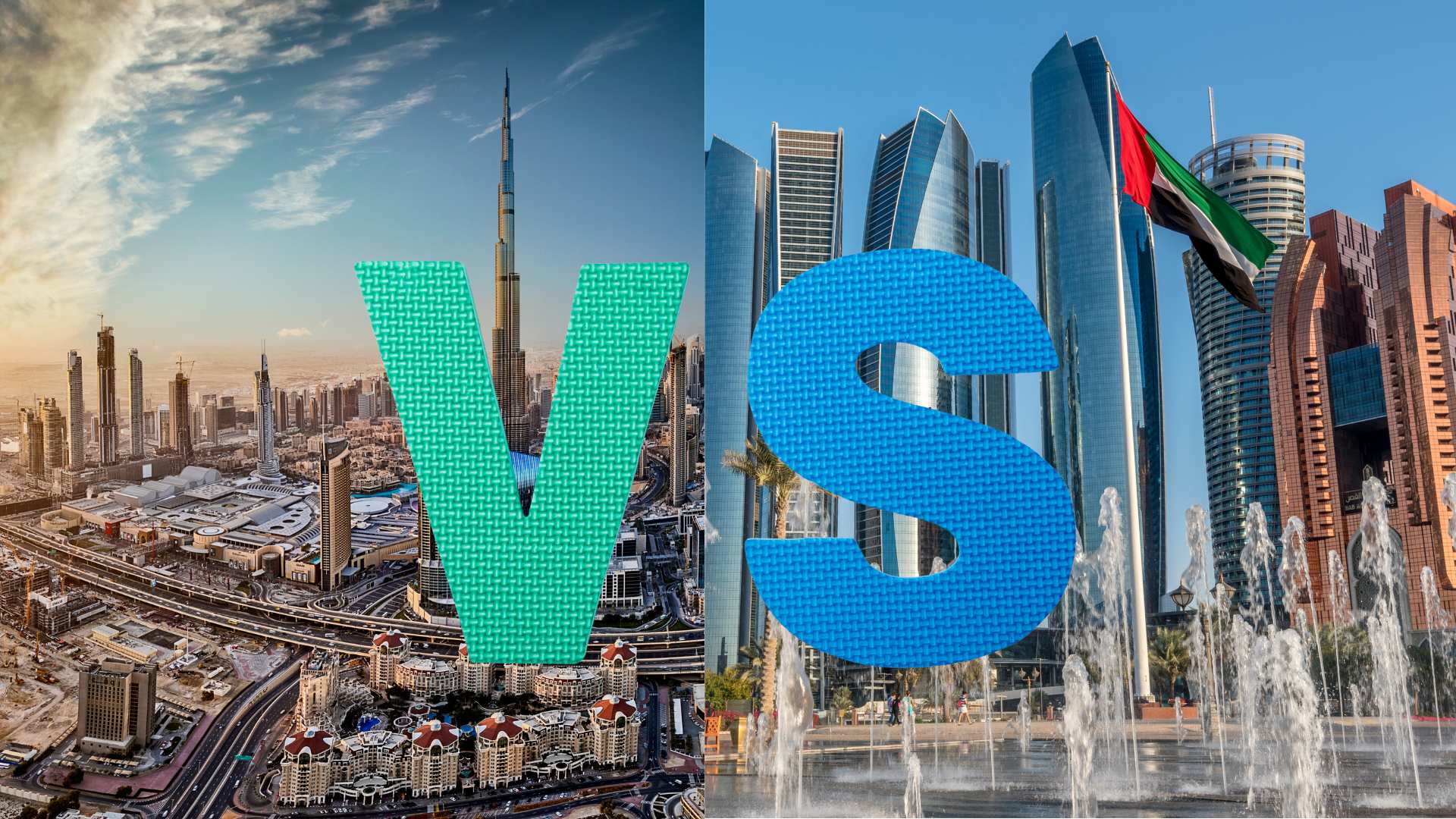
Dubai vs Abu Dhabi Solar Rules: Same Panels, Different Payout
A villa in Arabian Ranches banks its surplus solar power like currency. A villa in Khalifa City, 140 kilometres down the same highway, cannot bank it at all. Same panels, same sun, two irreconcilable rulebooks.
At SolarQuote.ae, we compared DEWA's and Abu Dhabi Department of Energy's own published rules. The result is a distinction every homeowner should understand before requesting a solar proposal.
Drive the E11 from Dubai to Abu Dhabi and the meaning of the meter on your roof changes somewhere around the emirate border. In Dubai, a homeowner who installs rooftop solar under Dubai Electricity and Water Authority's Shams Dubai programme can over-produce on a sunny afternoon, export the excess to the grid, and see it appear on the next bill as a credit that never expires and rolls forward indefinitely, according to DEWA's Shams Dubai FAQ. In Abu Dhabi, a homeowner installing the identical panel under the Department of Energy's self-supply policy — expanded to residential villas in March 2026 — gets no such thing. Exported power there is, in the regulator's own words, “not subject to netting or offset” (DoE Self-Supply Policy, effective 05/02/2026).
This is not a technicality. It is the defining fact of the UAE's fastest-growing consumer energy market, invisible to most of the people it affects — because the country regulates solar power one emirate at a time.
Why this comparison matters now
Abu Dhabi's residential expansion is barely five months old. The DoE's Solar (Photovoltaic) Energy Self-Supply Policy took effect on 5 February 2026, initially covering only farms, ranches and rest houses — a sector the DoE judged “particularly well suited to daytime solar generation,” Director General of Regulatory Affairs Abdulaziz Alobaidli told the Khaleej Times. Phase two, announced 31 March 2026, brought villa owners into scope for the first time, per the official DoE announcement and confirmed by WAM. Abu Dhabi villa owners are only now weighing the decision Dubai homeowners have made since 2015 — and discovering it pays out differently.
Alobaidli has stressed this is deliberate. “At this stage, net metering or energy exports are not permitted under the policy,” he told the Khaleej Times, calling the framework “deliberately structured around self-supply and self-consumption.” The policy text is blunter:
“Export Electricity” is power “metered separately from imported electricity and not subject to netting or offset.” — DoE Self-Supply Policy, p.6
A clause aimed squarely at workarounds adds:
“Nothing in this Policy shall be construed as permitting net metering, cross-plot electricity sales, or any form of private wire arrangements unless explicitly authorised by the DoE.” — DoE Self-Supply Policy, p.6
Selling surplus to a neighbour, running a private cable between plots, splitting a system across a family compound — all are closed off unless the DoE says otherwise, case by case. For a fuller homeowner-level explanation of the framework, read our guide to Abu Dhabi's new self-supply policy.
Dubai net metering vs Abu Dhabi self-supply
Rulebook | Dubai: Shams Dubai | Abu Dhabi: 2026 self-supply policy |
|---|---|---|
Treatment of surplus solar | Exported electricity is credited against bills and rolls forward indefinitely | Exported electricity is separately metered and is not netted or offset |
Cash payment for surplus | No | No stated offset or payment mechanism under the new policy |
Practical design implication | A low-consumption month can still bank value for later | Solar must be sized conservatively around real-time use |
Main regulator / route | DEWA; application through a DEWA-enrolled contractor | DoE; applications through TAMM and DoE-approved contractors |
Dubai's model has had a decade to mature. Shams Dubai launched in March 2015, and DEWA's connection conditions — now version 4, June 2022 — run on genuine net metering: a bidirectional meter tracks imports and exports separately, and if a billing cycle produces more solar than the household consumes:
“the invoiced value of electricity will be zero and the surplus electricity will be shown as a credit which can be brought forward.” — DEWA's FAQ
That credit never expires — “an indefinite rollover is applied” — though DEWA is equally clear it cannot be cashed out: “the producer shall not be paid any money for the excess electricity.” Only DEWA-enrolled contractors can file the application; going outside that list, DEWA warns, means the system “will not be eligible for the grid connection” at all. DEWA has since folded a four-stage approval into three, per its connection-process page, with a one-off AED 1,500 connection fee per generator. See our Shams Dubai net-metering explainer for the step-by-step context.
Abu Dhabi's residential path, five months old, is visibly still under construction by comparison. The policy commits the DoE to issuing “detailed Guidelines setting out the implementation mechanisms, technical requirements, commercial arrangements, and administrative procedures” still to come (DoE Self-Supply Policy, p.13). Applications run through TAMM, the emirate's digital portal, requiring a “self-supply” or “instant electricity generation” licence and DoE-approved contractors, per the Khaleej Times — but exact fees and processing windows sit inside “implementing regulatory instruments” still being finalised months after the residential rollout.
Do not let an installer quote Abu Dhabi savings as if excess solar will earn a DEWA-style bill credit. The mechanisms are different.
See what solar could cost across either emirate at SolarQuote.ae/get-quote.
The legacy Abu Dhabi netting rule creates confusion
Adding to the confusion: Abu Dhabi is not a blank slate here. ADDC and AADC have run a separate “Small-Scale Solar PV Energy Netting Regulation” since 2017 that does credit exported kWh — no cash, but a genuine offset — per industry compliance tracking. The 2026 policy does not extend that legacy regime to residential customers; it creates a parallel, explicitly non-netting framework. The DoE's own stakeholder notes flag “ambiguity” between the two and confirm the new policy “repeals conflicting regulations,” with legacy licences grandfathered in (DoE Self-Supply Policy, p.15).
No federal fix in sight
Nothing federal compels the two emirates to align. Electricity regulation sits constitutionally with the emirates: “There is no federal energy policy at this time. Under the UAE's constitution, individual emirates have autonomy in management and regulation of energy and resources,” the International Renewable Energy Agency noted in its UAE assessment (IRENA, REmap 2030). Federal Decree-Law No. 17 of 2022 obliges every emirate's utility to permit distributed renewable connections in principle, but leaves export treatment to local regulators — a structure a 2026 review in Frontiers in Environmental Science said still needs “further legislative harmonization” (Frontiers in Environmental Science). An earlier WWF/Emirates Nature paper called explicitly to “harmonise renewable policy setting across Emirates” — a call still unmet eight years later (EWS-WWF). A search of 2025-2026 news turns up no Ministry of Energy and Infrastructure move to unify these rules. The absence is itself the story.
Consumers feel the gap even when they cannot name it. On Reddit's r/abudhabi, one resident explaining villa solar to another wrote:
“There is no net metering though, so if you generate more energy than what you need instantly, then this energy goes to the grid and you lose it. ADDC will not pay you for this energy. In Dubai, DEWA gives credit for the extra energy that you don't consume.” — r/abudhabi
That peer explainer is filling a gap official channels left open. Even industry writeups sometimes blur the two systems, describing Abu Dhabi as running a “net metering framework” when actually referring to the legacy 2017 ADDC regulation, not the 2026 policy that explicitly forbids the term.
Specialists frame Abu Dhabi's approach as a deliberate departure, not an unfinished copy of Dubai's. The Middle East Solar Industry Association put it directly:
“This is not a traditional net-metering framework. It is a structured, system-driven approach that prioritizes grid reliability, controlled deployment of distributed generation, and self-consumption-led project economics.” — MESIA
MESIA's session materials flag “zero-export system design” as “becoming critical”: size for what the household actually consumes, because anything exported earns nothing. For the homeowner implications in one place, compare Abu Dhabi self-supply with Dubai net metering.
What the rules mean for a homeowner
The same investment decision — install rooftop solar, at a cost that varies by system size and site and should always be quoted, not assumed — carries different logic depending on postcode. A Dubai homeowner can lean toward a slightly larger system, since a low-consumption month still banks value for later. An Abu Dhabi homeowner under the new policy must size conservatively to real-time use, because an exported kilowatt-hour currently carries no value at all.
That changes system size, realistic payback expectations, and what an installer should even be quoting for. We see this sizing mismatch as a recurring point of confusion near the emirate border, but SolarQuote.ae is a market participant, not a regulator, and no substitute for reading DEWA's and the DoE's published terms directly.
The fragmentation does not stop at two emirates. Sharjah's SEWA has no general residential net-metering programme publicly launched as of 2026 — the only working example is a 280-villa pilot inside the privately developed Sharjah Sustainable City, per SurgePV's compliance tracking. The Northern Emirates' utility, EtihadWE, runs its own scheme with export credits that expire every 31 December, unlike Dubai's. Neither market carries the weight of the Dubai-Abu Dhabi divide today, but their existence reinforces the pattern: in the UAE, “solar policy” is not one thing. It is several, loosely coordinated by nothing in particular.
The bottom line
None of this makes solar a bad investment in either city — both Shams Dubai and Abu Dhabi's self-supply framework are functioning, government-backed paths to a lower power bill, part of a national push toward 20 gigawatts of solar capacity by 2030, up from 6.7 gigawatts in 2025, according to reporting on the Abu Dhabi expansion. But “solar in the UAE” is a misleading phrase.
There is Dubai solar, and there is Abu Dhabi solar, and treating them as interchangeable is how a homeowner ends up promised a payback timeline built on a credit mechanism their emirate does not offer. Until a federal ministry decides two neighbouring capitals should play by the same rules — and nothing so far suggests that decision is imminent — the only reliable guide is not the technology on the roof, but the government department whose name is on the meter beneath it.