TL;DR
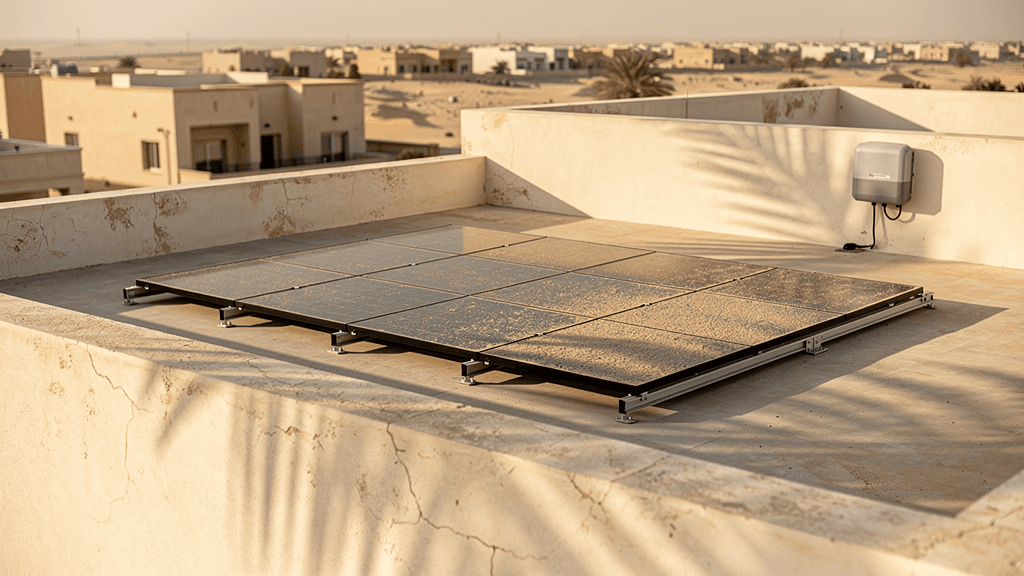
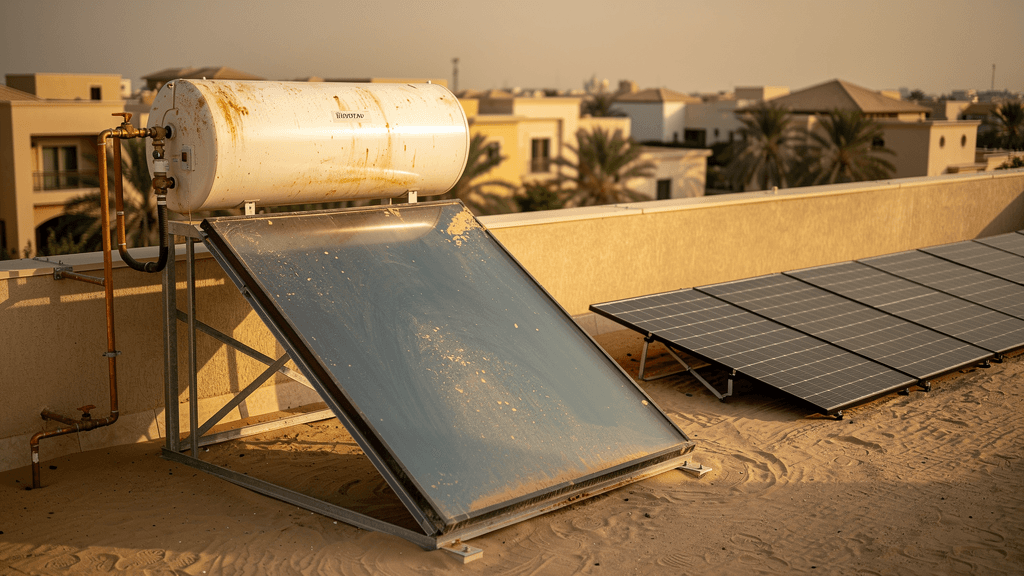
A solar water heater (solar thermal) makes hot water. Solar panels (PV) make electricity. They are different products, different trades and different approval routes — "solar" is not one thing.
For bill reduction in a Dubai villa, PV is the stronger candidate, because cooling dominates household electricity use while water heating is a small slice of it (IRENA).
Dubai does have a solar hot-water rule for new buildings — Al Sa'fat Regulation 504.02 and Dubai Municipality Circular 183 of 2011. We could not find any published villa floor-area threshold such as "above 400 m²". Treat that widely repeated figure as unverified.
Neither route puts the paperwork on you. Your consultant handles the water-heating submission at building-permit stage; a DEWA-enrolled contractor handles the PV application, NOC and inspection.
If you already have solar hot water on a new-build villa, that does not replace PV. The two offset different loads and many villas end up with both.
If you want to cut your DEWA bill, solar PV is the stronger lever for most Dubai villa owners. Cooling is the dominant household load; water heating is not. A solar water heater is a good product, but it can only ever attack the smaller number.
The complication is that solar water heating may not be optional on a new villa. Dubai's green building system requires new villas to use sustainable water heating, and where that is solar it must be sized to cover a defined share of demand. That rule applies at design and permit stage, not to your existing home.
So the honest answer for most readers is: PV for the bill, solar thermal because the code asks for it on new builds — and the two are complementary, not competing.
The core difference in one paragraph
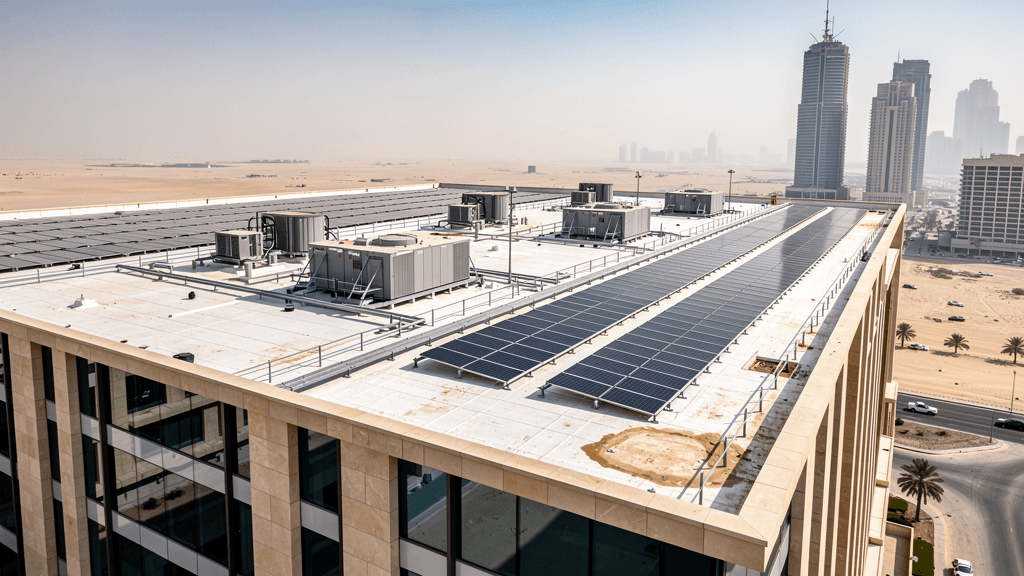
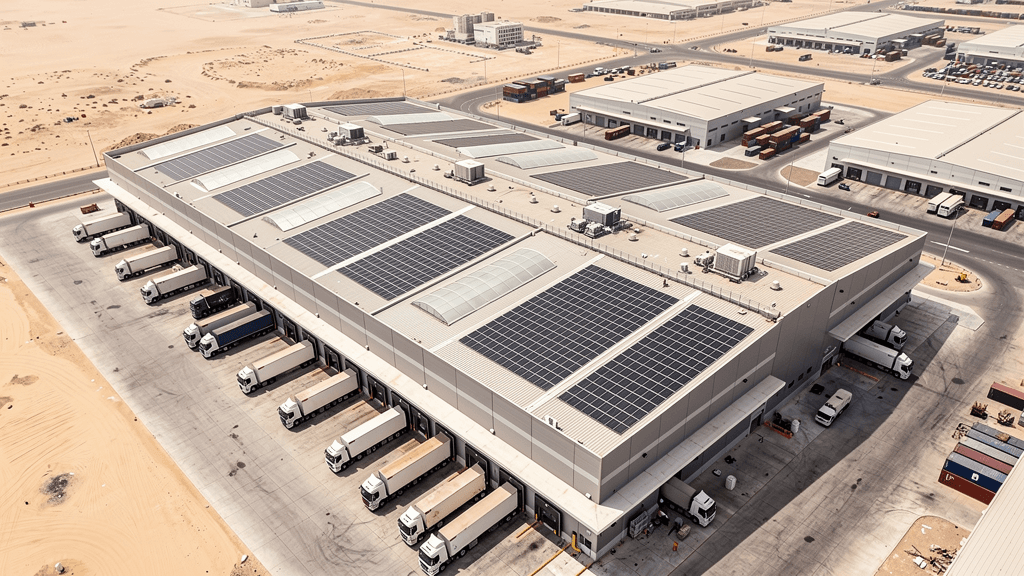
Solar thermal collectors heat water directly. Sunlight warms a fluid in a roof collector, that heat transfers into a storage cylinder, and you draw hot water from it. Solar PV does something else entirely: panels convert sunlight into electricity that runs everything in the villa, including the air conditioning. One replaces a heating element. The other replaces grid units.
Side by side: solar thermal vs solar PV in Dubai
Solar water heater (solar thermal) | Solar panels (solar PV) | |
|---|---|---|
What it does | Heats domestic hot water using a roof collector and a storage cylinder | Generates electricity for the whole property |
What it offsets | The electric water-heating element only | Any electrical load — chiefly air conditioning, the largest household load (IRENA) |
Grid interaction | None. It is a plumbing and mechanical system, not a grid connection | Grid-connected under Shams Dubai net metering; exports are credited against imports (DEWA) |
Approvals | Design calculations and drawings go to Dubai Municipality with the building-permit submission; the system must hold a Dubai Central Laboratory certificate and be installed by a DM-registered supplier (Dubai Municipality Circular 183/2011) | DEWA Solar NOC, design approval, inspection and connection — bundled into one contractor-submitted application (DEWA) |
Official fee | None published by DM for a domestic system | One-off connection fee of AED 1,500 per renewable generator (DEWA) |
Indicative hardware cost | UAE retail listings for 200–300 litre systems run roughly AED 2,225 (excl. VAT) for a 200 L evacuated-tube unit (Maxima Solar) up to AED 4,300–8,256 for branded 200–300 L units (Etihad Souq) — equipment only, installation extra | |
Roof space | Small — a collector array plus a cylinder | Large — scales with the size of your bill |
Best fit | New villas under Al Sa'fat; households with genuinely high hot-water use; pools | Villa owners whose main pain is summer cooling bills |
Who does the paperwork | Your consultant or the registered supplier | Your DEWA-enrolled solar contractor |
Cost note: the figures above are equipment listings from UAE retailers, not installed prices, and no government body publishes an installed cost for either technology in Dubai. Always compare several written quotes that state clearly what is included.
Not sure which one your villa needs? Request free quotes from installers covering Dubai and Abu Dhabi — one form, no markup, no obligation.
The regulation, carefully: what Dubai actually requires
This is the part most articles get wrong, so here is what the published documents say.
Dubai Municipality issued Circular No. (183) of 2011, addressed to consultants and contractors in Dubai, on the use of solar heating systems to supply hot water in buildings. It requires that all solar heating systems "must provide at least 75% of the required total quantity of hot water within the building", that swimming pools get an additional system covering at least 50% of pool heating demand, that every system has a backup electric heater, and that systems carry a Dubai Central Laboratory certificate. Enforcement was tied to permits: "as of 04 March 2012, the actual implementation and assessment of the above criteria will be evaluated for all newly submitted drawings to Building Permit Section" (Dubai Municipality).
That circular still sits underneath today's system. Al Sa'fat replaced the earlier Dubai Green Building Regulations from 19 October 2020, and Silver Sa'fa is mandatory for all new buildings (Dubai Municipality). Inside Al Sa'fat, Regulation 504.02, "On-Site Renewable Energy – Sustainable Water Heating System", states that central or decentralised hot water systems "shall be configured utilizing a sustainable hot water heating technology, such as solar hot water", and that "the system designer shall target 75% of the total hot water daily demand being produced by the solar hot water system" (Al Sa'fat 2nd edition, Jan 2023).
Dubai Municipality's practice guide is more specific about villas: "For all new villas, labor accommodations, hotels, mosques, and educational facilities, sustainable water heaters must be used to provide the total demand of hot water for the building. In case of using solar water heaters specifically, the system must be designed to provide the building with 75% of the total demand on hot water." The same guide requires design calculations and drawings to be submitted to Dubai Municipality for approval, and points back to Circular 183 (Dubai Municipality practice guide).
About the "villas above 400 m² since 2021" claim
You will see this threshold repeated by contractors and comparison sites. We searched Al Sa'fat's full text, the Dubai Municipality practice guide, Circular 183, the Dubai Municipality Al Sa'fat page and DEWA's site, and none of them states a villa floor-area threshold in square metres, and none introduces a new solar water-heating rule dated 2021.
What the published documents do say is that the requirement attaches to new villas as a building typology under Silver Sa'fa, with no size cut-off given, and that Regulation 504.02 has written exceptions — where a hot water system would be impractical due to "tenancy, metering, and pipework distribution constraints", or where point-of-use electric water heaters "would provide a more energy-efficient design solution" (Al Sa'fat).
So: the mandate is real, the 400 m² threshold is not something we can verify. If you are building or buying a new villa and the answer matters commercially, confirm it with Dubai Municipality or your design consultant rather than relying on any figure quoted online, including ours.
None of this is a burden you carry personally. On a new build, the water-heating calculation is a line item in your consultant's mechanical submission, handled inside the permit process you are already going through.
Do you need DEWA approval for a solar water heater?
Short answer: no, not in the Shams Dubai sense. This is the point where readers brace for bureaucracy, and they can relax.
A solar water heater does not generate electricity and does not connect to DEWA's network, so the Shams Dubai route does not apply. That route exists specifically for solar PV, where a DEWA-enrolled consultant or contractor submits the application, obtains the Solar NOC and design approval, arranges inspection, and gets the system connected (DEWA). Only DEWA-enrolled contractors may install grid-connected PV, and a system installed outside that route is not eligible for net metering (DEWA).
Solar thermal instead sits with Dubai Municipality. Installation, operation and maintenance must be carried out by companies licensed with the Department of Economic Development and registered and approved by Dubai Municipality, and the equipment needs a Dubai Central Laboratory certificate kept on site (Dubai Municipality Circular 183/2011). Dubai Municipality runs a registration scheme for solar water heater suppliers through the Dubai Central Laboratory (Dubai Municipality).
There is one thing that genuinely is yours to do, and it is short. If you live in a managed community, get the community NOC. In Emaar communities, "any alteration to the villa has to be approved by Emaar", applied for through the Home Modifications section of the community portal (Emaar Community Management), and the NOC exists to confirm the work complies with Emaar, Dubai Municipality, DDA and Civil Defence guidelines (Emaar). Your contractor supplies the trade licence, scope of works and drawings; you sign and submit.
That is the full list of homeowner tasks. Everything else is your installer's day job.
The UAE counterpoint nobody mentions
Here is the consideration that changes the maths in Dubai, and it is worth raising with any installer who quotes you.
In a temperate country, hot water is a year-round cost because the incoming mains water is cold. In Dubai, roof tanks and pipework sit in extreme ambient heat for much of the year, and demand for heated water falls accordingly. DEWA's own conservation guidance says the quiet part out loud: "Switch off electrical water heaters during summer and water coolers during winter, this can save up to 50% on your water heating and cooling energy consumption" (DEWA). DEWA also lists water heaters among the appliances to avoid running during summer peak-load hours of 12:00–18:00 (DEWA).
If a household is already switching the geyser off for part of the year, the load a solar water heater can displace is smaller than a generic international payback calculation would suggest. We could not find a published Dubai-specific figure quantifying that reduction, so treat this as a question to put to your installer — ask them to size the system against your actual usage, not a European default — rather than a settled number.
For balance, DEWA's guidance also says that when buying a new water heater "it is advisable to purchase solar water heaters if possible" (DEWA). At replacement time, solar thermal is a reasonable choice. As a standalone bill-reduction retrofit, it is a narrower one.
Why PV wins on bill reduction for most villas
The clearest available breakdown of where the energy actually goes comes from IRENA's UAE analysis: "A/C electricity consumption accounted for 41.7% of the total building energy consumption, with the remaining 19.6% for appliances, 5.6% for water heating, 18.3% for others, 1.0% for cooking and 13.7% for lighting." The same report notes that in Abu Dhabi the residential electricity load is 47% cooling and "can exceed 60% during the summer peak" (IRENA).
Those figures come from a 2015 study and the building stock has changed since, so treat them as indicative of the shape of the problem rather than today's exact split. The shape is the point: cooling is roughly seven times the size of water heating in that breakdown.
Solar thermal can only address the 5.6% slice. PV can address the whole bill, and it produces most strongly during the same daylight hours when the air conditioning is working hardest. Under Shams Dubai, whatever you do not use is exported and credited against future bills with an indefinite rollover, though DEWA does not pay cash for surplus (DEWA). Our Shams Dubai net metering guide covers how the credit mechanism works.
IRENA also describes solar water heating in the UAE as having "very significant untapped potential", while noting its use has been concentrated in hotels, Dubai new-builds and government-funded housing (IRENA). Both can be true: the technology is underused, and it is still the smaller lever for a villa owner staring at a summer DEWA bill.
Comparing thermal and PV quotes? Get free installer quotes through one request — quotes come direct from installers with nothing added on top.
Flat plate or evacuated tube — and the third option
If you are specifying solar thermal, the collector choice matters.
Flat plate collectors use copper tubes fitted to a flat absorber plate inside an insulated, glass-covered box (ENERGY STAR). UK government guidance describes them as "generally cheaper" than evacuated tube collectors, with a good cost-to-performance ratio, and they can be roof-integrated, roof-mounted or façade-mounted (UK Energy Technology List guidance).
Evacuated tube collectors surround the fluid tube with a vacuum, so very little heat escapes; ENERGY STAR calls them "the most efficient collectors available" and notes they can cost twice as much per square foot as flat plate (ENERGY STAR). UK guidance puts their annual collection at roughly 450–550 kWh/m² and notes they cannot be installed integral to the roof (Energy Technology List guidance). Those yield figures are for UK conditions, not Dubai, and should not be applied here directly — ask your installer for a UAE-based yield calculation.
Both are sold locally in 200 and 300 litre configurations, which is the usual villa range in UAE retail listings (Etihad Souq, Binja).
The third option: PV plus an efficient electric heater
There is a route that skips solar thermal altogether. Install PV, then heat water electrically using your own generation during daylight hours — the same hours when a solar collector would have been working. Heat pump water heaters, which move heat rather than generate it with a resistance element, are sold in the UAE (Atlantic UAE) and pair naturally with daytime PV output. We could not find a UAE-specific published efficiency comparison between heat pump and resistance water heaters, so ask any installer proposing one to show you manufacturer performance data at UAE ambient temperatures.
On a new-build villa this route may also intersect with Al Sa'fat's written exception for cases where point-of-use electric water heaters "would provide a more energy-efficient design solution" (Al Sa'fat). That is a judgement for your consultant to make and defend, not for you to argue with the Municipality.
Frequently asked questions
Is a solar water heater mandatory in Dubai?
For new buildings, Dubai's green building system requires sustainable water heating, and where solar is used it must be designed to supply 75% of total hot water demand (Al Sa'fat). Dubai Municipality's practice guide names new villas specifically (Dubai Municipality). It is a design and permit requirement for new construction, not a retrofit obligation on existing homes.
Does a solar water heater need DEWA approval?
No. It does not connect to the electricity network, so the Shams Dubai solar PV process does not apply. The relevant approvals are Dubai Municipality's — a Dubai Central Laboratory certified system installed by a DM-registered supplier (Dubai Municipality Circular 183/2011) — plus your community NOC if you are in a managed development.
Can I have both solar panels and a solar water heater?
Yes, and on a new-build villa you may effectively end up with both, because the water-heating requirement comes from the building code while PV is your own choice. They use separate roof areas and separate approval routes, and they offset different things.
Which saves more money in Dubai, solar thermal or PV?
For most villa owners, PV. Cooling dominates household electricity use while water heating is a much smaller share (IRENA), and PV offsets the whole bill rather than one appliance. The honest caveat is that savings depend on your specific consumption, so get both quoted against your actual DEWA bills.
Do solar water heaters still need a backup element?
Yes. Circular 183 requires that all solar heating systems be "equipped with a backup electrical heater that will be used whenever solar energy is not enough" (Dubai Municipality).
What about Abu Dhabi?
Abu Dhabi operates a solar self-supply framework, not net metering, and the two emirates should never be treated as having the same rules. Our Dubai versus Abu Dhabi comparison sets out the differences.
What to do next
If your goal is a smaller DEWA bill, price PV against your last twelve months of bills, and treat solar water heating as a separate decision driven by your building's status and your genuine hot-water usage. If you are building new, ask your consultant one question: how are we satisfying Al Sa'fat 504.02, and why that route.
Then get comparable numbers. Ask each installer the same three things — what the system offsets, what is included in the installed price, and who submits which approval. If those answers differ wildly between quotes, you are not comparing the same job.
Our cost breakdown and DEWA solar approval guide are the useful next reads.
Ready to see real numbers? Request free quotes — one request, quotes direct from installers, no markup and no obligation.