Rooftop solar can contribute to a Dubai warehouse's forklift-charging electricity bill, but buying panels does not mean the trucks must start charging at noon. First assess solar against the fleet's existing charging schedule. Only then compare a separate, manufacturer-supported change to batteries, chargers or shift routines.
This guide is for warehouse owners and authorised operations or finance teams with a DEWA-connected site. The useful question is not how many panels one forklift needs. It is whether a site-specific solar proposal still works after preserving truck availability, using measured charger demand and pricing any fleet changes separately.
Start with three different investment cases
An electric fleet that already charges overnight, a multi-shift fleet with suitable daytime charging opportunities and a planned diesel-to-electric conversion are not the same project. Ask bidders to keep these cases separate:
Warehouse situation | Solar comparison to request | Evidence needed before changing operations |
|---|---|---|
Existing electric trucks, current charging schedule retained | PV serving the building, with the existing charger demand included in the site load and billing model. | Measured charger input, actual charging times, other building demand and eligible DEWA account scope. |
Existing electric fleet, proposed daytime opportunity charging | The same PV baseline, then a separately priced charging-regime change. | Written compatibility and warranty confirmation from the battery/truck supplier, available charging breaks and electrical design review. |
Planned switch from diesel or LPG trucks to electric | A future electric-fleet load case, with solar's contribution shown separately from the fleet conversion. | Approved fleet specification, realistic deployment date, charging-energy estimate, operating trial and separate fuel-versus-electricity calculation. |
The building still needs a suitable roof, installation authority and an appropriate connection. Use our warehouse rooftop feasibility checklist for those physical go/no-go questions. A promising forklift load does not establish roof capacity or grant permission to install PV.
Overnight charging does not automatically rule out Shams Dubai
DEWA's Shams Dubai FAQ explains that PV electricity is available for local use and surplus is exported. Exports and carried-forward electricity credits are deducted from grid imports before tariff slabs and applicable fuel surcharges are applied. Standard Shams Dubai credits surplus electricity; it does not pay cash for it.
Consequently, a forklift charging after sunset can remain a grid load while eligible daytime solar exports contribute to reducing net billed electricity. Direct daytime charging and a lower electricity bill are different outcomes. The site does not have to store its lunchtime sunshine inside the truck to receive the permitted billing benefit.
That is not a guarantee that every export will be useful to this buyer. Ask for a monthly reconstruction of the actual account's bill, including credit balances, other site consumption and the planned occupancy period. If the chargers sit behind a different tenant's account, do not allocate savings to them without confirming the permitted arrangement. Our guide to which DEWA accounts can share solar credits explains why account identity matters.
This article concerns standard Shams Dubai, not a separate D33 agreement or another emirate's rules. Ordinary grid-connected PV is also not a promise that trucks can keep charging during a power cut. DEWA describes interface protection that stops the PV plant under relevant network conditions; any outage requirement needs its own assessed design.
Measure electricity entering the chargers, not just battery size
Give the solar bidder a charger-side demand record prepared by your facilities team or a suitably qualified electrical contractor. Battery capacity and charger nameplate power are useful equipment information, but neither is the measured daily electricity drawn by the fleet.
Energy: obtain input kWh for representative operating days, including quiet days, busy periods and relevant seasonal changes. Record the evidence period and any missing data.
Timing: record charging start and finish times, the number of trucks charging together, shift changes, breaks and non-operating days.
Fleet: list truck, battery and charger models, chemistry, ownership or lease terms, and any replacement already planned.
Site: identify the actual meter/account supplying the charging area and provide the whole-building interval profile where available, plus twelve months of electricity bills.
Availability: state when each truck must be ready for work. A model that depends on a truck being plugged in while it is moving stock is not an operating plan.
Ask the bidder to overlay forecast PV generation with whole-site demand, not just with the charger circuit. The same solar kWh cannot simultaneously be allocated in full to forklifts, cooling and warehouse lighting. If an end-use allocation is supplied, it must reconcile to the building total.
Opportunity charging is a fleet decision before it is a solar tactic
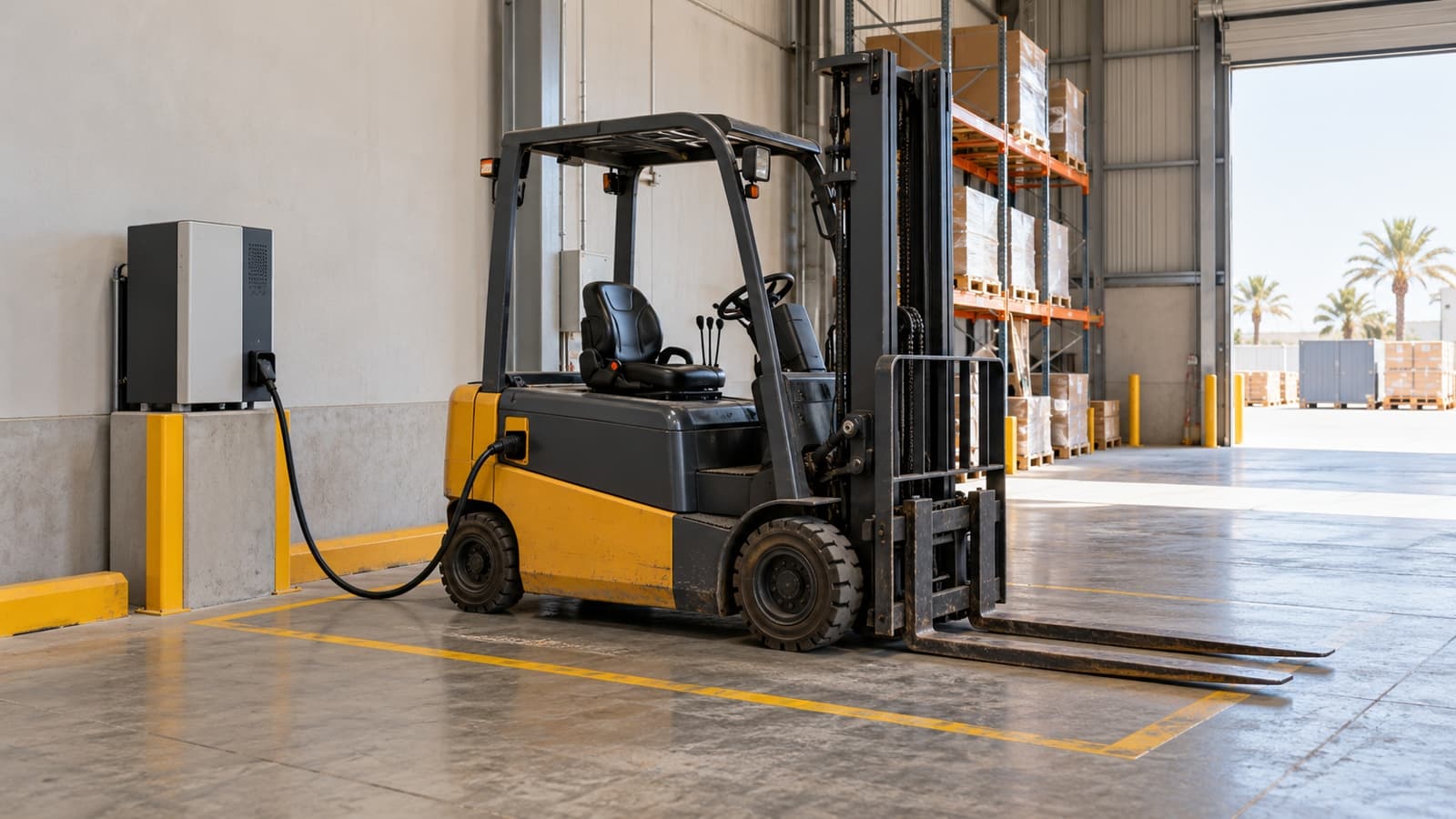
Opportunity charging means using suitable breaks or downtime to charge the trucks. Toyota Material Handling describes compatibility and charger-investment considerations in its June 2021 warehouse opportunity-charging guidance, and cautions that the approach will not fit every operation. It notes that lead-acid opportunity charging can bring battery-life and maintenance trade-offs, while discussing lithium-ion as better suited to this use.
That is manufacturer guidance, not a recommendation to buy Toyota equipment, a rule for every battery or a UAE charging-area approval. Do not adopt a charging rate, interrupt a required charge cycle or substitute equipment on the strength of a solar payback spreadsheet.
Before evaluating a daytime-charge option, request written answers from the truck/battery service provider and electrical design team:
Does this exact truck, battery and charger combination support the proposed duty cycle, within its operating instructions and warranty?
Which genuine breaks are available, and does the fleet retain enough working availability through peak dispatch periods?
Are new chargers, batteries, electrical distribution works, controls or changes to the charging area required?
Who assesses the location, ventilation or cooling needs, traffic separation, fire precautions and applicable permissions for the actual equipment and premises?
What acceptance trial will demonstrate readiness for the next shift, and who owns any ongoing servicing obligation?
These are procurement questions, not instructions for installing a charging station. Retain the current safe, authorised arrangement until the responsible specialists approve any change.
Do not buy an upgrade with savings you already receive
Compare a PV-only proposal using the existing charging schedule with a PV-plus-charging-change option using the same building, solar capacity and generation assumptions. If suitable net-metering credits already offset the relevant imports, increasing direct self-consumption is not automatically an additional cash saving.
Require the bidder to identify the actual difference between the two bill models. “More solar used on site” is an energy-flow result, not a second financial benefit to add on top of electricity already credited. For a related overnight-load example, see our cold-store guide to daytime generation and night-time imports; forklift availability still needs its own operational analysis.
Use three separately priced budgets:
PV project: survey and design, permissions, roof work, installation, connection, monitoring, maintenance and replacement allowances.
Charging change: compatible chargers or batteries, electrical works, area alterations, software, training, servicing and any interruption to operations.
Fleet conversion, if relevant: vehicles or lease costs, infrastructure, energy, maintenance and the evidenced fuel cost being replaced.
For each option, ask for the annual bill with and without PV, then subtract the option's incremental operating costs to compare annual net benefit. Compare that benefit against its own upfront or contractual payments over the same period. Keep VAT treatment, financing and replacement assumptions consistent. Do not quote a standard forklift-solar price or payback before the site and fleet scope are known.
If replacing combustion-engine trucks, separate the vehicle-conversion saving from the solar saving. The electric fleet needs a credible grid-electricity cost baseline first; PV then changes that baseline. Counting the entire avoided diesel bill as a solar saving would overstate what the panels deliver.
A quotation brief your operations team can actually use
We operate a DEWA-connected warehouse in [location] and have authority to assess the roof. Our current/planned electric fleet comprises [truck, battery and charger types]. Charging currently occurs [times]; trucks must be available [shift requirements]. We can provide twelve months of bills, the supplying account details and [available interval/charger data]. Please price PV with the existing charging regime as the baseline. Show any manufacturer-supported charging change separately, including equipment, electrical/area works, operational assumptions and the incremental bill benefit. Identify what needs surveying or specialist confirmation before a final offer.
Decision takeaway: proceed with a solar assessment when the roof, account and measured building demand justify it. Change the fleet's charging regime only when the equipment supplier supports it and the separate operating and financial comparison holds up. A larger direct-solar percentage is not worth missing a dispatch.
To compare suitable site-specific options, request commercial solar quotations through SolarQuote. Identify the property as a warehouse or industrial site and have its Dubai location, bills, roof authority and charging schedule ready for follow-up. SolarQuote is a comparison and installer-matching platform; responses depend on project suitability and installer availability.
Sources checked 30 October 2026. This is an owner-facing investment and procurement guide, not a battery-selection instruction, electrical design, approval or guaranteed return.