Short Summary:
Abu Dhabi opened its Solar Energy Self-Supply Policy to villa owners and eligible residential buildings on March 31, 2026.
The published policy explicitly does not set the detailed metering, export and settlement rules that determine what surplus solar is worth.
This is not Dubai-style net metering: exported electricity is not automatically offset against imported electricity.
Until DoE issues its promised guidelines, villa owners and installers are planning around an incomplete public rulebook.
Abu Dhabi Opened Rooftop Solar to Homeowners in March. Five Months Later, No One Can Tell Them How the Meter Works.
A villa owner in Abu Dhabi who wants rooftop solar has one question before calling an installer: if the panels overproduce on a July afternoon, does the surplus vanish into the grid for nothing, or become a bill credit? Five months after Abu Dhabi's Department of Energy (DoE) told villa owners they could apply for rooftop solar, no official document answers that question.
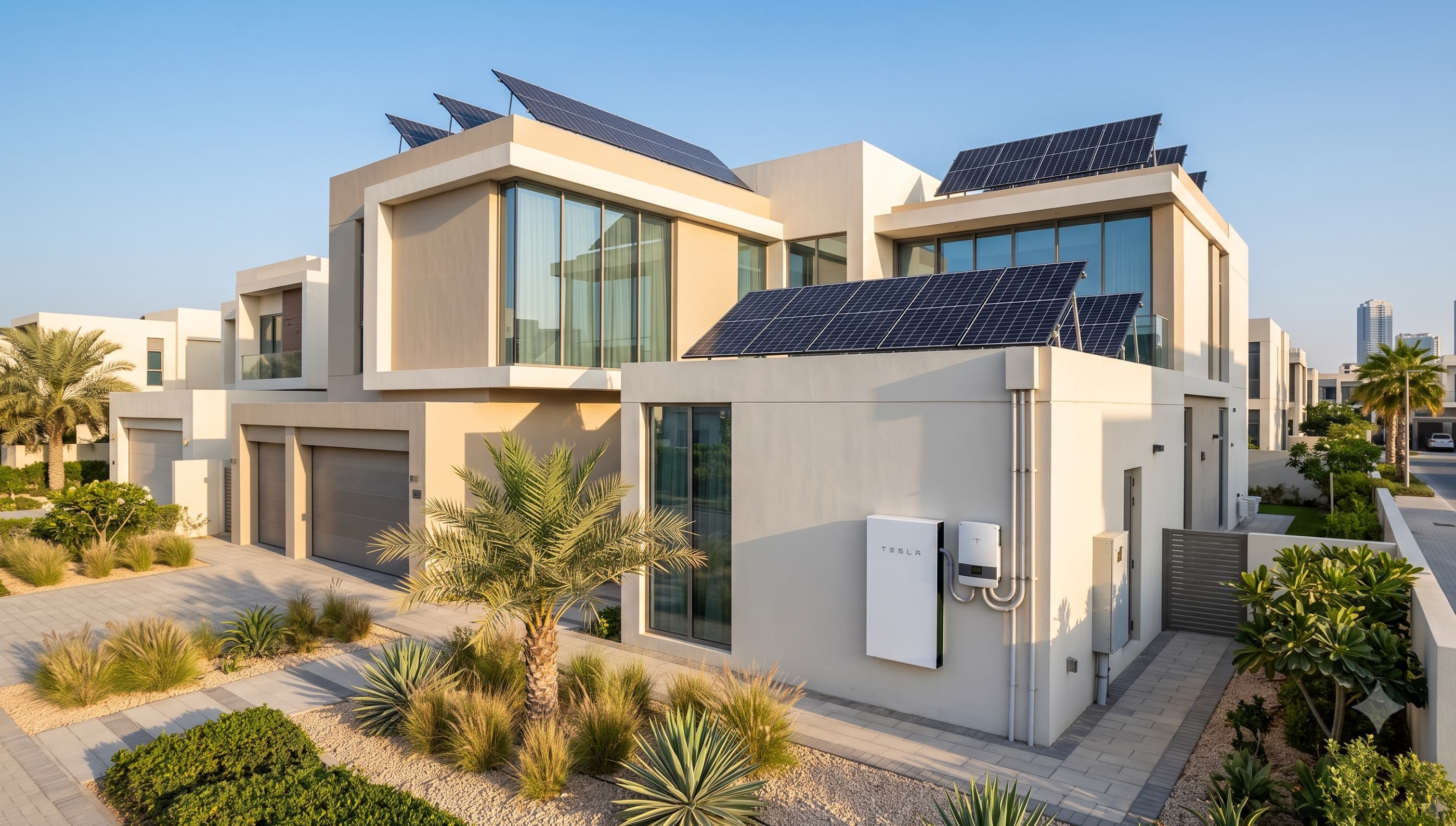
Our analysis of the DoE's own policy documents found that, on March 31, 2026, the regulator launched the second phase of its Solar Energy Self-Supply Policy, extending eligibility "to include the residential sector for the first time in Abu Dhabi," covering "villa owners and residential buildings where applicable"—a genuine milestone, and the first time ordinary homeowners have been allowed to install rooftop solar and storage under a dedicated Abu Dhabi policy (DoE, March 31, 2026).
But the policy is explicit about what it does not yet settle:
“not govern detailed technical requirements, network connection processes, operational protocols, or commercial settlement rules”
“will issue a detailed Guidelines” with “binding provisions on metering, settlement, application and approval processes”
(DoE Self-Supply Policy PDF, effective 05/02/2026)
As of pv magazine's most recent reporting, published June 9 and refreshed in August, that guidance had still not landed: clarity is still needed "around licensing thresholds, export rules, committee review processes, network investment zones, storage treatment, and tariff development" before "developers, investors, and customers can move from interest to execution" (pv magazine, June 9, 2026). For the eligibility and policy basics, see our Abu Dhabi self-supply policy explainer.
Why this matters now
Abu Dhabi has legally opened rooftop solar to a huge, previously locked-out segment of homeowners—and left the single most important practical question, how the electricity gets counted and billed, unanswered in public. Villa owners can apply for a self-supply licence today via TAMM, the emirate's government-services portal, but cannot find a published rulebook explaining what their bill will look like afterward—an unusually long stretch of regulatory silence that installers, industry bodies and homeowners are all trying to plan around.
The bottom line: permission to install solar is not the same as a published answer on whether, or how, excess generation affects a bill.
What the policy says—and doesn't
The rollout has been deliberately phased. Phase one, effective February 5, 2026, opened licensing to "owners of farms, rest houses and ranches" (pv magazine, February 9, 2026; Khaleej Times, February 27, 2026). Phase two, announced March 31, brought in villa owners and eligible residential buildings, letting households "meet a significant share of their daily energy consumption during daylight hours" and store surplus in batteries—a step DoE Director General of Regulatory Affairs Abdulaziz Mohammed Al Obaidli called part of "advancing the policy's implementation" (DoE, March 31, 2026).
What the policy is not—and the regulator has been emphatic about this—is net metering. The DoE defines "Export Electricity" as power "metered separately from imported electricity and not subject to netting or offset," adding:
“Nothing in this Policy shall be construed as permitting net metering, cross-plot electricity sales, or any form of private wire arrangements unless explicitly authorised by the DoE”
That is the opposite of Dubai's Shams Dubai programme, where DEWA credits exported solar against a customer's bill—a true net-metering scheme, no cash but a guaranteed credit (Kayrouz & Associates). Read our plain-English guide to Shams Dubai net metering or our Abu Dhabi self-supply versus Dubai net-metering comparison for the practical distinction.
Under Abu Dhabi's policy as published, surplus beyond what the DoE authorizes for export carries no assured value at all. MESIA, the Middle East Solar Industry Association, has told members the regime is "not a traditional net-metering framework" but "a structured, system-driven approach" where "zero-export system design is becoming critical"—framing built around guidelines still unpublished at the time (MESIA webinar page).
Question | What is published | What remains unresolved in public |
|---|---|---|
Who can apply? | Villa owners and eligible residential buildings are included in phase two. | — |
Is this net metering? | No; exports are separately metered and not subject to netting or offset. | What export, if any, will be authorised. |
How will bills be settled? | DoE says detailed guidelines will contain binding metering and settlement provisions. | The detailed rules themselves. |
The gap installers and homeowners are stuck in
That gap has stretched across roughly six months with no published metering and settlement rulebook. pv magazine's February coverage flagged the DoE's promise of "binding provisions on metering, settlement, application and approval processes" (pv magazine, February 9, 2026); March coverage noted the DoE "did not specify a target for new residential capacity additions" (PV Tech, March 31, 2026); and by June, pv magazine's follow-up—from inside a MESIA industry discussion—was still describing clarity on export rules and tariffs as needed before the market could move "from interest to execution" (pv magazine, June 9, 2026). No dated DoE release, PDF or WAM dispatch reviewed for this analysis announces the guidelines have since been published.
The confusion isn't confined to conference rooms: on Reddit's r/abudhabi forum, one resident wrote, "I've been researching if Abu Dhabi follows the same process as in Dubai where if you exceed the generation, it will count as credit... but couldn't find anything," while another explained, "there is no net metering, so if you generate more energy than what you need instantly, then this energy goes to the grid and you lose it. ADDC will not pay you for this energy" (r/abudhabi thread)—anecdotal, not verified fact, but a texture of confusion matching the open questions the policy leaves unresolved.
Who this affects, and why the tariff math matters
Abu Dhabi does not publish an official count of villa owners newly eligible, and no source reviewed for this analysis puts a number on it. SCAD's census recorded roughly 441,410 residential units emirate-wide in 2023, growing to 783,970 total units by 2024, but does not break out a villa-specific figure—a gap worth flagging rather than papering over (SCAD Census data).
The tariff backdrop shows why the ambiguity carries real financial weight. ADDC's 2025 rate card shows UAE nationals paying roughly 6.7 to 7.5 fils per kWh, while expatriate residents—who make up the bulk of Abu Dhabi's villa-owning and renting population—pay 26.8 to 30.5 fils per kWh, roughly four times more (ADDC Residential Rates and Tariffs 2025). A subsidized national household has little to gain from solar even on generous terms; an unsubsidized expat-owned villa has a stronger case, but only if daytime surplus isn't simply forfeited for zero return. An older, narrower "Small-Scale Solar PV Energy Netting Regulation" does credit surplus as a kWh offset for licensed installations—legally distinct from the 2026 policy, and how the two relate is itself unresolved (DoE netting regulation PDF). Any savings estimate must be treated as a range contingent on rules that don't yet exist in published form.
If you are assessing a villa system while the rules are evolving, compare quotes from installers across Abu Dhabi and Dubai. Ask them to set out their proposed export-control, battery and system-sizing assumptions—not just an estimated savings figure.
The bigger logic—and the risk
None of this looks like indecision so much as deliberate sequencing. DoE Chairman Dr. Abdulla Humaid Al Jarwan told WAM in April the department was "enabling all segments of society to contribute directly to this transition," citing residential self-supply within a planned AED 160 billion, five-year energy and water investment programme, with clean sources already exceeding 45% of Abu Dhabi's energy mix and "a clear pathway" to 60% (WAM, April 21, 2026). pv magazine's June analysis similarly framed the policy as prioritizing "grid reliability, infrastructure utilization, demand-side management, and cost allocation" over rapid export—a regulator moving cautiously by design (pv magazine, June 9, 2026).
But caution risks curdling into stagnation: villa owners have legal permission with no way to evaluate the investment, and installers must design systems without knowing the rules they'll operate under. At SolarQuote.ae, we have flagged the same gap to prospective customers, cautioning that "some operational detail — metering, settlement, exact application steps — was still being issued at the time of writing" and urging homeowners to "treat this as an actively evolving policy" (SolarQuote.ae, updated August 2026).
What to watch next
The clearest marker of progress will be the DoE's promised implementing guidelines—the document converting "self-supply is legal" into "here is what your bill will look like." Until it appears, villa owners applying through TAMM are weighing a financial decision against an incomplete rulebook. Also worth watching: whether the DoE's Self-Supply Committee publishes its terms of reference; whether TAMM approval numbers for villas are disclosed; and whether Abu Dhabi narrows the gap with Dubai's credit model or stays export-averse. For now, the honest answer is the one the regulator itself has published: it depends on guidelines that do not yet exist.