A solar carport can be worth assessing for a Dubai school when useful roof space is limited or the campus already needs better parking shade. It is not automatically a better investment than rooftop solar. The decision turns on the complete canopy cost, the parking and access it preserves, and the electricity benefit the school can actually use.
Ask for roof-only, carport-only and combined options where the site supports them. Compare each against the same campus demand and operating constraints, rather than selecting the largest installed capacity. This guide is for school owners, authorised operators and facilities teams at DEWA-connected campuses in Dubai.
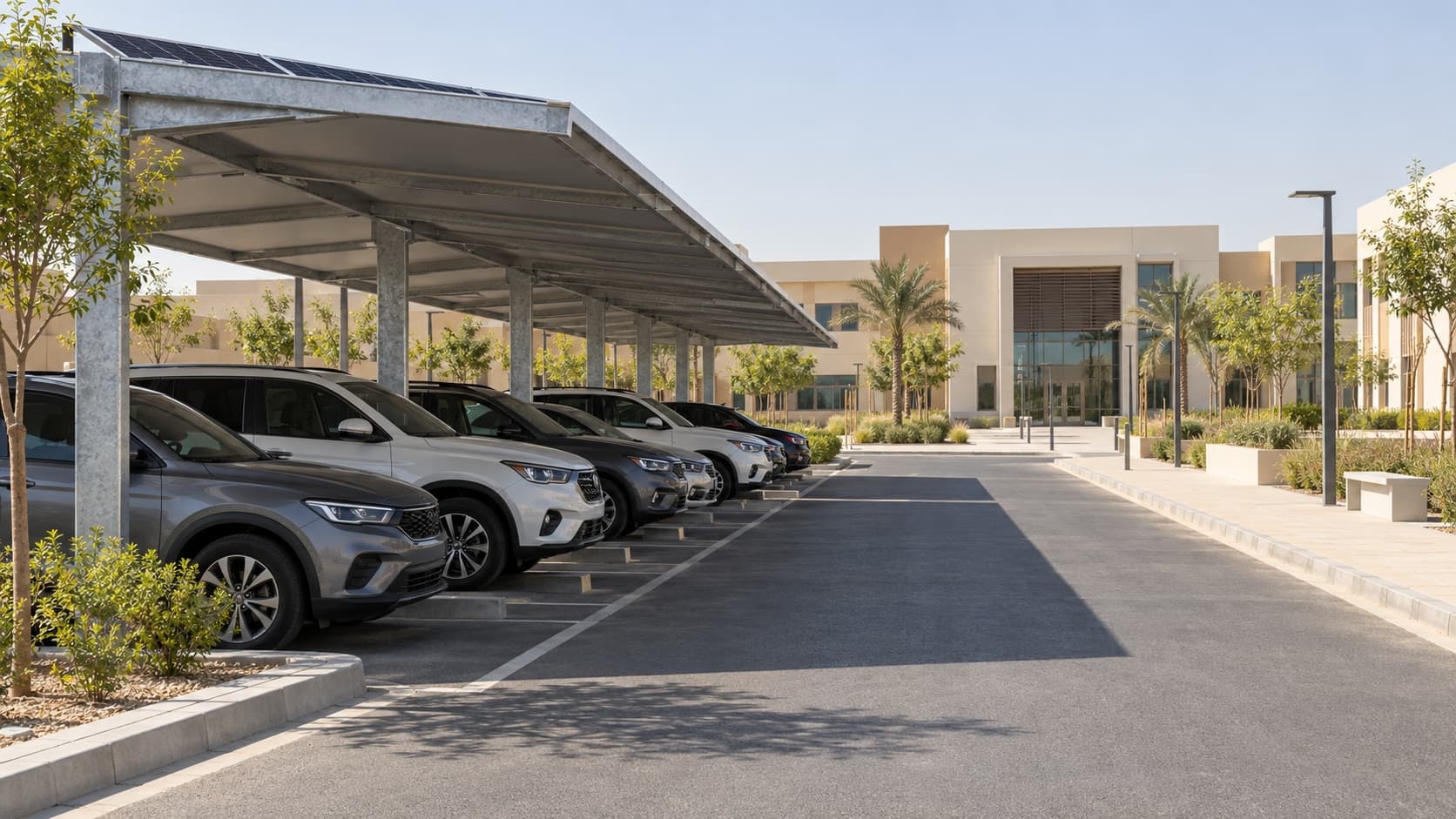
Generated illustrative image of a Dubai-style campus parking canopy, not a named school, approved design or documented installation.
What local school projects establish
There is a documented local basis for considering parking, not just classroom roofs. Positive Zero's GEMS Education project page describes rooftop, carport and bus-parking systems across 23 Dubai schools. When checked on 18 October 2026, the page labelled the programme “Under Construction”. That is provider-reported scope and status, not independent confirmation of completion or a savings result for another campus.
Swiss International School Dubai's 13 July 2023 carport announcement described a new parking canopy with solar panels intended to shade 200 parking spaces. It expected energisation in October 2023 and identified Yellow Door Energy as the developer financing, building and maintaining the plant during the lease. Those are the school's published plans and responsibilities, not a verified current-output measurement.
The useful lesson is that parking can be a separate solar asset with a separate construction and commercial scope. Neither example establishes permission, price or suitability for your school.
Compare three campus options before committing
Option | Why investigate it? | What must be priced or checked? |
|---|---|---|
Roof-only solar | A suitable roof may provide generation without constructing a new parking canopy. | Structural assessment, roof condition, waterproofing, shading, plant access and future roof works. |
Parking carport | It can add a generation location and parking shade where the site layout allows. | Canopy engineering, foundations, underground services, drainage, vehicle clearance, remaining usable bays and access. |
Combined roof and carport | It may use two suitable areas rather than forcing every panel onto one surface. | One coordinated electrical and billing assessment, both construction scopes and the additional benefit of the second area. |
A suitable existing canopy is a fourth starting point, not a free structure. Ask the structural adviser whether it can carry the proposed installation, what alterations are needed and whether its approvals and condition support the change. A fabric shade structure should not be assumed suitable for adding panels.
Keep the electrical demand model identical across the options. Roof and parking arrays serving the same school cannot each be credited with independently eliminating the same bill. For the separate question of holiday demand and carried-forward credits, use our Dubai school solar summer-break guide.
Start with a parking plan, not a panel count
Ask the campus team to mark the bays and routes that must remain usable before a bidder produces the proposed canopy layout. These are recommended procurement checks for professional assessment, not prescribed dimensions or a substitute for the school's safety and safeguarding procedures.
Separate car and bus areas. Record the actual vehicles, turning paths and overhead-clearance needs. A design drawn around parked cars is not evidence that buses can enter, turn and leave beneath it.
Protect arrival and dismissal. Identify drop-off lanes, queuing areas, pedestrian crossings and routes between parking and the school entrance. Show columns and protection measures on that same drawing, rather than on a separate solar-only plan.
Count the bays left after construction. Ask for the existing and proposed usable parking totals, including accessible spaces and access aisles. Nominal canopy coverage is not the same as retained parking capacity.
Check what is underground. Have the design team establish the information and surveys needed for services and foundations before treating civil costs as fixed.
Keep emergency and maintenance access. Ask the responsible professionals to review emergency routes, lifting and cleaning access, drainage and the treatment of runoff near walking areas.
Allow for the next campus change. Identify planned extensions, parking alterations and any likely relocation of bus operations. A long-lived canopy should not quietly occupy land needed for an approved future project.
Request a written list of unresolved assumptions. If clearances, foundations or parking losses remain unverified, label the option provisional rather than presenting its capacity and payback as settled.
Separate the canopy permission from the solar connection
DEWA's solar PV FAQs recognise parking-lot rooftops as a possible PV location, while stating that ground-mounted panels are not envisaged within Shams Dubai. That is not a blanket permit to build a new canopy or to relabel a freestanding panel frame as parking infrastructure.
The same FAQs identify a building permit from the competent authority for civil or structural works and a completion certificate after that authority's checks. Have the appointed adviser name the relevant building authority for the campus, establish property-owner consent and identify any additional site-specific reviews. Do not assume every Dubai school has the same approval route.
The DEWA workstream also needs an enrolled solar consultant or contractor, permits and connection approval, inspection and metering. Our Shams Dubai approval walkthrough explains that utility process. Neither an indicative solar quotation nor an internal school decision replaces the required permissions.
Isolate the extra cost of choosing a carport
Do not compare a complete canopy offer with a roof quotation that prices only panels and electrical work. Give every bidder a common schedule covering surveys and design, structure and foundations, electrical connection, authority work, reinstatement, construction restrictions and lifetime maintenance. Ask which amounts are firm and which are allowances.
There are two different investment questions:
If the school needs solar but does not otherwise need a canopy: compare the full carport project against a complete roof alternative and against no project. Do not remove the steelwork or foundations from the solar budget simply because they also provide shade.
If the school already has a funded parking-shade project: obtain a like-for-like conventional-shade baseline and a solar-canopy alternative. Only a genuine avoided cost belongs in the comparison. Check that both options retain comparable bays, useful shade, drainage, design life and maintenance scope.
A practical finance test is to compare the additional whole-life cost of the carport option with its additional electricity-bill benefit over the roof option. If the carport generates no extra usable financial benefit, a higher price needs a separate, explicit justification such as a required shade improvement. Keep that amenity decision visible rather than disguising it as electricity savings.
Ask for annual and monthly forecasts with the generation, imports, exports, credits, maintenance and replacement assumptions shown. DEWA describes ordinary Shams Dubai surplus as bill credits, not cash payments for exported electricity. Do not value every extra panel as a guaranteed sale to the grid.
Our solar quotation line-item checklist helps expose exclusions. If comparing purchase with finance, our Dubai solar lease and PPA guide covers the wider contract questions. For a carport, add who owns and maintains the structure, who pays for collision damage or resurfacing interfaces, and what happens if the parking layout must change.
Make the delivery and service plan school-specific
Require the construction programme to show which bays and routes close, the replacement arrangements and how work is separated from pupils and staff. Set out deliveries, lifting, electrical work windows and a safe incomplete-works plan if the job runs into term time. A summer installation promise is not a guaranteed approval or energisation date.
Then test the maintenance plan against an occupied campus: when can cleaning and inspection take place, how will the area below be controlled, and who restores access? DEWA requires an operation and maintenance contract; distinguish the solar service scope from maintenance of the canopy, drainage and surrounding parking infrastructure. The owner should not perform electrical work.
What to send before requesting comparable options
Prepare a site brief with the property decision-maker and occupation horizon; a year's bills and available interval data; roof and parking drawings; existing canopy records; vehicle and pedestrian constraints; known underground-service information; planned campus works; and acceptable construction windows. Share sensitive drawings and detailed bills privately with the appointed professionals, not in a public enquiry.
Decision takeaway: a school solar carport deserves further assessment when the parking area is genuinely available, the layout remains workable and the complete cost is justified against the roof and any real shade-only alternative. More covered bays or more kilowatts alone do not settle the decision.
To compare suitable campus options, request commercial solar quotations through SolarQuote. Identify the Dubai school, your authority over the site and whether you want roof, carport or combined proposals. SolarQuote is a comparison and installer-matching platform; suitable introductions depend on project suitability and installer availability.
Sources checked 18 October 2026. This is an owner-facing feasibility and procurement guide, not structural, traffic, electrical or regulatory design advice, a campus approval or a guaranteed return.