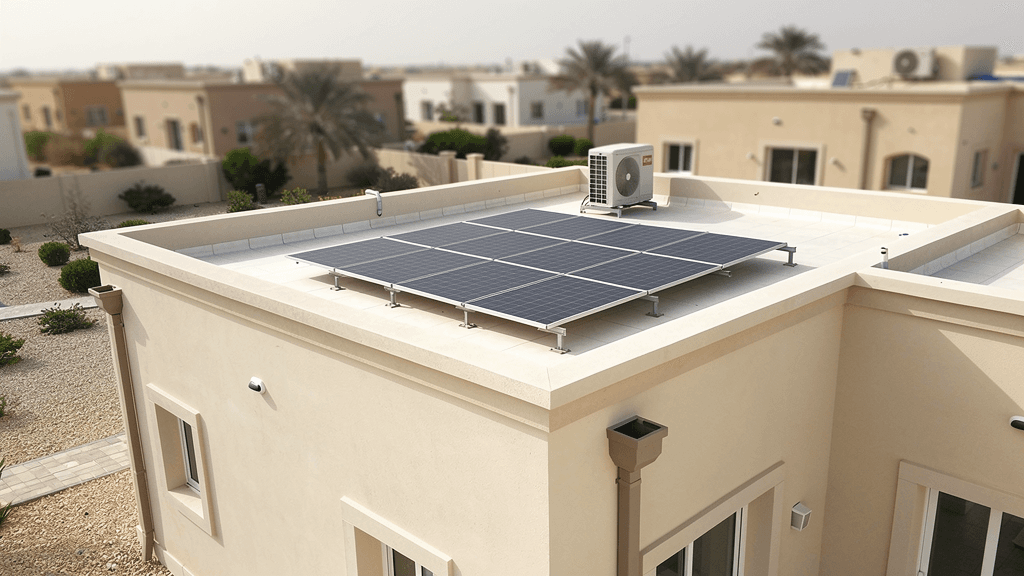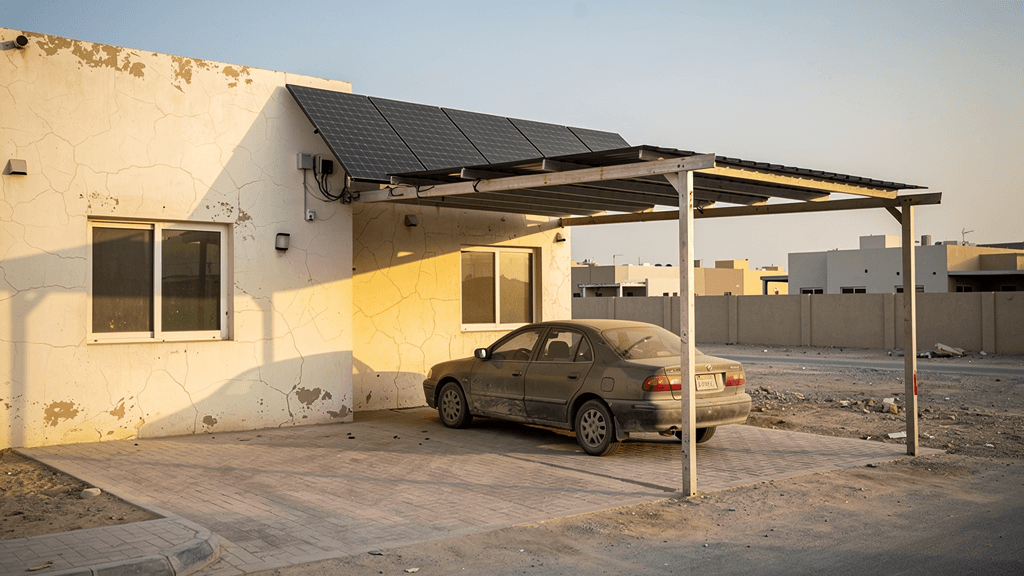
Illustration: a generated Dubai-style villa and solar carport. This is not a photograph of an approved installation.
Short answer: A solar carport is technically possible in Dubai, and DEWA has connected carport projects under Shams Dubai. That does not mean you can place panels over your villa driveway without checking the canopy's building approval, your community's rules and DEWA's site-specific connection requirements. An existing, approved carport and a proposal to build a new one are different projects.
This guide is for an owner considering grid-connected solar over a private Dubai villa parking space. It is not an approval for any particular plot, structure or community. Official DEWA material checked September 2026.
Carport versus ground-mounted panels: why the distinction matters
DEWA says PV can be integrated with structures, including parking-lot rooftops, but says ground-mounted panels are not envisaged within Shams Dubai. Its published examples include a solar carport at the Emirates Engine Maintenance Centre in Warsan. Those large commercial precedents show that a canopy is not categorically excluded; they do not establish a blanket permission for a villa driveway. See DEWA's Shams Dubai FAQ and its published carport example.
The practical question for a villa is whether the proposed array is on an acceptable, legally approved parking structure at your plot, not whether a freestanding rack can be relabelled a carport. Ask a DEWA-enrolled solar consultant to seek a project-specific answer rather than treating an example elsewhere in Dubai as a permit.
Three permissions to resolve before paying a deposit
The parking structure: obtain the existing canopy's approved drawings and completion paperwork, if any. If it is new, extended or structurally changed, ask the competent building authority what permit and completion process applies. DEWA says the civil or structural element needs a building permit from the competent authority and a completion certificate after its checks. The authority may differ by site.
The community or landlord: check the actual deed, community alteration rules and the decision-maker for exterior modifications. A community NOC, where required, is separate from DEWA's electrical approval. Get a written decision on the proposed elevation and canopy, not a casual assurance that somebody else has solar. For an example of why community sign-off matters, see our Arabian Ranches II approval guide; its Emaar process does not automatically apply to your community.
Solar connection: have a DEWA-enrolled consultant or contractor assess the precise canopy layout, equipment and account. DEWA's process covers solar permits and connection, inspection, metering and generation. The installer should explain who submits each document and when installation can begin; our Shams Dubai approval walkthrough gives the broader sequence.
Do not build first and seek approval later. In a managed community, a compliant solar design cannot rescue an unapproved external alteration. Equally, community consent does not replace a DEWA connection decision.
Existing carport, new carport or villa roof?
Existing approved carport: check the original structural design and condition, wind loading, anchoring, corrosion, water drainage and clearance above the vehicle. Approval for a shade canopy is not proof it can carry an array. Ask for a signed structural assessment and a panel layout showing maintenance access.
New carport: treat the support structure as a construction project in its own right. Clarify boundaries, setbacks, height, appearance, foundations and community permission before buying panels. A contractor's solar quote alone is not a building permit.
Villa roof instead: compare usable unshaded area, safe access, fixing and waterproofing, cable run and approvals. A roof may offer more area without a new freestanding structure, but it brings its own risks. Our flat-roof waterproofing checklist helps you scope that comparison.
What to ask the installer to put in writing
Is this design assessed as PV on an existing approved canopy, a proposed new canopy, or a different structure? Which authority and community decisions are still outstanding?
Who is responsible for structural calculations, the canopy permit, connection paperwork, inspections, insurance and any reinstatement if permission is refused?
What is the measured usable panel area after shade, access and vehicle-clearance constraints? Show an annual generation estimate with its assumptions, not a generic yield for all of Dubai.
Where will cables, isolators and the inverter sit, and how will they be protected from impact, weather and heat? Who maintains both the panels and the canopy?
What is excluded from the price, especially the canopy structure, foundations, design approvals, electrical upgrades and ongoing maintenance? Compare like-for-like with our 12-item solar quote checklist.
If the installer cannot distinguish a carport roof from a ground-mounted frame or will not identify the permitting path, pause the purchase. The lowest-risk first step is a measured site survey and a written feasibility answer from a DEWA-enrolled firm, followed by the competent building authority and your community's response. Only then compare the carport against the main villa roof and the expected electricity benefit.