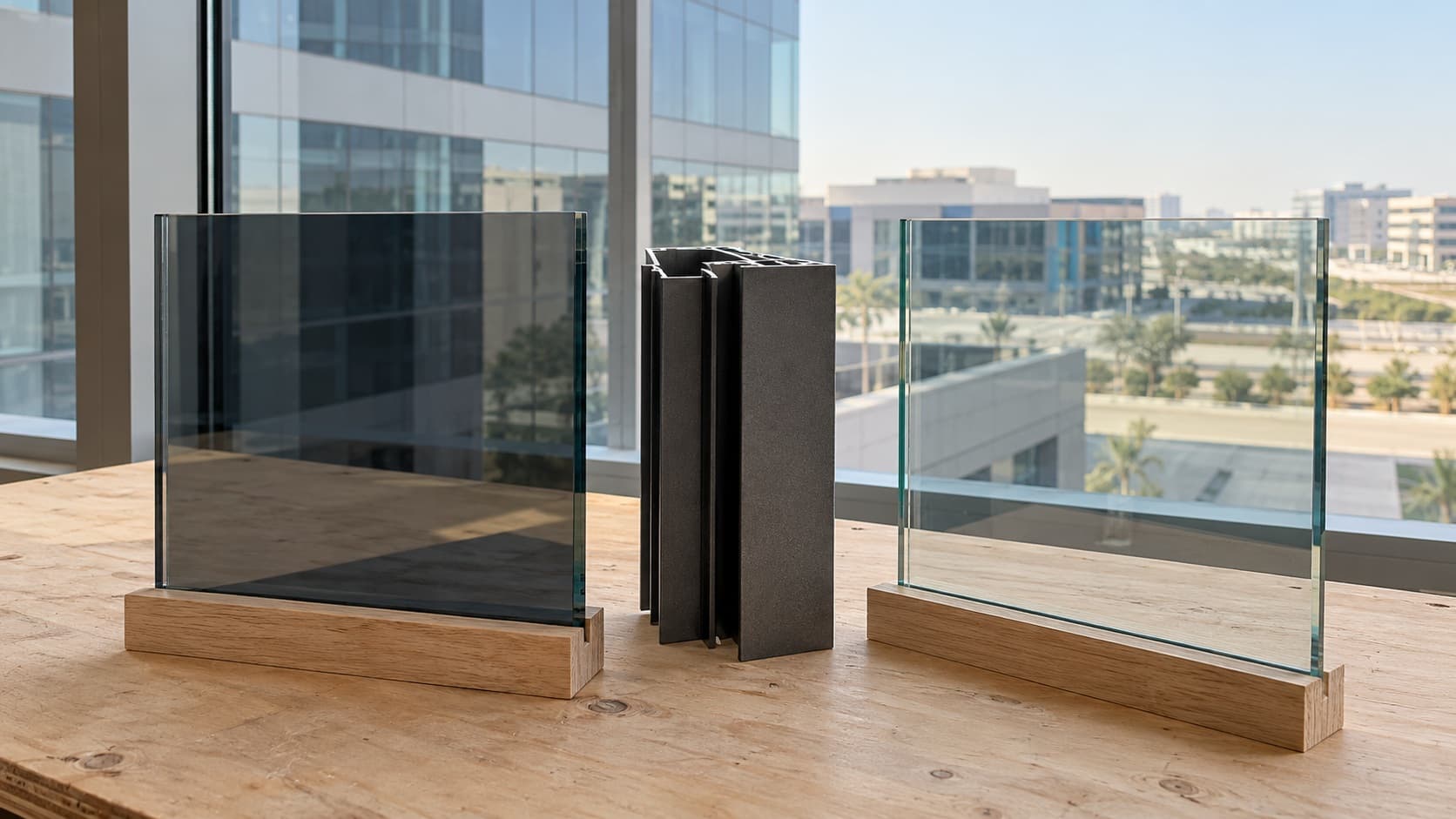
Illustrative image: a generic architectural-materials study, not an ALEC Energy project or product specification.
ALEC Energy is worth investigating if your Dubai solar brief involves either a conventional commercial installation or solar integrated with the building's architecture. The important comparison is not simply one contractor's price per panel: it is what the proposal includes, who takes responsibility for the roof or façade, and what you will own and maintain afterwards.
This is a desk-researched company profile, checked on 24 October 2026. It draws on the currently linked DEWA list and ALEC's public company and project information. It is not a customer testimonial, site inspection, workmanship rating or recommendation to award a contract.
Who is ALEC Energy, and which company is listed by DEWA?
ALEC Energy's website describes the business as a division of ALEC Engineering and Contracting L.L.C., established in 2015. The parent ALEC website also identifies ALEC Energy as its solar EPC business and links to the energy website. Ask for the exact contracting entity on your proposal rather than assuming the trading name is a separate legal company.
On this check, the document linked from DEWA's official enrolled solar contractors and consultants page names ALEC ENGINEERING & CONTRACTING LLC in the contractor section, with www.alec.ae. The list is internally dated 18 July 2025; the landing page displays 31 July 2025. Those are source dates, not a new certificate issued on our October 2026 verification date.
Enrolment is not a DEWA endorsement, project approval or guarantee of price or workmanship. DEWA's disclaimer makes that distinction important. Recheck the list and the entity submitting your connection application before appointment, and ask who is responsible for other building and property permissions.
What services does the company advertise?
In its published solar solutions, ALEC Energy describes concept-to-commissioning services, operation and maintenance, conventional solar installations, building-integrated photovoltaics (BIPV) and building-applied photovoltaics (BAPV). It describes an EPC agreement as engineering, procurement, construction and handover on a lump-sum basis.
The architectural distinction matters. The company describes BIPV as part of the building exterior, whereas BAPV adds solar elements to the basic building shape. Neither label tells you, on its own, what weatherproofing, structural work, access equipment or replacement service your own price includes.
For an existing warehouse, start with a roof-and-load feasibility brief. For a new commercial building or façade refurbishment, ask the solar and building-design teams to price a coordinated architectural option separately. A distinctive façade is not automatically the lowest-cost way to produce electricity.
Which published projects are relevant to a buyer?
The company's project portfolio includes entries for CPL Aromas Warehouse, Technical Glass & Aluminium Factory, Dubai CommerCity, Dubai Hills Mall rooftop and carpark solar, an IKEA Supply warehouse in Dubai World Central, and glass-glass PV cladding in Emirates Hills. These illustrate the different project types the company reports, not independently verified present-day output or evidence that every project has the same commercial terms.
The IKEA project page says ALEC worked on engineering, procurement, construction and operation and maintenance, and reports completion in 2021. By contrast, the Emirates Hills cladding page still describes an expected fourth-quarter 2022 completion and separates AES's subframe/module work from ALEC Energy's electrical and grid-connection scope. That forward-looking historic wording is not proof of present completion. It is a useful reason to ask for an up-to-date reference and a written split of responsibilities.
These are portfolio references, not a commissioning audit. Request a dated reference relevant to your own building. An industrial rooftop reference answers different questions from a custom glazed façade, while a villa-cladding example is not proof of suitability for a commercial tower.
Useful reference questions include: what did ALEC supply directly, what did another specialist supply, who coordinated the interfaces, and can the client discuss commissioning and aftercare? Ask for that evidence rather than extrapolating from a project's name, prestige or size.
Compare the scope before comparing the headline price
Use the following as a proposed tender structure, not as a statement of ALEC's standard contract terms.
Option to request | What the owner should compare | Responsibility to name |
|---|---|---|
Conventional rooftop or carpark PV | Site-specific generation, roof or canopy works, connection scope, safe access and annual operating costs. | Solar contractor, roof or structural designer, property authority and maintenance provider. |
Solar added to a building surface | Solar equipment plus the additional supports, envelope interfaces and access arrangements actually required. | Who designs, supplies, installs and warrants each interface with the existing building. |
PV forming part of the exterior | The complete architectural assembly against the non-solar exterior it replaces, alongside a conventional PV alternative where feasible. | Façade and solar design coordination, weatherproofing, testing, replacement access and warranty interfaces. |
For an integrated option, request two transparent comparisons: the total project budget and the incremental cost against the exterior you genuinely intended to build. Do not subtract a notional premium façade you would never have bought. Ask the designer to state which conventional materials and works are actually avoided.
Likewise, require a separate generation forecast for each proposed surface and orientation, with shading and loss assumptions. Do not transfer a rooftop yield estimate to vertical glazing. Our guide to reading the line items in a solar quote helps expose missing works and operating allowances.
Six questions to put in your ALEC Energy enquiry
Which entity and delivery team would contract for this project? Confirm the legal name, DEWA submission responsibility, design leads and any specialist façade or mounting subcontractors.
Can you provide a genuinely comparable reference? Request the same building use and installation type, a completion or commissioning date, and a clear account of the company's delivered scope.
What building work is inside the price? For a retrofit, identify roof repairs and interfaces. For architectural PV, request a coordinated schedule for glazing, framing, seals, wiring routes, access and the relevant design approvals. Ask which tests and acceptance documents are included.
How is output assessed, and what remedy is offered? Separate forecast energy from a contractual commitment. State the measurement boundary, exclusions and any shortfall remedy; the performance-guarantee comparison explains why a panel warranty is not a whole-project output guarantee.
Who pays when an exterior PV element needs replacement? Request written responsibility for diagnosis, specialist access, removal, replacement, temporary weather protection and reinstatement. Ask about matching replacement units and the consequences if the original design is no longer available.
What continues after construction? Separate included defects support from a priced maintenance agreement, cleaning scope, monitoring access, response commitments and future renewal charges. Request the owner's operating manuals, drawings, test records and warranty contacts at handover.
Purchase, maintenance or financed agreement?
ALEC's published lump-sum EPC description supports asking for an outright construction proposal. Its advertised maintenance capability supports asking for a separately defined operating scope. Neither proves that every installation includes lifetime maintenance, free repair labour or financing.
If a financed or pay-for-energy option is proposed, request the provider's identity, ownership structure, payment basis, term, escalation, buyout and exit obligations in writing. Do not assume a familiar contractor brand also owns or finances the plant. Compare offers using the same bills, roof rights, operating hours and study period, without inventing a standard ALEC price or payback.
The practical next step
For a straightforward existing commercial roof, request a conventional PV baseline first. For a building-envelope project, ask for the conventional baseline and a separately costed architectural option with named interface responsibilities. Choose on the complete scope and evidence, not the rendering.
You can approach ALEC Energy directly through its official website to request a proposal. If you want to compare alternatives, request multiple solar quotes through one SolarQuote submission, subject to project suitability and installer availability. Include your location, authority to approve work, recent electricity bills, building drawings and whether the brief is rooftop PV, a canopy or integrated exterior work.
SolarQuote is a comparison and installer-matching platform, not the installation contractor or DEWA. This profile does not imply ALEC Energy participates in SolarQuote or that a submission will produce a quote from the featured company.