TL;DR
Credits follow the DEWA account, not the person. DEWA's Shams Dubai FAQ is explicit that if you sell or rent the property, "your accumulated credit cannot be transferred to the new owner's or tenant's account" (DEWA Shams Dubai FAQ).
The system is normally the landlord's fixture under Dubai tenancy law — tenants can't remove improvements and can't alter the property without consent (Law 26/2007).
But the bill savings usually land with the tenant, because the DEWA account on a rented villa is normally in the tenant's name, and credits attach to whichever account the solar feeds. (Reasoned synthesis — see caveat below.)
The standard Dubai lease is silent on solar. No RERA/DLD/Ejari rule covers solar credit allocation, panel maintenance, or cleaning responsibility — this is a genuine gap as of July 2026.
There's no published UAE case law on landlord-tenant solar disputes. This is practical guidance, not legal advice — for your specific lease, consult a RERA-registered agent or lawyer.
The DEWA rule that anchors everything
Most of the "who owns the savings" confusion dissolves once you understand one DEWA mechanic: solar credits attach to the DEWA account linked to the connection point, and they cannot be moved between accounts.
DEWA's FAQ on selling or renting the property hosting a solar generator:
"Should you decide to sell or rent the property that hosts your Solar PV generator, you can agree with the new owner or tenant to transfer your generator to their account. However, your accumulated credit cannot be transferred to the new owner's or tenant's account." (DEWA Shams Dubai FAQ)
And the credit accrual principle: "The quantity exported to the DEWA grid is monitored by the meter so that you can be credited on your future electricity bills" — credits accrue to the account holder on that connection point (DEWA FAQ).
An industry compliance source makes the implication explicit: "Net metering credits under Shams Dubai are applied to the DEWA account linked to the connection point… There is no mechanism within the standard Shams Dubai framework for splitting or transferring credits between separate DEWA accounts" (SurgePV — secondary UAE installer source, informed interpretation not law).
So the question "who owns the savings" really reduces to: whose DEWA account does the solar system feed?
The default position: landlord owns the system, tenant often captures the savings
Two separate things are at play — physical ownership of the system, and who gets the bill credits. They don't always go to the same person.
The system is the landlord's fixture
Under Dubai tenancy law (Law No. 26 of 2007, as amended), tenants cannot make changes to the property without the landlord's consent, and "at the time of vacating the property, the tenant must not remove any improvements made [to] it, unless otherwise agreed between the parties" (Article 23, summarised by Potential Real Estate; primary law at Dubai Law No. 26 of 2007). The general legal principle (supported in non-UAE commentary by DLA Piper and Penningtons) is that rooftop solar is a landlord's fixture unless the lease says otherwise.
So by default: the landlord paid for it, the landlord owns it, and it stays with the property.
The savings usually follow the tenant's DEWA account
Here's the twist. For rented property in Dubai, the DEWA meter is normally in the tenant's name. The Dubai Land Department's tenancy guide requires, for lease registration, an "electricity and water invoice of the last month (the meter shall be in the name of the tenant)" (DLD Tenancy Guide). Once Ejari is registered, "the tenant's details are automatically transmitted to DEWA" (Continental Club).
The default position, made explicit: the landlord owns the system and should control the economic benefit unless the lease or generator transfer says otherwise. Operationally, though, DEWA credits apply to the account the system feeds — and in rented Dubai villas that account is often the tenant's. So the contractual ownership sits with the landlord, while the operational bill savings can land with the tenant.
Reasoned synthesis (the key insight — read the caveat): if the villa's DEWA account is in the tenant's name and the solar system feeds that same metered account, then the net-metering credits reduce the tenant's own bill — meaning in the common Dubai setup, the tenant effectively captures the solar savings while occupying the villa. This combines the DEWA rule (credits attach to the account on the connection point) with the norm that the rented-villa DEWA account is in the tenant's name (DEWA FAQ; SurgePV).
Important caveat: no single source states this exact villa scenario end-to-end. It's assembled from the DEWA transfer rule plus the tenant-account-holder norm. And it flips if the solar generator remains on the landlord's account rather than being transferred to the tenant's — in which case the landlord captures the credits. The outcome depends on how the account and generator are linked, and on what the lease specifies.
Landlord considering solar for your rental villa? Get quotes from vetted installers and structure the setup to match your lease strategy. Get quotes →
The gap: standard Dubai leases don't cover solar
This is where it gets practical — and where the law is silent. Dubai tenancy law (Law 26/2007) addresses maintenance and improvements generally:
Landlord's maintenance default: "Unless agreed otherwise… the landlord is responsible for maintenance, repair and restoration of any faults, defects, wear and tear caused to the property" (Article 16, per Potential Real Estate).
DEWA's O&M condition: the Shams Dubai FAQ places operation and maintenance on "the customer" (the account holder / system owner), who is "required to have an operation and maintenance contract with a service provider" (DEWA FAQ) — a program condition, not a RERA lease rule.
But no fetched RERA, DLD, or Ejari source specifically addresses solar systems, solar bill-credit allocation, or solar panel maintenance responsibility. The standard unified tenancy contract templates reviewed don't mention solar (DLD Unified Tenancy Contract).
Verdict: as of July 2026, there is no specific RERA/DLD/Ejari rule on solar in tenancies — a genuine gap. Standard Dubai leases are silent. Allocation defaults to (a) whose DEWA account the system feeds and (b) general fixture/maintenance provisions. The practical upshot: this must be handled by an explicit lease clause or addendum, because the standard framework doesn't cover it.
The disputes you actually need to pre-empt in the lease
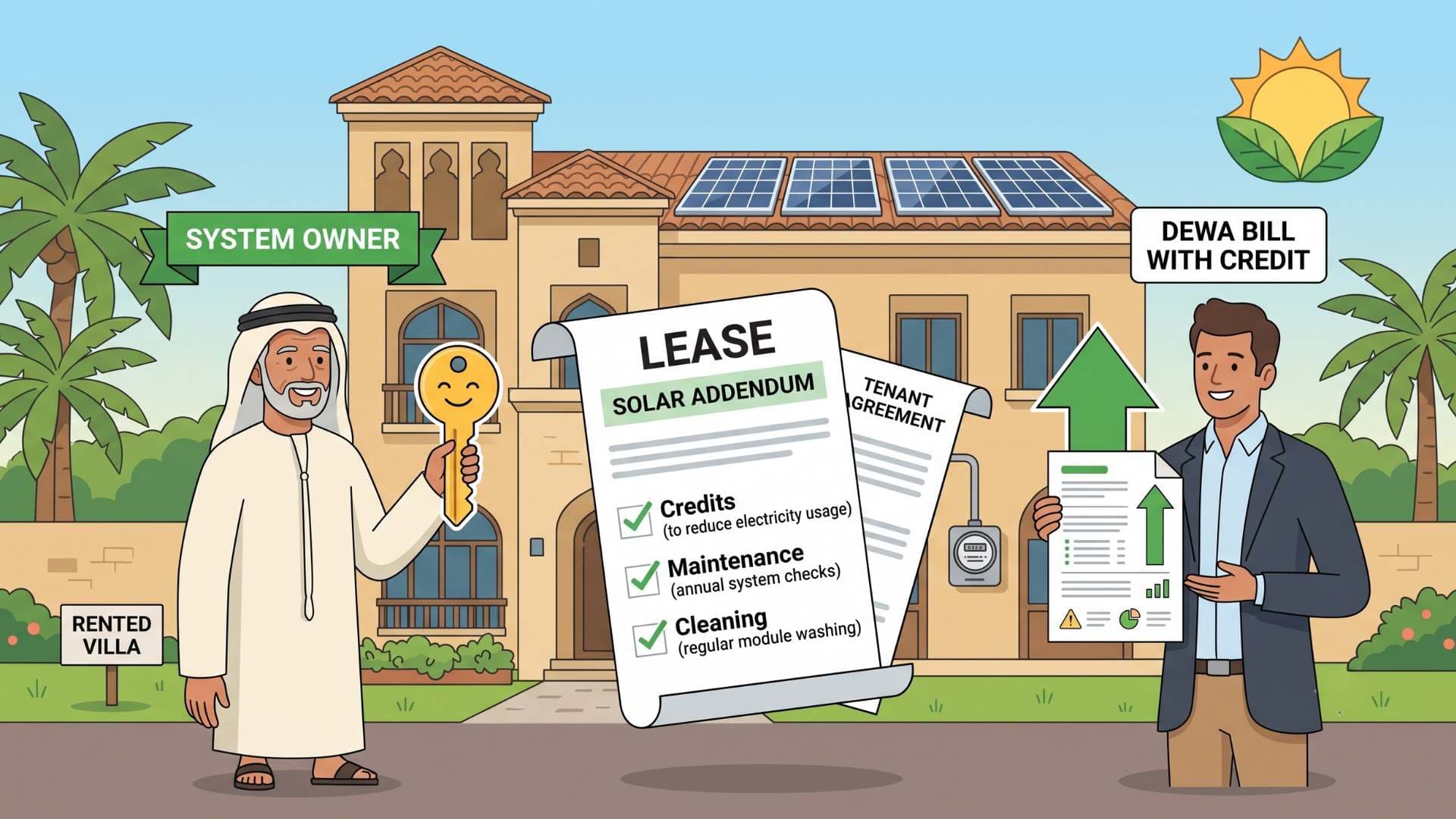
Because the standard lease is silent, the three friction points worth pinning down explicitly are:
Credit allocation. State clearly whether the solar generator is (or will be) transferred to the tenant's DEWA account, and confirm who receives the bill credits. If the landlord wants to capture the savings (e.g. via a higher rent or a service charge), say so — industry notes that "commercial landlords building solar for tenant benefit typically do so through a service charge or PPA arrangement… rather than through direct credit transfer" (SurgePV).
Panel maintenance responsibility. DEWA requires an O&M contract on the system owner (DEWA FAQ). If the landlord owns the system, the O&M contract is logically theirs — but the lease should state this so a tenant isn't billed for an inverter fault.
Panel cleaning responsibility. Desert dust materially cuts output (see our solar panel cleaning article), and cleaning falls under O&M. No UAE source assigns panel-cleaning responsibility between landlord and tenant — a genuine gap. Because it's a real ongoing cost (and a common flashpoint), name it in the lease: who cleans, how often, and who pays.
Is there any case law? (No.)
If you're hoping for a precedent to resolve a dispute, there isn't one. No published UAE case law or Rental Disputes Centre precedent specifically on landlord-tenant solar credit ownership was found as of July 2026 — a genuine gap. The RDC is the venue for Dubai tenancy disputes (RDC; Al Tamimi on RDC procedure), but no fetched source reports a solar-specific case.
The closest related coverage is a general "greening the building" Q&A where a landlord wanted to install solar and pass costs to the tenant via rent — resolved through the rent-control/service-charge framework, not solar credit ownership (The National, Sep 2025).
Practical playbook for landlords and tenants
If you're a landlord:
You own the system (it's your fixture). Decide upfront whether you're capturing the savings (keep the generator on your account / use a service-charge or PPA model) or passing them to the tenant (transfer the generator to the tenant's DEWA account).
Carry the O&M contract — it's a DEWA condition on the system owner.
Put credit allocation, maintenance, and cleaning in the lease. The default framework won't do it for you.
If you're a tenant:
Check whose DEWA account the solar feeds. If it's yours, you're likely capturing the credits; if it's the landlord's, you're not — and your rent may be priced to reflect that.
Ask for the lease to specify maintenance and cleaning responsibility so you're not charged for system faults.
Remember the DEWA move-out rule: any credit balance is forfeited when you leave. Don't bank a large surplus you can't use before vacating.
For both: this article is general guidance, not legal advice. For lease-specific terms, consult a RERA-registered agent or a qualified Dubai real-estate lawyer.
Landlord considering solar for your rental villa? Get quotes from vetted installers and structure the setup to match your lease strategy. Get quotes →
The bottom line
The honest answer to "who owns the solar savings in a rented Dubai villa" is: it depends on whose DEWA account the system feeds, and what the lease says — because the default framework is silent. Physically, the system is the landlord's fixture. Financially, the savings often land with the tenant (because the rented-villa DEWA account is usually in the tenant's name and credits attach to that account). But with no RERA rule and no case law, the only safe move is to make the allocation explicit in the lease — covering credits, maintenance, and cleaning — rather than relying on defaults that don't exist.