TL;DR
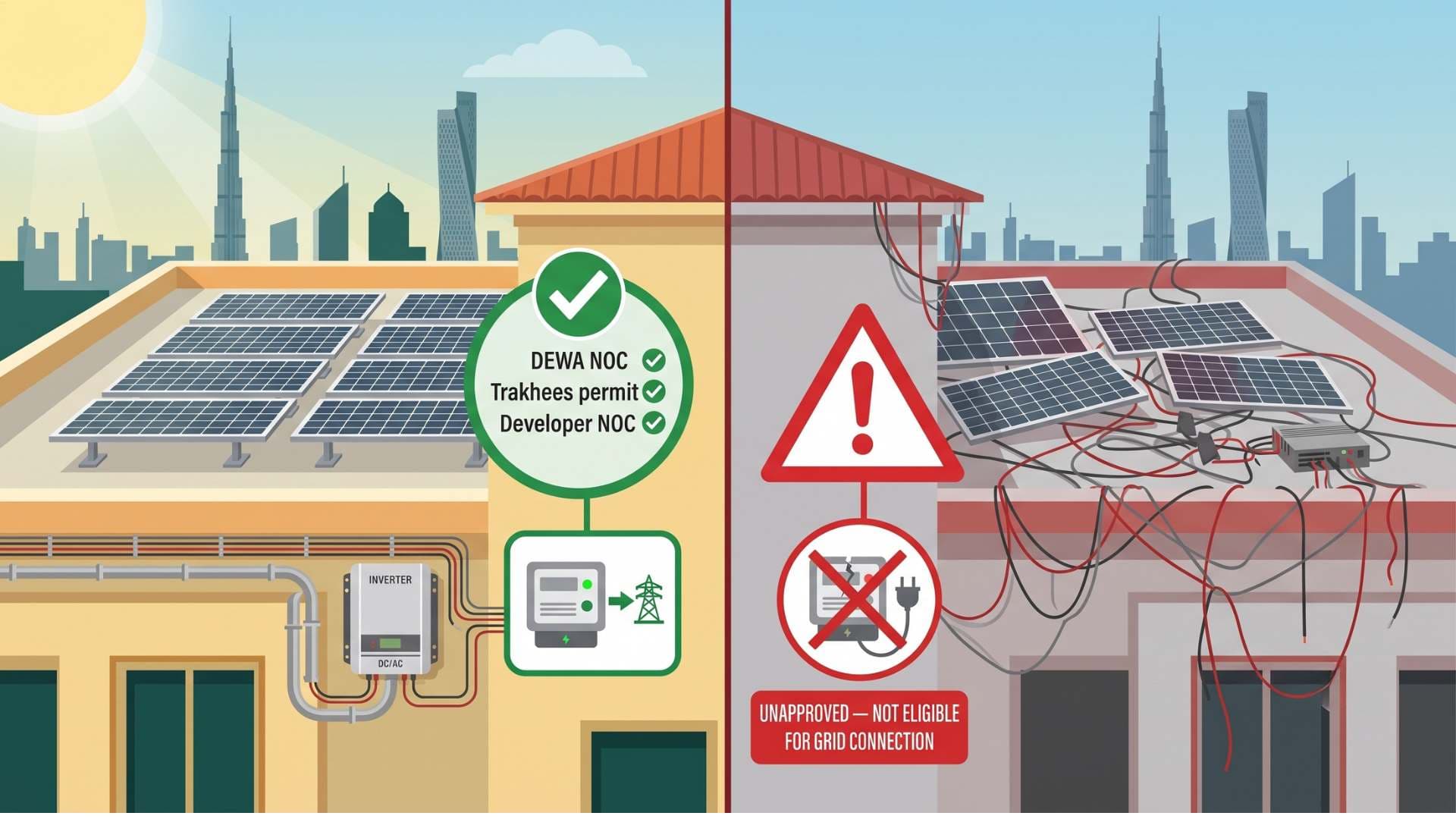
Grid-tied solar without DEWA approval is unlawful, full stop. Dubai's Law No. (6) of 2015 states that "no Person may perform any work or activity which may negatively affect the Public Network without first obtaining the relevant Authorisation from DEWA" (Law 6/2015).
A true standalone off-grid system is a different, lighter legal case — but it's not approval-free in Dubai. DEWA's own connection conditions still expect design approval for off-grid systems on serviced premises, and building/structural permits always apply.
Three approval bodies are involved depending on your community: DEWA (always, for grid-tied), plus Dubai Municipality or Trakhees (or Etihad Esco) for the building permit.
Penalties exist under a formal fines framework (Resolution 4/2022), but specific AED amounts aren't publicly published — and DEWA can disconnect supply and remove the meter.
The honest financial counter-argument: subsidised tariffs and permit costs mean small/DIY solar often doesn't pay — but that's a forum perspective, not SolarQuote's claim.
Off-grid vs. illegal DIY: two different things
The question "is off-grid solar legal in Dubai?" collapses two separate scenarios that have very different answers. It's worth separating them cleanly.
Scenario A: unapproved grid-tied DIY (not legal)
Connecting a solar system to the DEWA grid without authorisation is prohibited. Law No. (6) of 2015 on the Protection of the Public Electricity and Water Network states:
"No Person may perform any work or activity which may negatively affect the Public Network without first obtaining the relevant Authorisation from DEWA." (Law 6/2015)
The law also requires owners to "obtain an Authorisation in advance from DEWA where they intend to make changes to their real property, which may affect power loads and the Public Network," and it applies across "all zones of the Emirate including Special Development Zones, and free zones such as the Dubai International Financial Centre" (Law 6/2015).
DEWA reinforces this at the program level: "Only DEWA enrolled Electrical & DRRG Solar PV Consultants and Contractors are authorised to install, operate and maintain your solar PV system. If you do not rely on an authorised contractor, your system will not be eligible for the grid connection" (DEWA Shams Dubai FAQ). Industry guidance is blunter: "connecting a solar system to the grid without an NOC and written approval… is a breach of the supply agreement. DEWA… reserve[s] the right to disconnect the customer's supply and remove the meter" (SurgePV).
So a hand-installed grid-tied system is both legally exposed and practically pointless — it can't legally connect to earn net-metering credits, which is the entire financial basis of Dubai solar.
Scenario B: standalone off-grid (lighter, but not approval-free)
A genuinely standalone off-grid system — panels, battery, inverter, never touching the DEWA meter — is a different case. DEWA acknowledges off-grid as a distinct category: "While off-grid PV systems depend on rechargeable batteries to store excess electricity, grid-connected systems do not require any storage" (DEWA Shams Dubai FAQ).
But "different case" does not mean "no approvals." DEWA's DRRG Connection Conditions state:
"Exceptional cases (for example, remote areas) for which prior written approval has been obtained from DEWA to utilise an off-grid system for normal operations. In all cases, the third party shall obtain the design approval from DEWA for the off-grid system." (DEWA DRRG Connection Conditions)
Some industry sources claim off-grid systems "not connected to DEWA do not require approval" (Deye Inverters; FSolar) — but that's an industry reading, not a DEWA statement, and it conflicts with DEWA's own DRRG wording. There is no explicit DEWA statement that residential off-grid is wholly exempt from all approvals. The safe assumption: even off-grid, expect DEWA design approval for serviced premises plus structural building permits.
Skip the legal risk. Get quotes from DEWA-enrolled installers who handle approvals for you. Get your solar quotes →
Who approves what: the three-body chain
A grid-tied Dubai rooftop install needs sign-off from two layers.
1. DEWA (Shams Dubai) — always, for grid-tied
DEWA is the grid-connection authority under Executive Council Resolution 46 of 2014 (DEWA Shams Dubai). The process covers the Solar NOC, design approval, and the bi-directional meter: contractors "apply for Solar Permits & Connections through the system after uploading required documents and technical drawings, for obtaining Solar NOC, Solar Design approval and DEWA invoice" (DEWA — Solar PV connections).
2. Building permit from the "competent authority" — Dubai Municipality, Trakhees, or Etihad Esco
DEWA's FAQ is explicit that you need more than its own approval:
"You will need a Building Permit from the competent Authority/Entity (i.e Dubai Municipality, Trakhees, Etihad Esco etc.) for the civil or structural part of the installation, and a Completion Certificate after the competent Authority has inspected and completed its final checks." (DEWA Shams Dubai FAQ)
When each applies:
Dubai Municipality (DM): the structural/building permit for properties under DM jurisdiction — most of mainland Dubai. For DM-permit projects, "contractors and consultants can obtain an NOC through the Dubai Building Permit System" (Gulf News Journal, May 2025).
Trakhees (PCFC Civil Engineering Department): the building permit in Trakhees-managed zones — many freehold/Nakheel communities (e.g. Palm Jumeirah, Jumeirah Islands, parts of JVC, Discovery Gardens), JAFZA, and free zones. The official PCFC circular requires an "'EHS NOC for Building Permit' and final 'Building Permit' from Trakhees-Civil Engineering Department for any sort of modification or for installation of machinery/racking system" (PCFC circular). A real Trakhees modification permit example shows the work described as "Installation of Solar Panels on the roof of existing building" — confirming Trakhees issues solar-specific permits (Trakhees NOC example).
Etihad Esco / others: listed by DEWA as possible competent authorities in specific cases (often related to existing energy retrofit programs).
3. Your developer (if any)
In many freehold communities, the developer's own NOC sits on top of the municipality/Trakhees layer. An installer on r/dubai confirms the stack: "You need to get approval from DEWA, DM/Trakhees and the developer (if any). We take care of all this" (r/dubai).
What happens if you skip it: consequences and penalties
Dubai has a formal fines framework for PV connection violations under Administrative Resolution No. (4) of 2022, which sets "the minimum and maximum amount of fine for each of the violations" based on severity, damage, frequency, and compromise of safety (Resolution 4/2022).
Important caveat on amounts: the resolution sets the framework but the specific AED figures sit in the attached schedule to Executive Council Resolution 46 of 2014, which was not retrievable in full. Do not accept a specific fine figure from a salesperson or blog unless it cites an official government schedule. What's verifiable: a fines regime exists, and a settlements mechanism exists under Administrative Resolution 2/2025.
Beyond fines, the practical consequence is disconnection: DEWA "reserve[s] the right to disconnect the customer's supply and remove the meter," with remediation costs — "re-application, re-inspection, and potential equipment replacement if unapproved kit was used" — falling on the customer (SurgePV, industry-reported). Forum users echo the enforcement risk: "You can't put large solar panels on your property without the municipality's approval. They may issue a fine and could initiate legal action" (r/UAE, forum-reported).
Is DIY solar even worth it financially? (the honest counter-view)
There's a legitimate debate in the forums about whether small/DIY solar makes economic sense in Dubai at all — and it's worth presenting neutrally rather than dismissing.
The argument against, in forum users' own words:
On subsidised tariffs: "most villas are owned by locals. There is literally no incentive for them to invest in solar as the govt. is heavily subsidizing the electricity for locals" and "low or subsidised electricity cost does not encourage solar for villas" (r/dubai).
On small systems: "for any on-grid system, you have to have a DEWA permit, which only an approved solar integrator can get. The flat cost of this is about 5,000" dirhams, and "on an economical point of view, this won't save you anything considering the initial investment" for small balcony systems (r/dubai).
On payback for subsidised households: "with lower energy prices here and no incentive, you'd expect a payback of at least 10–12 years" (r/dubai, 2016).
The argument for: villa owners with high bills report strong returns under net metering — "I have 25 kWp plant installed in my villa… Return on investment is about 6-7 years" (r/dubai). And a blog framed the DIY risk starkly: "A DIY approach is not just inadvisable; it's illegal and dangerous. Connecting to the grid requires certified equipment, rigorous safety standards, and DEWA's official approval and metering" (800molds — opinion blog).
Net: the financial case depends heavily on your bill size and tariff. High-bill expat villa owners on unsubsidised tariffs can see 5–7 year payback; subsidised or low-consumption households see weak ROI. Either way, the legal path is the same: you cannot legally self-install grid-tied solar — only a DEWA-enrolled contractor can obtain the NOC.
Skip the legal risk. Get quotes from DEWA-enrolled installers who handle DEWA, Municipality/Trakhees, and developer approvals for you. Get quotes from vetted installers →
The bottom line
Can you legally go off-grid with solar in Dubai? A genuinely standalone, battery-based system is the lightest legal case — but even then, expect DEWA design approval for serviced premises plus a structural building permit, and never assume "off-grid" means "no approvals." Grid-tied DIY is simply not a legal option: only DEWA-enrolled contractors can secure the NOC, and connecting without it breaches Law 6/2015 and risks fines, disconnection, and meter removal. The honest reality is that Dubai's subsidised tariffs and permit costs make small DIY solar marginal anyway — but the workaround is a properly approved, properly installed system, not a shortcut.