TL;DR
Yes, it's technically possible — but "charging your EV with solar" can mean two very different things, and only one needs special hardware.
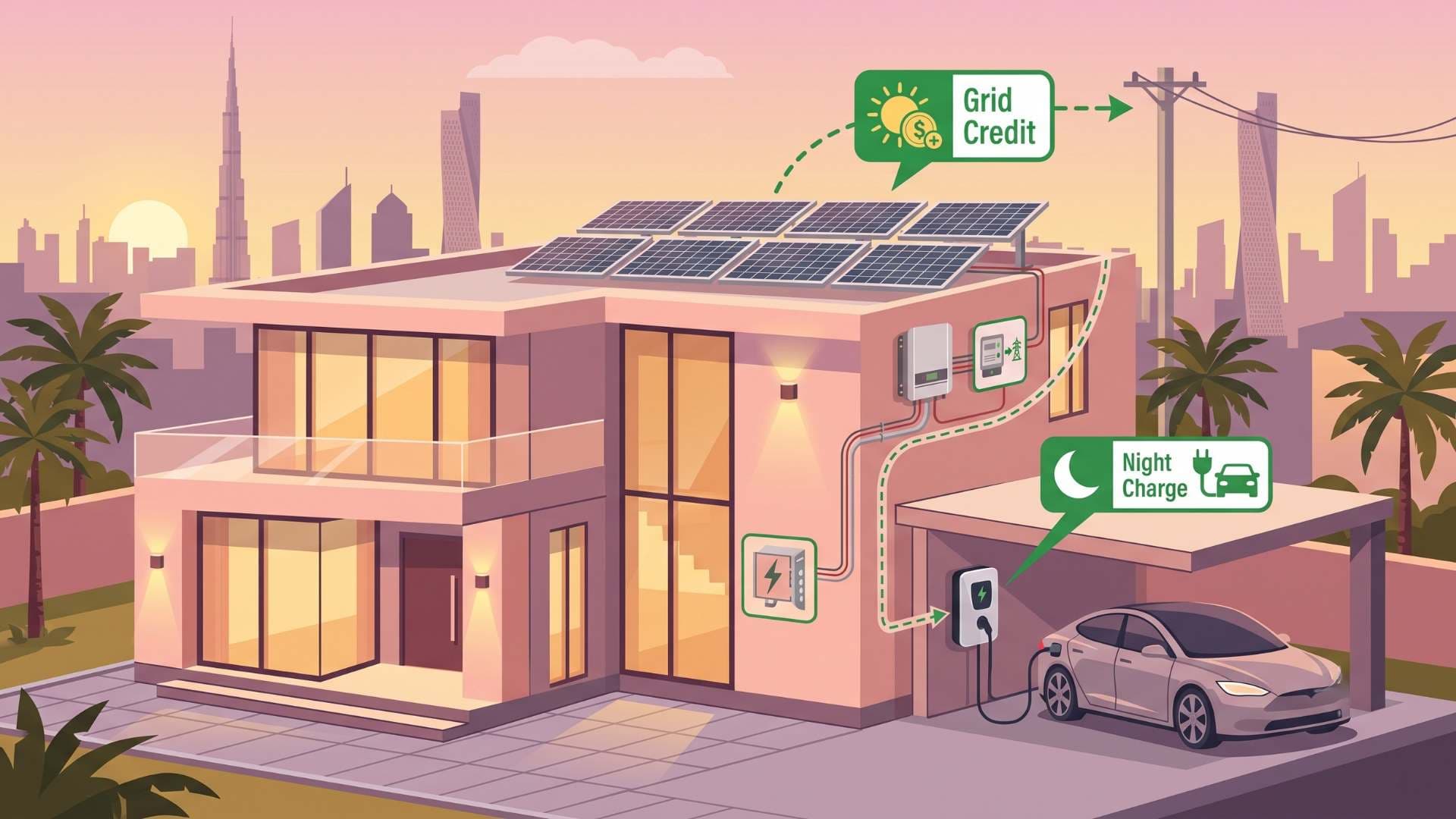
The simplest setup needs nothing extra: under Dubai's net metering, you export solar by day and charge the EV from the grid at night using banked credits. No special charger required.
Direct solar-only charging needs a smart charger (e.g. Fronius Wattpilot, Tesla "Charge on Solar") integrated with your inverter/smart meter, or a DC-DC solar EV charger for off-grid — all global/manufacturer hardware, not UAE-specific.
The honest financial truth: with 1:1 net metering, "exporting solar and charging at night lands you in the same place financially with less hassle" (Florida Solar Design Group). The smart "charge on solar" automation adds no savings.
Caveat upfront: there is no independent, audited UAE residential solar+EV case study as of July 2026. Vendor case studies exist, but their savings claims are self-reported. This is genuinely underexplored locally.
The upfront honesty: this is a data-light topic in the UAE
Most of what's written about solar+EV charging globally comes from the US, Europe, and manufacturers — not the UAE. There is no independent, third-party-verified UAE residential solar+EV home-charging case study with audited savings figures as of July 2026. The closest thing is a single villa case study (HomeControl, Sustainable City) that is vendor-published marketing (HomeControl).
So this article is deliberately forward-looking and cautious. Where local data is missing, it says so rather than filling the gap with US numbers presented as if they were Dubai figures. Treat any precise savings claim you see elsewhere with the same scepticism.
Two ways to "charge your EV with solar" — only one needs special gear
This is the distinction almost everyone blurs. There are two fundamentally different setups.
Setup A: grid-tied, charge whenever (no special hardware)
Your solar exports to the grid via a standard inverter under net metering; your EV charges from the grid using a normal home AC charger, day or night. Because the solar you exported is banked as a credit, charging the car at night effectively "uses" your solar. DEWA's Shams Dubai FAQ confirms the mechanic: "The electricity produced by the solar panel system is available for your own use and any excess is fed back into the grid… you can be credited on your future electricity bills" (DEWA Shams Dubai FAQ).
Crucially, home EV charging in Dubai is billed at the normal residential electricity rate — "the bill of used electricity will be added to your monthly DEWA bill at a normal residential electricity rate" (Dubizzle), corroborated by official WAM: "if the vehicle is charged at home, the standard residential electricity rate will be applied" (WAM).
So: no Powerwall, no smart charger, no DC-DC box. Just solar + net metering + an EV charger.
Setup B: direct solar-surplus charging (special hardware)
If you specifically want the car to draw only excess solar rather than grid power, you need a smart EV charger integrated with your inverter or smart meter that diverts surplus to the car. A Fronius Wattpilot guide describes activating a "Use surplus PV" mode that requires connecting to the "Inverter/Smart Meter IP," with a minimum of ~1.38 kW (6A) of excess solar before the car will charge (FVComponentes). Tesla's "Charge on Solar" similarly needs a Powerwall + solar + Gateway and a minimum of roughly 1.2 kW excess solar (Tesla Support).
For off-grid direct solar-to-EV charging without AC conversion, purpose-built DC-DC solar EV chargers exist (e.g. Ampernext's 30 kW unit, described as a "solar DC EV charger with DC input and MPPT functionality… for sites with installed solar panels and no AC grid available" — Ampernext; see also Electrek, 2024).
All of these hardware sources are non-UAE / manufacturer / global. No UAE-published technical explainer on hybrid-inverter or DC-DC solar EV charging was found. If an installer specifies hardware, ask whether it's deployed and supported locally.
The financial question nobody asks clearly
Here's the part that gets lost: in a net-metered market, does direct solar-only charging actually save you more money than just exporting and charging at night?
The candid answer, from a US solar installer who specialises in this exact question:
"With 1 to 1 net metering, exporting solar and charging at night lands you in the same place financially with less hassle… There is no penalty for exporting mid-day and charging your EV overnight… The billing outcome is the same… the automation does not magically reduce your bill." (Florida Solar Design Group, 2025)
The logic: if your export credit equals your import cost (1:1 net metering), then a kWh sent to the grid at noon and a kWh pulled back at 11pm net to zero. The smart "charge only on solar" automation saves you nothing — it just changes the sequence of the same credits.
Critical UAE caveat: I could not find a source explicitly confirming whether DEWA Shams Dubai credits exports at the full retail rate (1:1) or a lower rate. This is the crux of whether the argument above holds in Dubai. If DEWA is not 1:1, direct solar charging could beat grid-import — but until that's confirmed, treat the "export by day, charge at night" equivalence as a strong likelihood, not a certainty. (For contrast, in California under NEM 3.0, "you only get about 5-8 cents per kilowatt-hour for excess solar you send back to the grid, but you pay 30-45 cents per kWh when you pull from the grid at night. That's a 75% loss" — US Power — which is why batteries and direct charging make sense there but not necessarily here.)
A forum user on r/solar summarises the grid-as-battery idea: "If you benefit from a 1:1 net metering system, your utility grid effectively functions like a battery… when you charge your electric vehicle (EV) at night, you won't incur additional costs" (r/solar) — illustrative user commentary, not authoritative.
The UAE EV context you're operating in
The EV market in the UAE is real and growing fast, which makes solar+EV a forward question worth answering well.
DEWA Green Charger network: DEWA states it "has deployed more than 400 EV Green Charging Stations across the city, equivalent to around 740 charge points" (DEWA EV Charging guide). Press reports cite higher current numbers — Dubai's EV fleet "tops 41,000" (Gulf News, Sep 2025) and the emirate targets ~1,860 charging stations (The National, Apr 2026).
Public charging tariff: per Cabinet Decision No. 81 of 2024, AED 0.7/kWh (AC) and AED 1.2/kWh (DC), plus VAT (DEWA EV Charging FAQ). Note this is public charging — home charging is at the residential rate, which is cheaper.
Emirate target: ADNOC and TAQA aim for "70,000 EV charging points in the emirate by 2030" (PwC — UAE EV strategy).
The upshot: home charging at the residential slab rate is already the cheapest way to fuel an EV in Dubai. Adding solar to that equation is where the savings stack — but you don't need direct solar charging to capture them; net metering does the accounting.
What UAE solar+EV case studies actually exist
Some UAE-specific vendor case studies do exist — all marketing, none independently audited:
HomeControl — Sustainable City, Dubai (villa, May 2025): results claimed include "EV fully charged from solar excess," "load shifting to maximize solar self-consumption," and "90% reduction in annual energy bills" on a 3,800 sq ft villa with AED 150,000 investment (HomeControl). This is the closest thing to a genuine UAE solar+EV home case study — but it's vendor-published.
Sungrow — private Dubai homeowner (April 2024): two-EV villa with a 22 kW smart AC charger, framed around "harsh climate conditions, characterized by extreme heat, dust, and sand" (Sungrow). Note: an EV charger case, not explicitly solar-coupled.
First Unicorn (Dubai installer): "7 kW system on 4-bedroom villa… EV charger added 6 months later" and "typical EV uses 8-12 kWh/day, well within a 10 kW system's capacity" (First Unicorn) — vendor, self-reported.
Commercial: Meagle Energy's solar carport with integrated EV charger (Meagle) and Positive Zero's 60+ solar carports at Dubai Autodrome (Positive Zero) — commercial, not residential.
Treat every savings figure above as a vendor claim, not verified performance.
Sizing: how much extra solar does an EV need?
Expressed in the terms the sources actually use (kWh and panel counts), not a single kW figure:
A Tesla Model 3 needs roughly "4,000 kWh per year for charging alone," requiring "5 to 12 solar panels to fully offset" (PPM Solar — US estimate).
A Dubai installer's figure: a "typical EV uses 8-12 kWh/day, well within a 10 kW system's capacity" (First Unicorn — vendor estimate).
A full system "sized for one EV" is referenced at roughly 12 kW solar + 13.5 kWh battery (US Power) — California reference, not UAE.
Gap: the commonly-suggested "~3–5 kW extra PV per EV" figure was not found verbatim in any fetched source; sources instead express sizing as annual kWh, panel counts, or daily kWh. Use kWh-based framing and label it as an industry estimate.
The honest bottom line
Charging an EV with home solar in the UAE is technically straightforward and economically sensible — but the smartest version is usually the simplest: a grid-tied solar system under net metering plus a standard home EV charger. You capture the savings through credit accounting, not through fancy direct-solar hardware. Direct solar-only charging is a real option if you want it (or if you're off-grid, where it's mandatory), but under net metering it rarely changes the bill.
The UAE market is early on this curve. There's no audited local case study, no UAE-published technical standard for solar-coupled EV charging, and an unconfirmed assumption about whether DEWA net metering is truly 1:1. If you're an early mover, that's an opportunity — but go in with eyes open about what's verified and what's vendor marketing.