TL;DR
Your DEWA bill is dominated by air conditioning, and DEWA itself says setting your thermostat to 24°C can save up to 5% per degree — most villa owners are leaving easy savings on the table with zero-cost habit changes (DEWA cooling tips).
Behaviour and maintenance fixes (filters, thermostats, insulation, LED lighting) stack up — but they cap out. The single biggest lever is rooftop solar under Shams Dubai, which cuts your imported kWh and pushes your remaining consumption into cheaper tariff slabs (DEWA Shams Dubai FAQ).
One widespread myth: shifting appliance use to "off-peak" hours saves you money on the rate. It doesn't — DEWA's residential tariff has no time-of-use pricing, only consumption slabs. Peak-shifting is grid advice, not a rate discount.
Solar only reduces your electricity line — not your housing fee, water, sewerage, or district cooling charges. Know what you're actually saving before you commit.
Ready to see what solar could save on your actual bill? Get free quotes from DEWA-enrolled installers.
Why your DEWA bill is higher than it needs to be
Most Dubai villa and apartment owners never look past the total on their DEWA bill. But DEWA itself publishes a long list of official conservation tips — and most residents apply almost none of them (DEWA Sustainability and Conservation). Below are the 15 measures that actually move the needle, ranked roughly from free/behavioural to capital investment, all sourced from DEWA's own guidance or verified UAE regulation. Where a saving figure exists, it's quoted directly from DEWA or a named, credible source — never invented.
1. Set your AC to 24°C — DEWA's single most repeated tip
DEWA's own cooling guidance is unambiguous:
"Keep your thermostat set at 24°C, or higher. Each degree increase in set point temperature can save up to 5% on AC consumption." (DEWA — Cooling tips)
DEWA has also specifically advised residents to set AC to 24°C when home, and 27°C — or off — when out (DEWA news, August 2021). Since air conditioning is the single largest load in most Dubai homes, this is the highest-leverage free change you can make. Note: the official figure is "up to 5%" per degree — not the 6-8% you'll see quoted on some UAE blogs. Stick with DEWA's number.
2. Clean or replace your AC filters monthly in summer
"Clogged or dirty AC filters can block the normal airflow and reduce the system's efficiency significantly. It is recommended to clean your AC filters periodically or at least once a month during summer." (DEWA — Cooling tips)
DEWA doesn't publish an exact percentage saving for this specific action, but a blocked filter forces your compressor to work harder for longer, so it's a maintenance basic — not optional in Dubai's dust and heat.
3. Replace ACs older than 10 years with 4- or 5-star units
This is one of DEWA's biggest quantified savings claims:
"The optimal lifetime of an AC is ten years. If yours are older, consider replacing them with new energy-efficient ACs with 4 or 5 stars from Emirates Authority for Standardization and Metrology (ESMA). This will help you save up to 25% of cooling consumption." (DEWA — Cooling tips)
The star-rating scheme is now run by MOIAT (which absorbed ESMA), and is backed by UAE federal regulation on appliance energy efficiency (MOIAT — Performance Efficiency Cards; UAE Cabinet Resolution, Technical Regulations for Home Appliances). Check the star label before you buy — it's the only officially recognised efficiency signal in the UAE.
4. Use a programmable or smart thermostat
"Use a programmable thermostat (Smart Thermostat) to better control the room temperature and AC operation duration. This will in turn reduce AC consumption." (DEWA — Cooling tips)
DEWA also recommends smart systems that let you schedule AC and lighting from your phone (DEWA news, August 2021). No official percentage saving is published for smart thermostats specifically — treat vendor claims of a fixed % as installer marketing, not fact.
5. Insulate, weather-seal, and shade your windows
DEWA's tips booklet is detailed here:
"Caulk and weatherstrip doors and windows that leak air." "Keep blinds and curtains closed to reflect heat away from the house." (DEWA General Tips booklet)
For new builds, DEWA recommends double-glazing with spectrally selective coatings. A 2024 study reported by The National found that combined passive measures — insulation, sealing, shading — cut cooling demand by roughly 42% in August in a UAE villa test case (The National, January 2024). DEWA has separately said thermal insulation retrofits, done with Dubai Municipality, can cut AC load by 40% (Gulf News, 2019). These are property-specific results, not guaranteed outcomes for every villa.
6. Switch to LED lighting and add timers, sensors, and dimmers
"Use LED lighting and clean them regularly." "Use timers or motion-detectors to control the light's operation, wherever applicable." "Install dimmers to control the brightness of lights." (DEWA news, April 2020)
DEWA also notes that dirty light bulbs alone can cut light output by around 10% (DEWA General Tips booklet) — a simple, free fix.
7. Turn off or insulate your water heater in summer
"Close your water heaters in the summer. The water gets naturally heated at that time of year." "Insulate your water-heater and water pipes." (DEWA General Tips booklet)
Dubai's ambient water temperature in summer often makes electric heating unnecessary altogether — check before you leave it running year-round.
8. Run the pool pump off-peak, and cover the pool — but understand what that does and doesn't save
DEWA advises:
"Run your pool pump during off-peak hours and not during the afternoon." "If you have a pool, use a pool cover. This will help cut down on evaporation." (DEWA General Tips booklet)
Important clarification: DEWA's residential electricity tariff is a consumption-slab system, not a time-of-use tariff — there is no published cheaper rate for off-peak hours (DEWA Slab Tariff). Running your pool pump outside the 12pm–6pm window is genuinely good advice, but it's a grid-responsibility and equipment-longevity measure, not a way to unlock a lower AED/kWh rate. If you have solar, the smarter move is running the pump during daylight hours to self-consume your own generation. Covering the pool, on the other hand, directly cuts water loss and heat gain regardless of timing.
9. Buy 4- or 5-star MOIAT/ESMA-rated appliances
"When purchasing a new appliance, consider purchasing one with a high ESMA... energy efficiency rating (5 or 4 stars), to save energy." (DEWA news, April 2020)
This applies to fridges, washing machines, dishwashers, and AC units alike. The official labelling scheme is now run by MOIAT (MOIAT — Energy Efficiency Labels) — look for the star card on the appliance before purchase.
10. Wash full loads, use cold or warm water, and skip the dryer
"Only run your dishwasher and washing machines when it is full." "Dryers consume a lot of electricity. Take advantage of the sunshine and hang your clothes to dry." (DEWA news, April 2020)
DEWA quantifies one of these directly:
"Wash your clothes in warm rather than hot water; this will decrease your consumption by 50%." (DEWA General Tips booklet)
11. Set your fridge to 4°C and maintain it properly
"Set the fridge temperature to 4°C, or to the manufacturer's recommendation to avoid excessive cooling and wasting energy." "Keep your freezer temperature at -18 degree Celsius." (DEWA news, April 2020)
Also clean the condenser coils behind the fridge every six months, keep the door seal in good condition, and keep the unit away from the oven and direct sunlight (DEWA General Tips booklet).
12. Unplug standby ("vampire") loads
"Unplug personal computers, electronic devices and chargers when they aren't in use; most electronics use electricity even when switched off." (DEWA General Tips booklet)
DEWA doesn't publish a percentage figure for how much standby power adds to a typical Dubai bill — treat any specific number you see elsewhere as unverified. But a power strip you switch off at night is a zero-cost habit.
13. Build or retrofit to Al Sa'fat green building standards
Al Sa'fat is Dubai's mandatory green building system, in force since 19 October 2020 (Dubai Municipality — Al Sa'fat). For all villas, the building envelope's average thermal transmittance (U-value) must not exceed 0.40 W/m²K (Al Sa'fat Practice Guide, §501.02). If your villa was built before this rule, it's worth benchmarking your walls, roof, and glazing against the current standard — a poorly insulated envelope is often why an otherwise efficient AC unit never stops running. Al Sa'fat's higher tiers (Golden and Platinum) also mandate on-site solar generation covering at least 10% of the building's electrical load (Al Sa'fat Practice Guide, §504.03).
14. Install rooftop solar under Shams Dubai — the biggest single lever
Everything above helps at the margins. This is the one that changes your bill structurally.
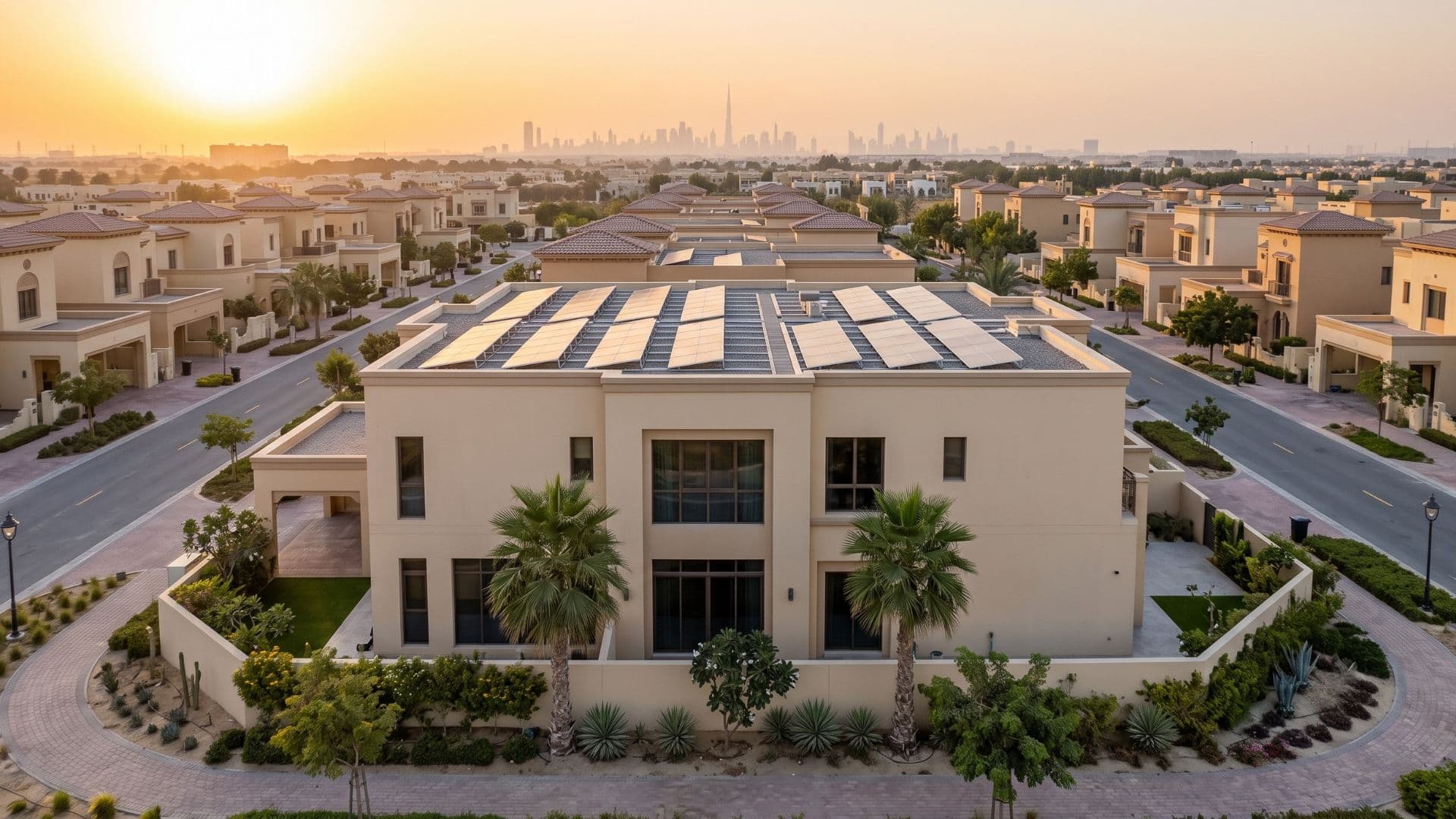
Shams Dubai is DEWA's net metering programme, enabled under Dubai Executive Council Resolution No. 46 of 2014, letting villa and building owners install grid-connected solar and export surplus back to DEWA (DEWA — Shams Dubai). Here's the part almost nobody explains properly:
"Electricity exports within the billing period and electricity credits carried forward from previous billing periods are deducted from the electricity imported from the grid, and only then are DEWA tariff slabs (and any applicable fuel surcharges) applied to calculate the bill. This means more savings for customers, as residual consumption is billed at lower slab rates." (DEWA — Shams Dubai FAQ)
In plain terms: your solar credits are subtracted before DEWA works out which slab you fall into. So solar doesn't just save you the retail value of the kWh you generate — it can also drop your remaining consumption out of the expensive Orange (0.320 AED/kWh) or Red (0.380 AED/kWh) slabs entirely and into cheaper bands (DEWA Slab Tariff). Any unused surplus rolls forward indefinitely to offset future bills (DEWA Shams Dubai FAQ).
DEWA is direct about how the payback works:
"The investment return and savings depend on how much electricity you currently use, and the tariff you are paying." (DEWA — Shams Dubai FAQ)
Connection is a flat AED 1,500 one-time fee, and installation must go through a DEWA-enrolled contractor. This is the point where it's worth comparing real numbers for your own villa rather than guessing — get free quotes from DEWA-enrolled solar installers and see what your actual system size and payback would look like.
One important limit: solar reduces your electricity line only. It does not reduce your housing fee (5% of annual rent, billed monthly through DEWA on behalf of Dubai Municipality), water, sewerage, or district cooling charges — these are separate line items on your bill and are unaffected by how much solar you generate (DEWA — Understand Your Bill).
15. Track and benchmark your usage with DEWA's own tools
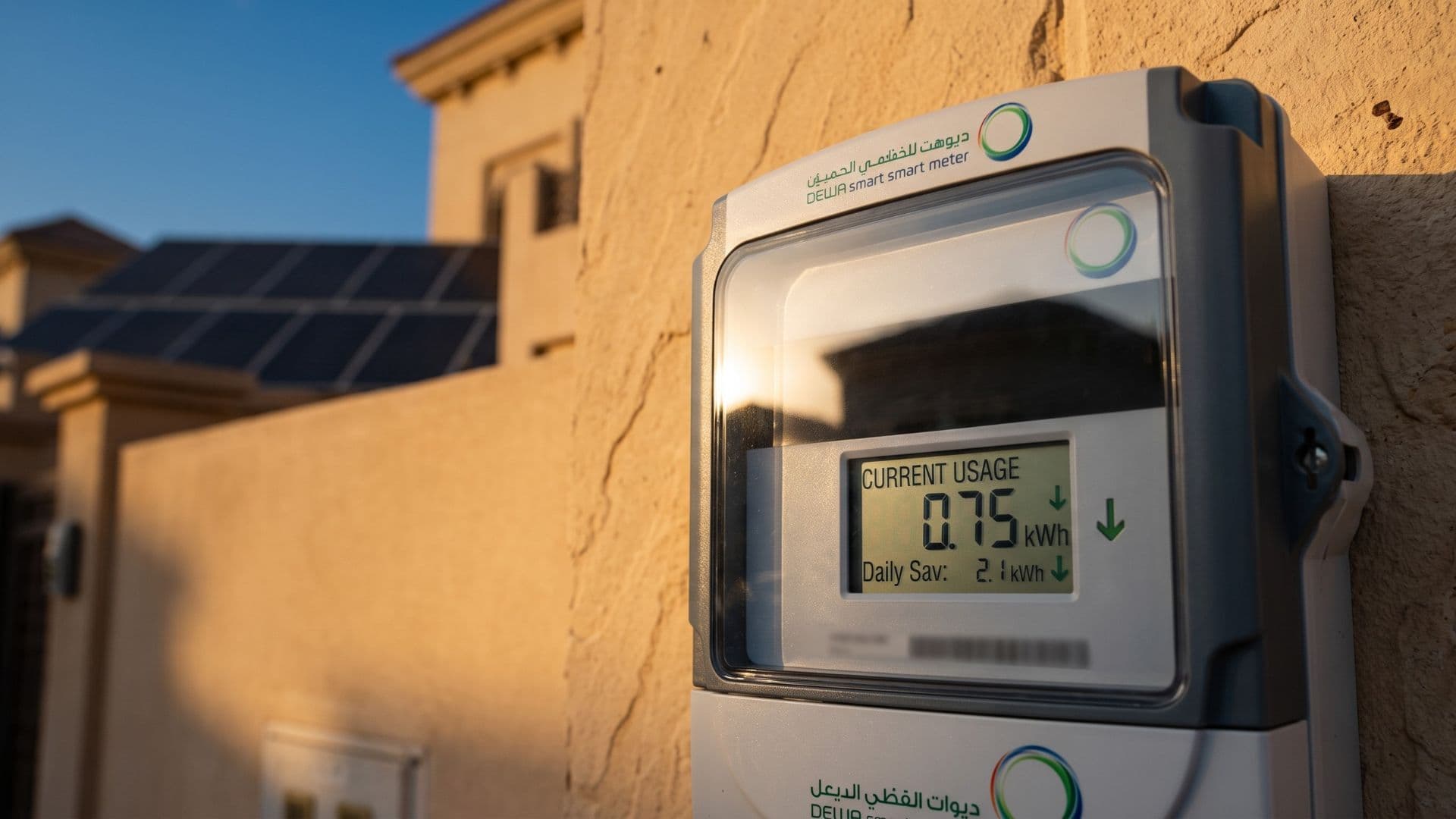
DEWA's My Sustainable Living Programme lets residential customers compare their consumption against similar homes in their area — more than 400,000 customers were enrolled as of August 2020 (DEWA — My Sustainable Living Programme; DEWA news, August 2020). Combine this with the DEWA Tariff Calculator to see exactly where your consumption sits on the slab table, and the DEWA Smart App for day-to-day monitoring.
Bonus: if you're charging an EV at home, know the rate you're paying
DEWA confirms that home EV charging is billed at your normal residential rate:
"When charging an EV at home, the electricity used is added to the normal DEWA bill at standard residential electricity rates." (DEWA — Consumer FAQs)
Because the residential tariff is slab-based, adding EV charging on top of your normal household load can push your entire bill into a higher slab — which is exactly the kind of consumption jump that makes solar more valuable, since it displaces the units that would otherwise land in your most expensive slab. This is a reasoning-based conclusion from the published tariff structure, not a DEWA statement.
Don't fall for the "off-peak saves money" myth
You'll see plenty of advice — some of it echoed from US and UK energy markets — telling you to run appliances at night to "save on your DEWA bill." DEWA does ask customers to shift heavy appliance use out of the 12pm–6pm window during summer, but this is explicitly a grid-load and campaign measure:
"The Peak-Load campaign... encourages users to limit their use of devices that use a lot of power... during peak consumption hours from 12-6pm, and reschedule their use to the morning and evening as much as possible." (DEWA news, August 2014)
There is no published residential time-of-use tariff in Dubai — DEWA's slab tariff applies the same rate per band regardless of the time of day you consume (DEWA — Slab Tariff). Shifting your laundry to 9pm reduces grid strain, not your AED/kWh rate. The only way to actually pay less per kWh is to use fewer total kWh, or to generate your own with solar.
The real order of priority
Action | Cost | Typical impact |
|---|---|---|
24°C thermostat setting | Free | Up to ~5% AC saving per degree raised (DEWA) |
Filter cleaning, appliance habits, LED swaps | Low cost | Meaningful but unquantified by DEWA |
Replace AC >10 years old (4-5 star) | Moderate | Up to 25% cooling saving (DEWA) |
Insulation and sealing retrofit | Moderate–high | ~42% combined reduction in one reported study (The National) |
Rooftop solar (Shams Dubai) | Capital investment | Displaces electricity-line kWh and can drop you into cheaper slabs (DEWA Shams Dubai FAQ) |
If you've already tightened the free and low-cost items and your bill is still high, solar is where the structural saving lives. The fastest way to know your numbers is to compare real quotes.